
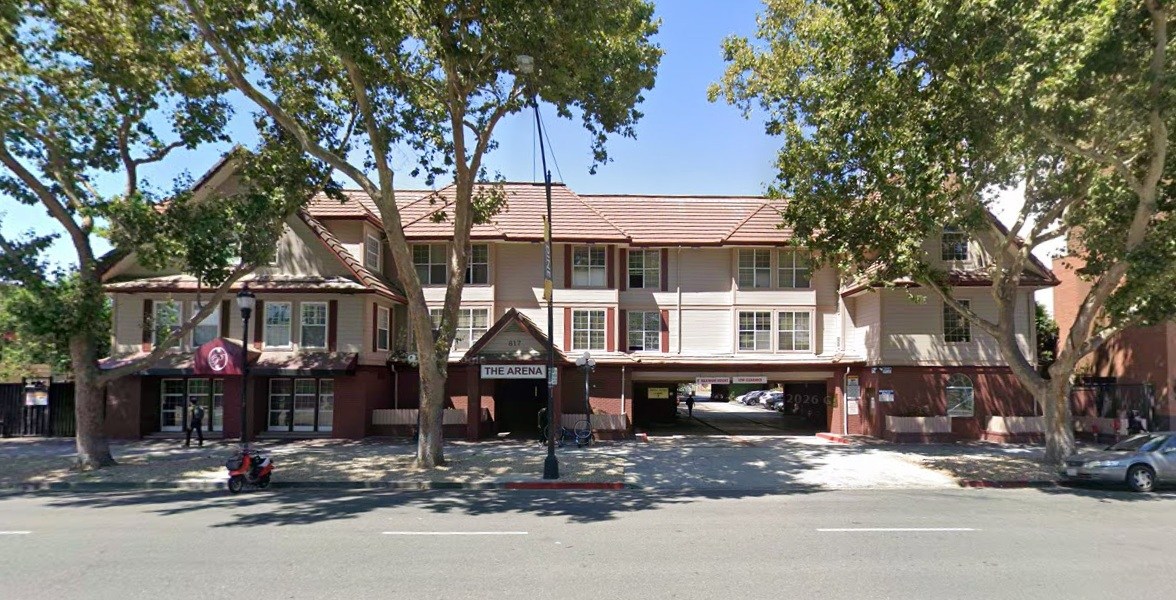
After deeming a fully affordable housing project at the Arena Hotel financially unfeasible, San Jose is asking the state to allow a new mixed-income development at the site and to explore moving its required extremely low-income units to an alternate location.
This detail was part of a resolution the San Jose City Council unanimously approved Tuesday, authorizing negotiations with nonprofit Episcopal Community Services of San Francisco to take over the site — where more than 200 housing units are planned — from the previous developer. The resolution also designated Propertyworx LLC as a backup option in case the deal falls through.
This transition aligns with San Jose’s recent push to test new funding models and shift toward mixed-income developments to improve operating self-sufficiency. City officials have argued that without financial incentives, zoning changes alone will not get housing built.
The site, which currently serves as an interim shelter, was planned to be transformed into permanent supportive housing under the state’s Project Homekey, a program that provides funding to convert motels, hotels and other properties into low-income housing.
The initial agreement is expected to be finalized around next spring, when the developer subsequently will have 36 months to break ground.
Once finalized, the city will hold the developer to benchmarks for design, due diligence, and financing leading up to groundbreaking, and may terminate the deal, in favor of backup developer Propertyworx, if milestones are missed.
The site has seen roughly $46 million in combined state and local investment to date, though the resolution authorizing negotiations with a new developer requires no additional budget from the city.
Episcopal Community Services replaces Urban Housing Communities and HomeFirst Services of Santa Clara County after the city determined their proposals were not financially feasible.
Currently, the project is planned in two phases: the first phase will convert the current motel into 89 deeply affordable units for individuals earning less than $43,200, while the second phase will construct more than 200 mixed-income units over the site’s existing surface parking lot.
If the state allows San Jose to transfer the required deeply affordable units off-site, both development phases would become mixed-income housing for residents earning up to the moderate-income level — or up to $172,000 for an individual.
A memorandum from Mayor Matt Mahan and Councilmember Michael Mulcahy directs housing staff to report back to the City Council by April with updates on state negotiations, alternative site locations, and any potential changes to the unit mix. The final amended agreement with the state must return to the council for public review and approval before it can be signed.
Aside from creating a financially self-sustaining project, the staff memorandum said mixed-income housing “promotes greater integration into the surrounding community and reduces socioeconomic segregation.”
The shelter is slated to remain open until groundbreaking, which the city’s schedule caps at 36 months after the initial deal is finalized. Officials have not yet determined where existing shelter residents will be transitioned once renovation begins.
Housing Director Erik Soliván said they already were in talks with the state to restructure the project.
“We’re hopeful that, with essentially recasting the entire project… and based on some of our preliminary conversations with HCD, they are open to it,” Soliván said.
The council vote had been deferred from August to allow for community meetings after neighbors and merchants voiced frustration over conditions under the previous management.
Speaking before the vote, Mulcahy pointed to the toll on the surrounding corridor.
“It really created a recipe for blight, an attractive nuisance,” he said. “So the challenges of the Arena Hotel and the promise of the Alameda Business District have been contrasted in this council chamber over the last year.”
While acknowledging the importance of a financially sustainable project, county resident Brian Darby urged the council to guarantee protections for current interim residents, writing, “I know that a move can affect much more than someone’s address.”
Darby asked the city to clearly explain how the 89 deeply affordable units and their associated services will be preserved if transferred to a new site.