
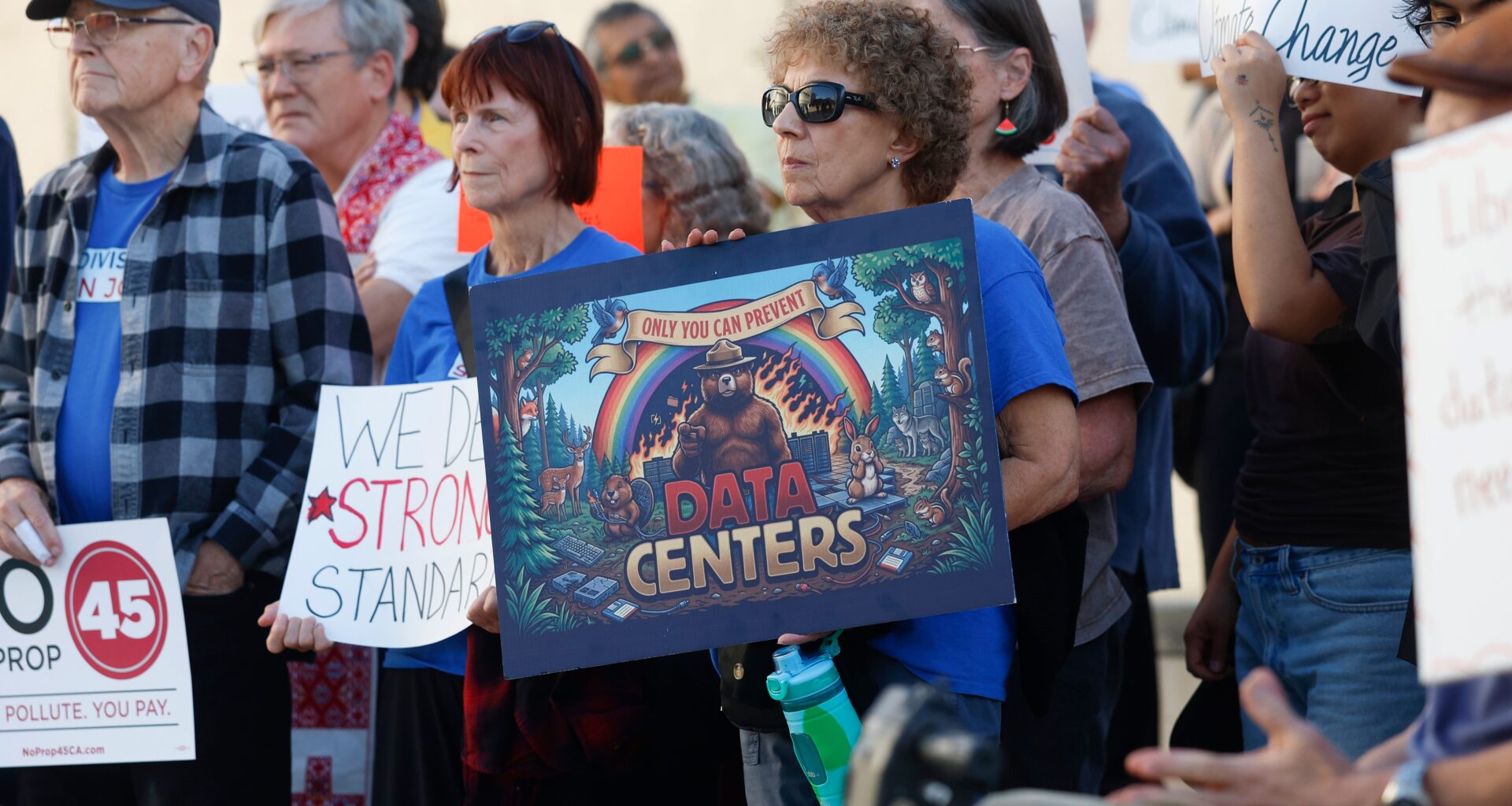
As the city of San Jose presented its draft standards on data centers to the public for the first time Thursday evening, dozens of residents demanded an immediate pause or moratorium on the sites amid growing environmental, public health and quality-of-life concerns.
The proposed regulations come as San Jose attempts to balance the economic promise of data centers against unprecedented strains on local resources and potential environmental harm. With 13 data center applications already in the pipeline, city leaders face intensifying pressure from residents who argue the draft standards do not go far enough to protect surrounding neighborhoods. There are already 25 to 40 data centers operating throughout the city.
The meeting grew contentious before public comment even began.
Security escorted one woman out of council chambers for shouting over perceived delays in allowing the public to give feedback, while another audience member later heckled a labor speaker as dozens of union workers urged the city to require union labor with environmental safeguards rather than halt development completely.
While other Bay Area cities like San Francisco and Oakland have hit pause on data centers, San Jose is trying to rein in the facilities with targeted rules on power, water, and noise rather than an outright ban.
Under the draft regulations, facilities drawing 20 megawatts or more would face strict environmental and design rules. To curb resource strains, projects would be barred from using drinking water in open cooling systems, required to run on 100% carbon-neutral power, and capped at 25 hours a year for backup generator testing — half the state limit. Sites would also need sound baffling, downward-pointing shielded lights to block glare, and annual self-reporting on energy, water, and sewer usage.
The proposals also impose new rules on developers. Companies would have to comply with state prevailing wage and skilled workforce laws where applicable – with the city encouraging voluntary compliance on other sites – and notify neighbors within an expanded 1,500-foot radius. San Jose also is considering developer fees to fund local affordable housing, strengthen the power grid, and capture sales taxes from server equipment purchases.
But many residents remain unconvinced.
Common concerns raised Thursday included evaluating projects in isolation rather than studying the combined citywide impacts, the risk of rising electricity rates, and the constant low-frequency sound of massive cooling fans rattling nearby homes.
Following Thursday’s meeting, staff will present the final draft standards and accompanying ordinances to the Planning Commission on Nov. 18. The proposals are expected to reach the City Council on Dec. 8, with a second and final vote set for Dec. 15. The public will still have opportunities to chime in until and during those meetings.
A major reason that the city is pushing ahead is because data centers would provide a much needed influx of revenue amid the city’s current tight budget constraints. San Jose estimates that a large data center can generate between $3 million and $7 million in annual tax revenue. But several community members pushed back on that calculus, testifying that data centers should not serve as a financial lifeboat for the city’s projected budget deficits.
Linda Hutchins-Knowles of Mothers Out Front Silicon Valley questioned why the city is moving ahead without a pause, especially after staff confirmed that the new standards will not apply retroactively.
“I want to ask why there is a resistance to putting on a pause?” Hutchins-Knowles said. “Why would we want to allow any more data centers to be approved before the standards take effect? The approvals are irreversible.”
Frances Herbert, president of the Oak Grove School District Board, wrote in her individual capacity as a District 2 resident that she was concerned about the high concentration of projects in South San Jose.
“I am also concerned that District 2 and South San José could bear a disproportionate share of the impacts while community benefits are distributed across the entire city. If our neighborhoods are expected to host these facilities, a meaningful portion of any community-benefit funding should be directed back to the areas most affected,” Herbert wrote. “That could include investments in schools, parks, air-quality monitoring, traffic safety, green spaces, and local infrastructure.”
City staff did not respond to calls for a moratorium during the meeting. Mayor Matt Mahan attended the first part of the forum.
“We have not defaulted to unfettered capitalism, nor have we put our head in the sand and tried to ban change,” Mahan stated previously. “And I believe we have an opportunity and a responsibility to regulate technological change to make it work for people.”
Earlier this week, San Jose Silicon Valley Chamber of Commerce convened a panel discussion bringing together representatives from the city government, the data center industry, PG&E, and organized labor to examine the proposed regulations. Unlike the contentious evening listening session, the morning forum focused on framing San Jose as a leader in crafting local guardrails rather than resorting to an outright moratorium.
“In terms of the business community, I would say the business community does want reliable, fair standards – predictability is really important,” said Leah Toeniskoetter, the chamber’s president and CEO. “Also, ensuring that the community feels that all of our environmental, community, and labor concerns are addressed is important to the business community as well.”