
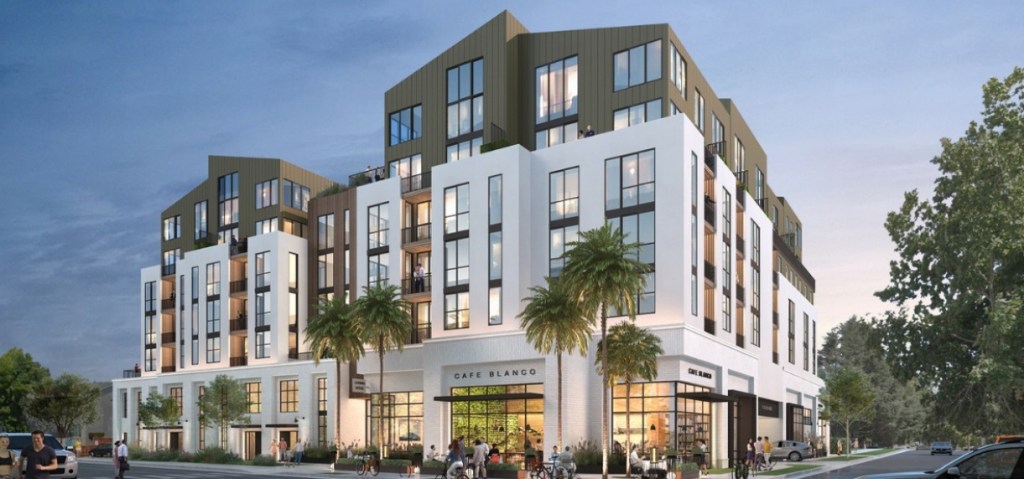
Despite some resident pushback, San Jose has approved permits for a seven-story, 126-unit mixed-use development in Willow Glen.
Many residents near the corner of Kotenberg Avenue and Willow Street say they are not necessarily opposed to new development at 940 Willow St., which a liquor store currently occupies.
But they have argued that such a large project, filed under the Builder’s Remedy, would change the character of their neighborhood and could negatively impact traffic and the aging sewer system.
“I would like to invite the developer to visit the site and view the corner, not merely as a parcel to be developed for profit, but as a neighborhood that will be changed irreparably and forever,” resident Maren Sederquist said at Wednesday’s Planning Director hearing. “If you look around, you will not see any buildings even half the height you are proposing. It will have an impact on neighbors as far as parking, property values and quality of life. I know that doesn’t matter to you, or to the Builder’s Remedy law, but it matters to the over 1,600 residents who’ve signed a petition against the development.”
Redco Development filed its preliminary application with San Jose in June 2023, when the city did not have a compliant housing element.
The project was one of 33 preliminary applications filed by developers throughout the city under the Builder’s Remedy, which prevents local governments from rejecting projects that are not in compliance with their zoning and planning guidelines unless they can show a specific, adverse impact on public health and safety.
Had the development not been able to use the Builder’s Remedy, planning officials said it would have been more difficult because the parcel is zoned as community commercial, which does not allow housing unless it is 100% affordable.
Redco’s proposal includes 52 studios, 50 one-bedroom, 20 two-bedroom and four three-bedroom apartments. The developer is also utilizing the state density bonus law and plans to offer 15% of the base number of units to very low-income households and another 15% to moderate-income households.
Since plans for the project became known, it has faced significant opposition. Along with 186 residents attending a community meeting about the project last year, 1,687 residents had signed a Change.org petition as of Wednesday, warning of potential impacts on the already overburdened sewer system and narrow neighborhood streets.
“This is a very old neighborhood, and we need to realize that,” resident Michelle Belasco said. “The size of that building will dramatically impact the quality of the sewer system and the health and safety … We just don’t feel like the developer has had any ability to compromise or had any interest in compromising with us.”
Chris Freise, managing partner of Redco Development, pushed back on the notion that developers did not care about the city or its fabric, noting the significant conversations they’ve had about building heights, architectural elements and parking to limit the impacts on the neighborhood.
“It costs more to build, but it’s in a way that we think is fitting of Willow Glenn,” Freise said. “It’s a project that (we) should be proud of.”
While a large contingent of residents has opposed the development, the project did have some supporters who said they recognized the need for more housing.
“All the comments I’m hearing against this project are the same tired comments I always see when housing is proposed,” resident Emanuel Ulloa said. “It doesn’t matter what neighborhood you propose it in. You could propose it on the East Side. You could propose it anywhere else in the city (and) people are gonna be against it. And usually, when housing is proposed — multifamily housing as a fact — the burden is shifted into lower-resource neighborhoods, so it’s time for Willow Glen to put up its fair share.”
While city staff acknowledged the concerns, they said state law limited their ability to find fault with the project.
“These kinds of projects are not the standard, and in this case, the applicant chose to take advantage of a state law to move forward with a project that, under normal circumstances, would — unless it was 100% affordable — likely not be permitted on this site,” hearing officer Ruth Cueto said. “However, state law is clear that builder’s remedies projects are exempt from local zoning and land use development regulations. The Housing Accountability Act limits local control, and it limits the legal authority of cities to deny a project.”