
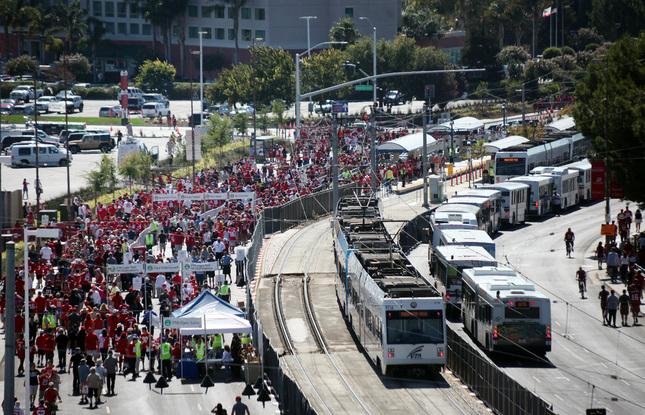
A record-breaking number of riders are expected to board light rail trains for Super Bowl LX, with the Santa Clara Valley Transportation Authority projected to spend $3.8 million to run extra trains and boost security.
VTA is planning to add 22 extra light rail trains to transport football fans to and from Levi’s Stadium on Feb. 8, operating at about 90% of its maximum capacity.
When Santa Clara hosted Super Bowl 50 in 2016, VTA clocked its ridership for the famed Sunday game at 10,000 passengers traveling to and from the stadium. That record was eclipsed by the 2015 NHL Winter Classic with 15,000 fans, and smashed even further by Taylor’s Swift’s The Eras Tour in 2023 as 23,400 Swifties boarded VTA light rail.
This year’s Super Bowl, the game’s 60th iteration, could see a new record broken for VTA ridership with the agency projecting 25,000 riders.
“2026 is going to be a huge milestone year for the agency and we’re really looking to put our best foot forward and shine both for residents who need to get around and all the visitors that we’ll have nationally and internationally,” said Sergio Lopez, a Campbell City Councilmember who serves as the chair of the VTA Board of Directors.
He expects the transit authority to play a major role in delivering passengers around Santa Clara County not just for the Super Bowl, but also for the FIFA World Cup, which is being held at Levi’s Stadium in June and July, and the NCAA’s March Madness at the SAP Center in San Jose.
Swift’s The Eras Tour and Beyonce’s Renaissance World Tour — both held at Levi’s Stadium in the summer of 2023 — served as training for the big 2026 sporting events, allowing VTA to “flex our muscles” and figure out what works to best, according to Lopez.
The agency has been planning for the Big Game the last two years, leading emergency preparedness efforts, evaluating best practices at other Super Bowls and developing a new Emergency Security Operations Center to keep riders safe.
But the additional influx of passengers and extra light rail trains come at a cost. A VTA spokesperson said that the anticipated $3.8 million price tag includes additional bus and light rail operator hours, maintenance support and other safety and security measures and personnel.
The agency said the funding is “being managed within existing budgetary resources” and is expecting some federal grants to offset some of the cost.
“The Super Bowl-related service is a short-term, limited-duration operational adjustment and does not materially impact the agency’s overall financial position,” VTA said in a statement. “The agency has taken steps to ensure that costs are controlled, strategically funded, and aligned with VTA’s commitment to regional mobility and public service during major events.”
But some VTA board members, like Santa Clara City Councilmember Suds Jain, have concerns over the cost.
When Santa Clara voters approved the ballot initiative in 2010 to build Levi’s Stadium, they did so under the pledge that the city wouldn’t use its general fund dollars on stadium-related expenses. Santa Clara will be reimbursed by the Bay Area Host Committee for both Super Bowl and the FIFA World Cup, but other cities won’t be getting that same deal.
“All of the transit agencies are losing lots of money,” Jain said.
The councilmember called the sporting events an “immense burden on the agency.” He had hoped the NFL and FIFA would have implemented a ticket surcharge to help fund the extra service.
Jain looks to neighboring San Jose as an example on keeping the costs down. Earlier this week, the city and the San Jose Sports Authority announced they raised nearly $5 million from corporate donors to help put on concerts, watch parties and drone shows around the major sporting events.
“I’ve been pushing the VTA staff to look at how do we get those sponsorships and how do we get our trains to be wrapped with advertisements from these big corporations,” Jain said.
But Lopez, the chair, said he believes there will be revenue-generating opportunities for the agency because of the spotlight on Silicon Valley in 2026. Public transit, he notes, is a “public good,” and he hopes the increased service will help transition first-time riders into frequent transit users.
“Whether it’s something exciting like Super Bowl or these mega events or another situation where you need to move people around quickly, I believe we should be thinking about investing in these system that form part of our critical infrastructure and fabric of our community the same way we would think about roads, bridges and sewer,” he said. “We need to think about how to make sure we have the infrastructure that serves us.”
VTA is expected to run its additional service plan only on the day of the Super Bowl, which will include more frequent trains — every 15 minutes — from Mountain View to Levi’s Stadium. Because of security restrictions, trains will not be allowed to go past the stadium on Feb. 8 and will turn back at Lick Mill and Great America stations.