
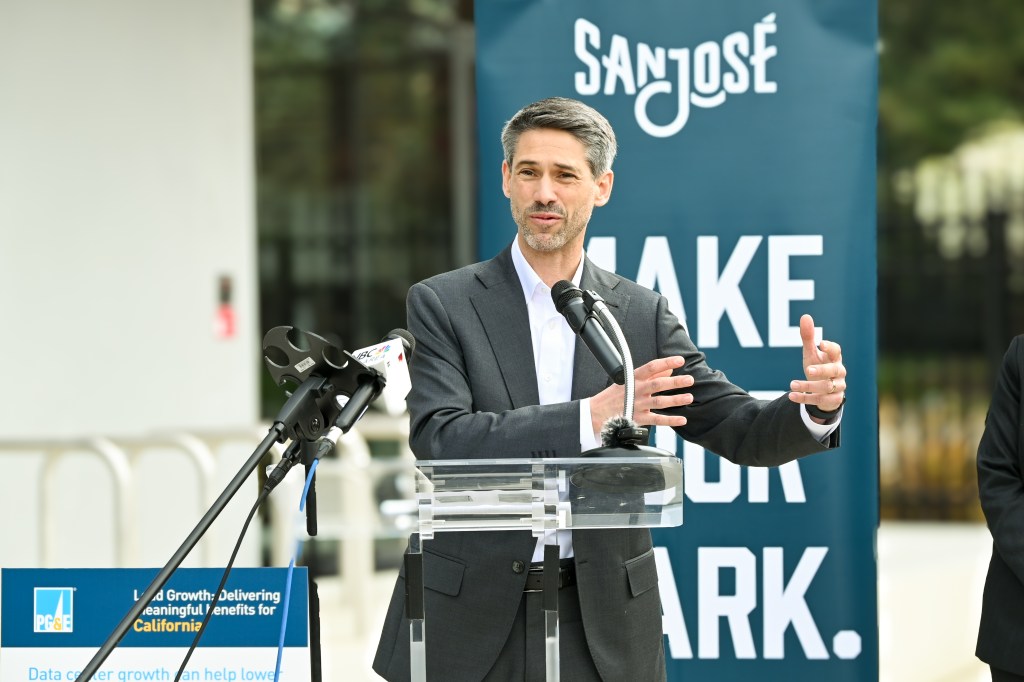
In a major milestone for the city, a data center in South San Jose has become the first project to receive power under a historic agreement with PG&E that guarantees service delivery for large energy customers, adds millions to the city’s coffers, and positions it as a major player for future digital growth.
Equinix’s data center campus at 123 Great Oaks Blvd. is adding 20 megawatts of power under the new agreement, bringing the site’s total to 40MW. It will mean additional revenue of approximately $2.5 million annually for the city — enough to fund the equivalent of either 12 new police officers or 25 interim housing units.
“Investments like this are how we will continue to make progress toward a city that works for everyone,” San Jose Mayor Matt Mahan said Wednesday. “It’s only possible because of the partnership and the standards we’ve put in place. We have created a unique set of circumstances here in the capital of Silicon Valley that will allow us to power the future without sacrificing our quality of life or our core values.”
After flirting with the prospect of creating its own municipal utility, as frustrations with PG&E over reliability concerns escalated, San Jose and the energy giant hashed out their differences through a July deal that promised infrastructure and speed improvements.
The need for greater reliability has been heightened by the potential for San Jose’s power capacity to grow from 1 gigawatt to 3GW once two high-voltage transmission lines constructed by Missouri-based LS Power come online within the next few years.
The agreement with PG&E established key objectives and results for the first 10 projects in Edenvale, North San Jose and downtown. All together, those projects equaled 880MW — equivalent to 80% of the city’s current energy use.
In the grander scheme, city officials envision San Jose becoming a data center hub thanks to its abundance of power, which would not only help attract major investments but also high-paying jobs.
According to a McKinsey & Co. report last year, the artificial intelligence boom could result in nearly $7 trillion in capital outlays worldwide by 2030.
While places like Northern California, Phoenix, the Pacific Northwest, and Northern Virginia represent the primary domestic markets for data centers, dozens of secondary markets have emerged across the U.S. due to power availability.
“We are the most power-ready city in California,” Mahan said. “If you’re a large load customer and you want to get permission, break ground and build a data center or a new fab (semiconductor fabrication plant), you want to make something (or work in) manufacturing, we can get you there faster with guaranteed power than any other city in the state.”
Also key in support of local data centers is their ability to infuse the city budget with a steady stream of funds, which has become especially relevant as San Jose expects a budget shortfall next year due to higher costs and stagnant revenue.
A city memo released last year outlined the financial benefits, estimating that a single 99MW data center could generate between $3.5 million and $6.4 million in annual revenue.
Within the next five years, PG&E expects to connect 15 data centers in the South Bay — totaling nearly 1.3GW — which it says will create 25,000 jobs, $227 million in property taxes and $390 million in sales tax revenue.
As part of the Equinix project, PG&E Corp. President Carla Peterman said the utility doubled the capacity of its Santa Teresa substation, including the installation of a new transformer and circuits. The 40MW of power the data center has access to is enough to power 30,000 homes simultaneously.
Approximately 93% of the electricity powering the data center will come from carbon-free sources, including 62% from renewable energy.
Peternan said Equinix self-funded the substation upgrades, ensuring that the costs did not fall on other PG&E customers.
“That’s one way to expand the grid without increasing prices for all,” Peterman said. “We meant it when we said we are doing everything we can to stabilize bills. National electric prices are expected to rise 10% this year. At PG&E, we’re bucking that trend.”
Peterman added that for every gigawatt of data center demands, PG&E customers could also see their bills decrease by 1% or more.
“The right kind of growth, like the load from this data center, can help us stay on that downward path towards lower prices,” Peterman said. “When large energy users connect to the grid, they take on a larger share of the fixed cost of operating and maintaining the electric system that we all use that can help drop prices for everyone else.”