
A group of Bay Area billionaires has poured $35 million into a campaign to block a proposed California wealth tax, backing three ballot initiatives designed to kill or weaken the measure.
The billionaires have put $35 million into a new political action committee called Building a Better California that is gathering signatures to put on the November ballot three counter-initiatives targeting the proposed California Billionaire Tax Act.
The union-created tax proposal would impose a one-time “emergency tax” of 5% on the net worth of California residents holding more than $1 billion in wealth.
RELATED: More than half of California’s billionaires call the Bay Area home: Who are they?
“Of course they’re going to oppose this,” said Jack Citrin, emeritus professor of political science at UC Berkeley, who dismissed the idea that billionaires are so loaded they shouldn’t care about the initiative’s proposed 5% hit on net worth. “Some of these billionaires have pledged to give half or all to charity. They want to control what they do. They want to live a particular lifestyle. They want to give money to their heirs.”
Building a Better California declined to comment on the billionaire tax proposal and their initiatives. The Service Employees International Union–United Healthcare Workers West, which put forward the initiative, on Friday decried Building a Better California’s “expensive and wasteful tactics.”
The union argues that the levy would help fill a hole in the state budget made by federal funding cuts. But it faces prominent foes including Gov. Gavin Newsom and San Jose Mayor Matt Mahan, who have expressed fears it will drive billionaires out of California, depriving the state of revenue, and stifling innovation.
Google co-founder Sergey Brin, the committee’s largest donor, has already left California. State records show the former Los Altos resident now lives in Nevada.
Media reports indicate Brin recently bought a $42 million mansion on the Nevada side of Lake Tahoe. Brin, worth $231 billion according to Forbes’ real-time billionaires rankings, put $20 million into Building a Better California, state records show.
Adding $2 million each to the committee were a who’s-who of Bay Area tycoons: former Google CEO Eric Schmidt of Atherton, who’s worth $34.8 billion; Kleiner Perkins chairman John Doerr of Woodside, who’s worth $19.4 billion; Stripe CEO Patrick Collison of San Francisco, who’s worth $17.5 billion; Ripple executive chairman Chris Larsen of San Francisco, who’s worth $12.3 billion; Sequoia Capital partner Michael Moritz, who’s worth $7.1 billion; and DoorDash CEO Tony Xu of San Francisco, who’s worth $1.6 billion.
Max Levchin of San Francisco, CEO of Affirm and worth $1.4 billion, threw in $1 million. Beverly Hills water and pomegranate magnate Stewart Resnick, co-owner of the Wonderful Company and worth $5.4 billion, added $2 million.
The group is backing three ballot initiatives — one designed to block the billionaire tax outright and two that could undercut it.
The first, titled the Retirement and Personal Savings Protection Act, would prohibit new state personal property taxes. If both that measure and the billionaire tax passed, the one receiving the most votes would take effect under state law, effectively canceling out the other, said Shaun Bowler, a political science professor at UC Riverside.
The other two initiatives could complicate or undermine the tax if voters approved it.
One proposal, called the Improving Transparency, Effectiveness & Efficiency in California Government Act, would require audits of programs funded by new state special taxes.
Another, titled the Protect Schools and Taxpayers Act, would require new taxes to comply with existing school-funding rules. That requirement could send a large chunk of the billionaire tax’s projected $100 billion revenue to schools instead of the health care programs the union hopes to fund.
Taken together, the measures appear to be “spoiler propositions” meant to weaken the tax or force legal challenges if voters approve it, Bowler said.
“It’s a clever strategy if you’ve got lots of money,” he said. “Money is no object here so you can get a wider range of strategies.”
While the California Secretary of State identifies Building a Better California as a top funder for five initiatives, only three are aimed at this fall’s election, said ballot-campaign strategist Brandon Castillo, president of Sacramento-based BCFS Public Affairs.
Given the multimillion-dollar cost of gathering enough signatures to qualify a measure for the ballot, launching multiple initiatives to counter a single proposal is uncommon, Bowler said.
In order to qualify for the November ballot, the three billionaire-backed measures and the billionaire tax initiative must each collect at least 874,641 signatures from registered California voters. The union’s petition drive must submit signatures by June 24, while Building a Better California has until Aug. 10.
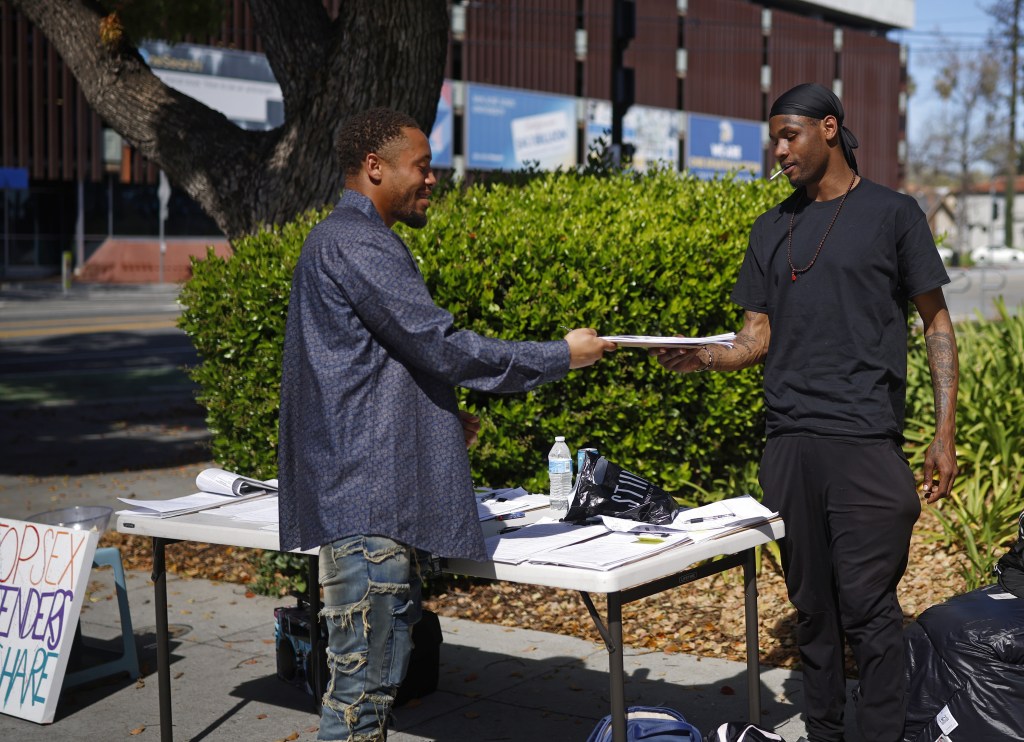
The battle over the billionaire tax initiative is already playing out at grocery stores, farmers markets, libraries and post offices across the state, where clipboard-wielding signature gatherers collect a bounty for each valid signature they turn in.
Experts say the size of that bounty often determines which petitions get promoted most aggressively.
“They’re going to lead with the measures that are paying them more,” said ballot-campaign strategist Castillo.
As of Thursday, on two of the three billionaire-backed petitions, signature gatherers were earning more per signature than those circulating the billionaire tax proposal, according to data from BCFS.
The initiatives banning new personal property taxes and requiring audits of tax-funded programs typically pay about $15 per signature — roughly 25% more than the $12 paid for signatures supporting the billionaire tax.
Resources, Castillo said, “don’t seem to be an issue” for Building a Better California.
That likely means the group’s heavy spending on signature gathering could foreshadow major advertising campaigns if the billionaire tax reaches the ballot, Bowler said.
“These guys have got more money than you can even conceive of,” he said. “Twenty million in advertising here, or $30 million there, it doesn’t mean anything to them.”
A survey of 1,220 randomly selected California registered voters conducted by UC Berkeley’s Citrin Center and Politico from Feb. 25 to March 3 found that 50% supported the billionaire tax and 28% opposed it.
But Citrin, for whom the center is named, noted that when respondents were asked about potential effects — including whether it could drive wealthy residents or businesses out of the state — majorities expressed concern.
An advertising campaign highlighting those issues could “whittle away some support” for the proposal, he said.
For now, however, the fight is unfolding on sidewalks and storefronts across California as petition sheets fill with signatures.
“We’ll see what happens,” Citrin said, “when the ads start bombarding people.”