
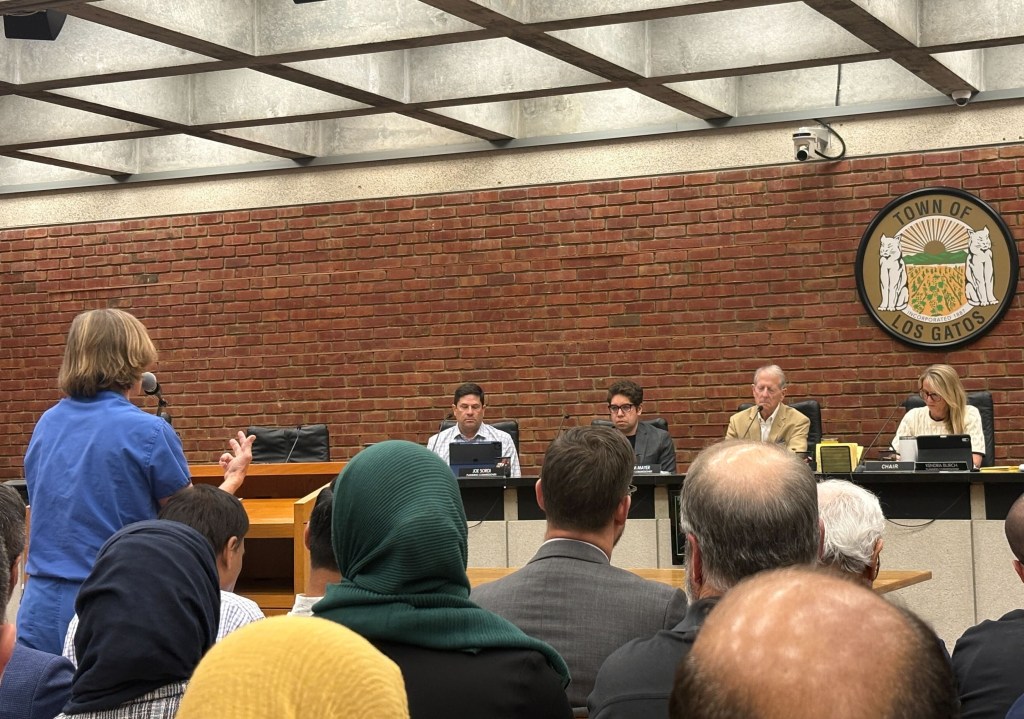
The Los Gatos Planning Commission on March 31 deferred a request by a local mosque to extend its hours of operation for the holy month of Ramadan in hopes of encouraging mediation with the mosque’s Farley Road neighbors.
The West Valley Muslim Association (WVMA) applied for modifications to its conditional use permit in September 2024, asking that its hours be extended to accommodate prayers 90 minutes before sunrise, night prayers until 10:30 p.m. and nightly prayers during Ramadan. During the month of Ramadan, the association requested that the mosque be allowed to remain open until 11:30 p.m. before daylight saving time and until midnight during daylight saving time. To adhere to their current CUP, the mosque received special permission from their scholars to only pray half a chapter of the Quran per night.
At a March 25 public hearing, WVMA founder Razi Mohiuddin emphasized that the prayer times follow the lunar calendar and so can’t be changed. He said there’s no evidence that Ramadan services impact the residential neighborhood where the mosque is located, citing a study by San Francisco-based audio engineering company Salter of vehicle activity and noise levels on the property. The study found that the sound of arriving and departing vehicles would not exceed the town’s noise laws if the hours of operation were expanded, he said, adding that the mosque manages traffic with trained parking guards and volunteers.
“A mosque cannot be a mosque if it cannot offer congressional prayers,” Mohiuddin said.
When asked by Planning Commissioner Rob Stump how many cars drove to the Farley Road location during Ramadan this year, Mohiuddin answered that about 280 cars came to the mosque over two nights, with overflow parking at Affordable Treasures and on nearby residential streets. Mohiuddin said that more people go to Ramadan prayers at their secondary location at Saratoga Prospect Center.
Last week’s public hearing drew an overflow crowd to the town council chambers, spilling out into adjoining rooms as children played outside. Dozens of speakers spoke both for and against the proposed changes to the mosque’s CUP.
Those who spoke in favor of the changes said they appreciated having a local mosque to foster feelings of community and that their request for accommodation was “modest.”
“It’s been a challenging time being Muslim in America — in a post-9/11 America — and with the loneliness pandemic exacerbated by COVID, building community is more critical than ever for everyone,” said Amina Darwish, who leads services and special programs at WVMA.
Anas Syed, a WVMA board member, said they had spent time and money trying to adhere to neighbors’ requests for privacy and quiet. He said they replaced aging fences and planted trees to dull lights and sounds from the mosque’s services, often footing the bill for the renovations. He added that board members also attempted to reach out to neighbors during Ramadan by making available their direct phone numbers and emails.
Syed said their congregation had moved its Eid al-Fitr celebrations at the end of Ramadan to the Vallco parking garage in Cupertino last year and to the gymnasium at West Valley College in Saratoga to avoid “creat(ing) any burden on the surrounding community.”
However, some residents argued that WVMA is out of compliance with its existing conditional use permit and that worshippers and staff go to and from the mosque outside of operating hours. They complained of vehicle noise and lights shining into their homes at night, saying that the town should maintain the character of their neighborhood.
“The Muslim religion has been around for a long time, and I respect that and all the tradition that comes with it, but asking the neighbors in a quiet environment to bear the burden of the oversight of WVMA’s purchase decision and investment for a facility that would not support critical hours necessary for five daily prayers and 30 days of Ramadan should not constitute our neighborhood changing the culture and character we’ve enjoyed for over 30 years,” said a resident named Michelle.
Neighbors complained of a “cacophony of noise” caused by multiple slamming car doors. Resident James Ratcliff asked that parking be limited to the mosque’s lot or that permit parking be enforced.
A resident named Christine said she believes the town is at fault for pitting neighbors against the mosque.
“This issue is a zoning issue; it is not an issue about a place of worship,” she said. “It is about use of space in a neighborhood. I am very uncomfortable speaking about this, and I’m very resentful that I have to.”
The Northern California chapter of the American Civil Liberties Union submitted a letter in support of WVMA last year, saying that rejecting the modified CUP would mean Los Gatos would be violating the Religious Land Use and Institutionalized Persons Act (RLUIPA), a federal law that protects religious institutions from discriminatory land use and zoning laws.
WVMA’s latest CUP application comes with 25 conditions of approval. In 1990, the Jehovah’s Witnesses who occupied the Farley Road building had seven conditions. WVMA’s initial CUP in 2020 had 10.
The letter’s authors argued that Los Gatos unfairly put more conditions on WVMA than other religious and nonreligious institutions similarly situated in residential areas, like Faith Lutheran Church and La Rinconada Country Club. They noted that while WVMA has restrictions on delivery times outside of specific hours and commercial activities, Faith Lutheran does not. The letter also points out that La Rinconada is allowed to be open past the town’s quiet hours.
The ACLU also argues that there is no specified “compelling government interest” for the restrictions on WVMA.
“The bottom line here is that the town has legal obligations under RLUIPA and it has to fulfill those obligations,” said ACLU legal fellow Lauren Davis in an interview. “For us, the important thing is that the town follows the law, and right now, what we’ve seen is a proposal for restrictions on the mosque that are more restrictive than the church and the country club.”
After some additional hours of public comment on March 31, the planning commission and staff discussed possible remedies to the traffic, noise and lighting issues around WVMA. The town attorney confirmed that the extended hours were a negligible expansion of use, rendering the application CEQA exempt, after some members of the public raised questions about environmental impact. The town engineer also said nothing could be done from an engineering or public works perspective to remedy the issues.
Commissioner Jeffrey Barnett introduced a motion to approve the mosque’s conditional use permit with additional conditions, which included removing the “Right turn only” sign at the mosque’s exit, requiring contact information for WVMA board members and staff, installing an electronic speed sign on Farley Road during Ramadan, submitting a parking lot expansion application within six months and completing the renovation within a year, and reviewing compliance of the conditions of approval yearly. Barnett’s motion was not seconded, so it could not move forward.
Commissioner Stump proposed mediation between WVMA and the Farley Road residents. Mohiuddin said the association would reluctantly agree to a mediation as long as they had a mediator with experience in RLUIPA. Ratcliff spoke on behalf of the neighbors and said that they would appreciate mediation because talks with the mosque leadership had reached a “standstill.”
However, the question became who would pay for mediator. The town attorney said that the town does not have a mechanism to collect and fund outside mediation. Mohiuddin said they were willing to pay for only half of the cost for mediation. A representative of the Farley Road Neighborhood Coalition could not definitively say that they would be interested in splitting the cost of mediation because they do not know how much it would cost.
The discussion was rescheduled for April 22.