
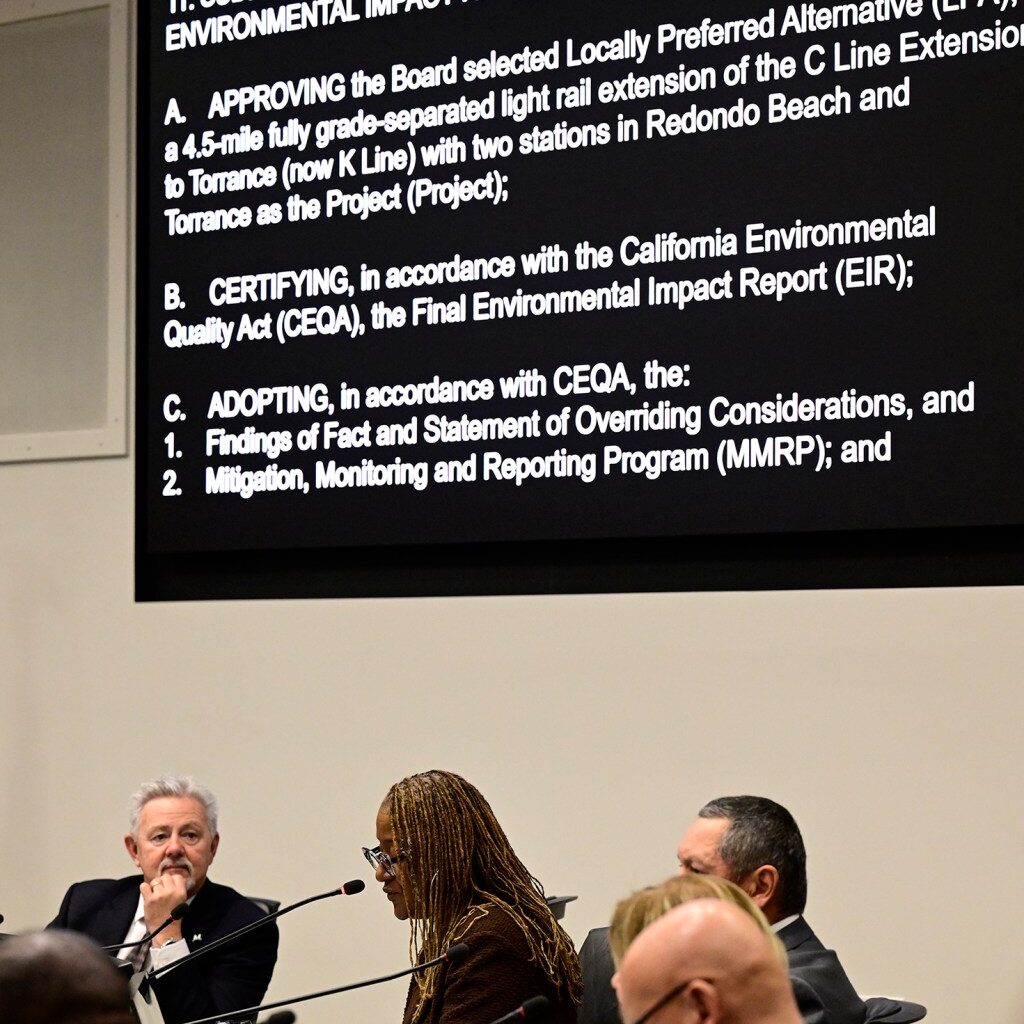
Should the 13-member LA Metro board be expanded?
And if so, who would be added?
A new Ad Hoc Board Composition Committee, formed by LA Metro board chair Fernando Dutra, has been tasked to review and consider potential changes to the structure, makeup and size of LA Metro’s governing board. The board decides on major rail, rapid bus, freeway improvements and pay lane projects and has an annual operations budget of about $9 billion.
LA Metro’s board decides on major train routes, such as last month’s approval of an extension of a 9.7-mile San Vicente-Fairfax extension of the K Line light-rail from Crenshaw through Mid City, the Fairfax District to West Hollywood at a cost of $15 billion. Metro will open the first leg of the D Line subway extension beneath Wilshire Avenue to Beverly Hills on May 8. The board approved the route for a major project costing upwards of $25 billion on Jan. 22 that would create an underground rail through the Sepulveda Pass, setting the stage for the first transit connection between L.A.’s Westside and the San Fernando Valley.
The public can share their input as to the board’s future makeup at several “listening sessions” or at the next Ad Hoc committee meeting:
• April 6, 5 p.m., in-person listening session at Residence Inn Conference Room, 240 Marine Ave., Redondo Beach. Online: go to https://www.zoomgov.com/i/1601341255 and use webinar ID: 1601341255.
• April 8, 6 p.m., in-person listening session at LA Metro Headquarters, 1 Gateway Plaza, 3rd Floor Board Room, Los Angeles (at Union Station). Online: go to https://www.zoomgov.com/j/1618562032 and use webinar ID: 1618562032.
• Two more listening sessions planned: April 9, 5 p.m. at Gateway Cities Service Council and April 9, 6 p.m. at the Public Safety Advisory Committee (PSAC) meeting at Metro Headquarters. No more information is available on these two meetings.
• The Ad Hoc Board Composition Committee’s next meeting is Monday, April 27, 1 p.m. at Metro Headquarters.
The committee has met twice and includes Metro board members, former board members and a member of the PSAC group who is a regular transit rider. They will formulate a report by sometime in June for approval by the existing board and ultimately, the State Legislature.
“The idea is to come with a local proposal of what the board should look like, such as how many members, and who should they represent,” said John Fasana of Duarte, an Ad Hoc committee member and former Metro board member who represented the San Gabriel Valley cities.
At the heart of this introspection is the passage of Measure G in 2024. It changed the LA County charter by adding four new members of the Board of Supervisors, going from five to nine. Since each one automatically serves on the LA Metro board, that means when there’s nine members by 2032, the Metro board will go from 13 to 17.
Or will it?
That depends on the State Legislature, which makes the rules for the powerful transit body’s governance.
“My stance is, they may not be real excited about having four more members on the Metro board,” said Fasana, saying some on the committee thought it would be too unwieldy.
That’s the first problem.
Another issue was raised by Fourth District LA County Supervisor Janice Hahn, a Metro board member and former Metro chair. It is her intention to appoint someone to the board who is a bonafide, full-time transit rider. Sure she’s taken the Silver Line rapid bus from the South Bay occasionally, especially when she was chair, but she doesn’t ride a Metro train or bus all the time.
“As we look at the governance of this board, I do hope we include more transit riders to the board,” she said at a recent board meeting. “Having a transit rider sit next to you on the dais will make us stronger.”
That has been a criticism of the board. Namely, that it is out of touch with regular bus and train riders, who have had to worry about crime, loiterers doing drugs, mentally unstable riders and inconvenient train and bus schedules.
Dutra started the committee as a way to give Metro a leg up on any future Legislative fixes by proposing its own ideas, after a bill by state Sen. Ben Allen, D-El Segundo, was killed that would’ve expanded the board to 18 members.
“It gives us an opportunity to control our own destiny,” he said.
Dutra referred to Ad Hoc committee member and North Hollywood resident Jeremy Oliver-Ronceros, who often rides the B Line from the San Fernando Valley to downtown L.A. as a frequent Metro transit rider who is contributing to the discussion on the committee.
Since Metro was created in 1993, there were 13 voting members: five county supervisors, the mayor of L.A. and three mayoral appointees, and four members representing 87 other cities in the county by geographic area (North County/San Fernando Valley, San Gabriel Valley, Southeast County/Long Beach and Southwest Corridor).
Some have suggested the board members be more representative of the ridership. The majority of bus riders are Black and Latino, and many can’t afford a car and are transit-dependent. Others say the board should have a member from a county unincorporated area. Unincorporated areas include about 1 million people.
Fasana would like the board to have someone with first-hand experience with goods movement, freeways and highways.
Riders can also share feedback by taking a survey.
For more information, go to: gometro.la/governance.