
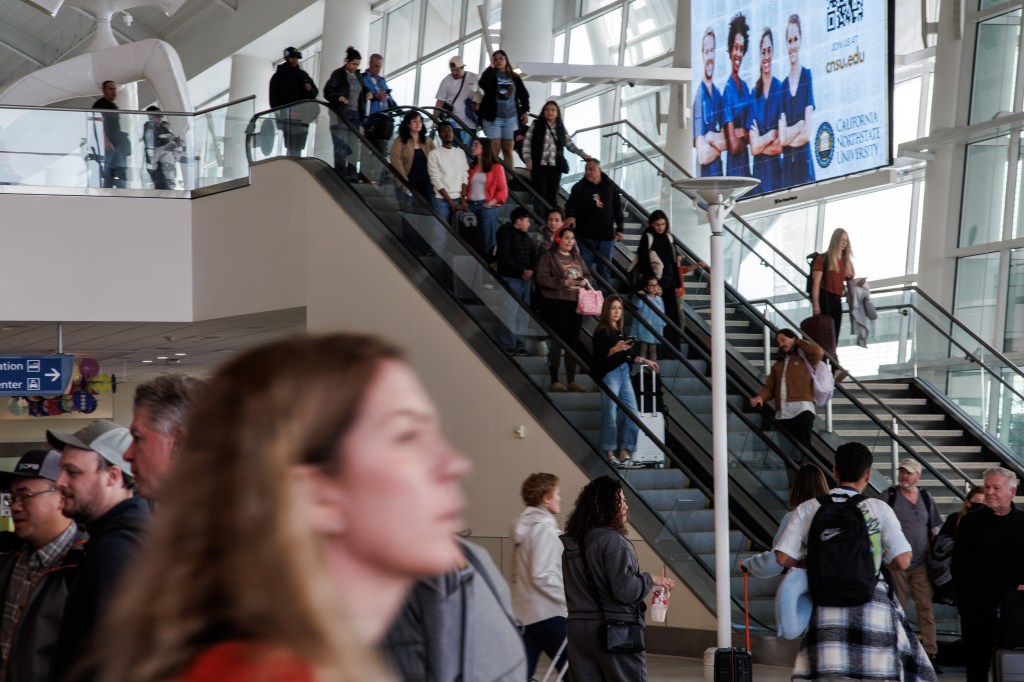
SAN JOSE — While a partial government shutdown snarled airport security operations throughout much of the nation in February, Super Bowl events in the region during the same month appeared to have done little to lift the fading fortunes of at least two of the Bay Area’s major airports.
The region was expected to draw as many as 260,000 visitors over the roughly eight days that included the Super Bowl and its preceding events, according to estimates ahead of the game on Feb. 8.
According to a review of the latest passenger statistics from the travel complexes, February was a month of mixed results for San Jose Mineta International Airport, Oakland San Francisco Bay Airport, and San Francisco International Airport.
San Jose accommodated about 673,600 passengers in February, up 4% from January, but down 9.7% compared to February 2025.
Oakland handled approximately 607,600 passengers in February, down 0.5% from January and 9.1% below the total of February 2025.
San Francisco saw about 3.7 million passengers in February, down 7.6% from January, but 4.4% higher than February 2025.
“Passenger levels at San Jose Airport are being shaped by broader industry trends,” airport spokesperson Julie Jarratt said. “While major events like the Super Bowl can create short-term spikes, they don’t typically drive sustained demand.”
For Oakland, private jets may have provided a key boost for the airport during Super Bowl week and right after the game, airport officials said.
“Although commercial passenger traffic saw an overall decrease at several airports in February, Oakland Airport experienced a steep increase in general aviation activity during the Super Bowl,” Kaley Skantz, an airport spokesperson, said.
Oakland accommodated more than 1,000 private aircraft during Super Bowl week, Skantz said.
Then came a partial government shutdown that began on Feb. 14.
Without proper funding, long lines leading to TSA checkpoints imposed challenges for travelers, as numerous agents either quit their jobs or didn’t show up. The effects of those challenges may not have severely impacted the region’s airports.
“We have not seen any measurable impact to passenger volumes due to TSA wait times at SJC related to the partial government shutdown, and operations have remained steady,” Jarratt said.
Longer-term passenger trip trends at the three airports point to some trouble ahead.
Over the 12 months that ended in February, San Jose handled 10.48 million passengers, down 10.4% from the comparable one-year period ending in February 2025.
Similarly, Oakland accommodated 9.04 million passengers during the one-year period ending in February, a 14.1% drop from the 12-month period that ended in February 2025.
San Francisco was the only one of the three airports that posted an improvement using the same metric. The 54.66 million passengers that it handled over the 12 months ending in February was 3.5% more than the totals for the comparable period in the prior year.
All three airports still remain below the levels they had achieved in 2019, the final year before the outbreak of the coronavirus triggered wide-ranging business shutdowns and travel restrictions starting in February 2020.
In a comparison of the 12 months that ended in February to the pre-COVID passenger trips, San Jose’s totals are 33% below the 2019 level, Oakland is 32.5% lower, and San Francisco is down 4.9%.
The longer-term trends are a reminder that numerous external factors beyond the control of the three airports play major roles in their respective fortunes.
“Airline capacity decisions, business travel recovery, and evolving travel patterns continue to be the primary factors influencing overall passenger volumes,” Jarratt said.