
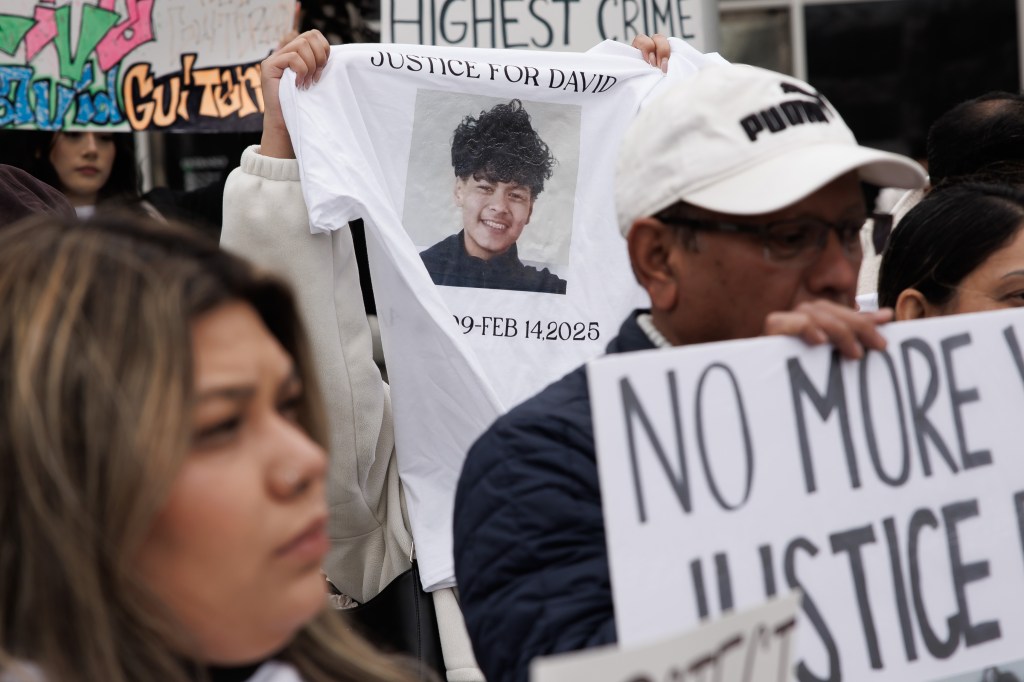
The 13-year-old who stabbed to death a 15-year-old at Santana Row on Valentine’s Day was a “frightened teenager reacting in a rapidly escalating confrontation” and didn’t intend to kill him, a defense lawyer argued in closing statements Monday, claiming self defense in a murder trial that renewed debate about appropriate punishments for minors.
Public defender Jennifer Redding suggested that her client, now 14, believed that the victim, David Gutierrez, who was waiting for a reservation for his dinner date, may have had his own knife. And she alleged that both teens were goaded on by David’s girlfriend who she claimed has a history of fighting herself and may have lied about whether David had a knife and possibly concealed it when police arrived.
“We can tell he didn’t have intent to kill,” Redding said. “It wasn’t until he was pushed and pushed and pushed and he realized he couldn’t get out of this.”
But Deputy District Attorney Viet Nguyen argued there was no evidence that David had a knife — four eyewitnesses testified that only the suspect had one and police never found one. He also said that the defendant cannot claim self defense because he was the initial aggressor and had no reason to believe that David, on a date with his girlfriend, would cause him significant harm. David, he said, was unarmed, never threw a punch or took a defensive posture during the brief, fatal encounter.
“He did not actually believe David was a threat,” Nguyen said. “He was cold and calculated when he stabbed David in the heart. The court must find him guilty.”
The suspect, whom the Mercury News is not naming because he is a juvenile, didn’t take the stand in his defense. He faces up to 8 months at a youth camp if found responsible for first-degree murder — a penalty David’s family has decried as too lenient for murder. Juvenile Court Judge Andrea Flint said she will return a verdict on Friday.
The case energized debate between David’s family, who staged repeated protests demanding that the suspect face “adult punishment for an adult crime,” and youth advocates who say juveniles need rehabilitation, not punishment. District Attorney Jeff Rosen also weighed in, saying young offenders need tougher consequences and more accountability.
On the last day of the trial Monday, both the prosecutor and public defender relied heavily on security videos from the upscale, outdoor mall in San Jose to make their case, including graphic images that left the family of the victim sobbing in the courtroom. The suspect sat solemnly in a grey suit at the defense table, with his mother sitting behind him in the courtroom gallery.
Nguyen told the judge that the suspect and a group of suspected gang friends were out to cause trouble on Feb. 14, 2025. Nguyen played security footage showing the defendant throwing the first punch when they jumped a man in a red jacket — a rival gang color — less than an hour earlier at Valley Fair mall across the street.
The group then walked to Santana Row, where they encountered David, also wearing a red jacket, and attacked him, the defendant again throwing the first punch. Moments after a security guard broke up the beating and the teenagers scattered, the 13-year-old came upon David and his girlfriend at the fountain plaza next to the theaters where the fatal stabbing took place.
Police and David’s family say the 15-year-old — a sophomore at Sequoia High — had no gang affiliation and was wearing a red jacket to celebrate the holiday. The only provocation, Nguyen suggested, was when David — who had just been attacked by the suspect and his friends — challenged him to a fistfight in the plaza.
“He said something to the effect of, ‘put the knife down and let’s fight one on one,’” Nguyen said.
The public defender said, however, that the suspect declined, saying he already got his “hits in,” but that David’s girlfriend, in her initial police interview, said she told the suspect “you are going to fight my boyfriend one on one.”
The suspect then showed his weapon, Redding said, essentially to say “I have a knife, leave me alone.”
“She is in his face, pointing her finger,” Redding said. “She was loud and she was angry.”
Redding also pointed to text messages between David and his girlfriend four months earlier when the girlfriend told David about punching a male in the face who had told her she was too loud, and how he hit her back. David texted back that he was “ready to kill him if he saw him,” Redding said.
“They would often be in situations where fights would break out,” Redding said. “They were emotional teenagers who were often angry with each other and angry with other people.”
The young couple were on a date for Valentine’s Day, but they had fought moments earlier over trust and jealousy issues, Redding said, referring to the girlfriend’s statement to police and videos showing them parting ways shortly after they arrived at Santana Row. So David was already upset when he encountered the suspect, Redding said. Videos show the girlfriend, then 15, ran to his side when he was first attacked.
Redding also suggested that while David might not have been a member of a gang, he was “influenced” by the Norteños who wear red. In text messages with his girlfriend when he bought the red Nike sweatshirt, she wrote that “you’re a big Norte, huh?” Social media photos showed David throwing up gang hand symbols — all evidence, she said, that David may have come across as more dangerous than the prosecution suggested.
Later Monday, David’s aunt, Diana Gutierrez, rejected the suggestion he had gang ties, saying police thoroughly investigated David’s past after his death, including searching his room that the family didn’t touch after his death.
“They ruled that out,” she said.
She also objected to the defense portrayal of David’s girlfriend, saying that although she wasn’t injured in the altercation, “that’s trauma to her as well. I think people forget that she’s a victim. She was testifying for a whole day, asking her about her dead boyfriend.”
The public defender also said that because her client grew up in a rough neighborhood of San Jose, his father was in prison, his mother had substance abuse problems and they lived for a time out of a car, he was conditioned to be fearful and impulsive. He had been stabbed in the arm a year earlier. In his community, fighting was practically “recreational,” she said, and “violence was normalized.” She also referred to expert testimony that the brain of a 13-year-old is not fully developed, so he had less control of his actions.
Whether David actually had a knife is less important than her client’s perception that he may have had one. A police officer initially reviewing security tape thought David might have been holding a knife because of the way his arms were gesticulating.
Her client, she said, “had reasonable belief he was in imminent danger of suffering great bodily harm or being killed. Is he holding a cell phone or a knife? I don’t know. The defense doesn’t have to prove he didn’t have a knife.”
The prosecutor said, however, that it didn’t appear from the videos that the suspect was afraid for his life. The suspect, along with David and his girlfriend, circled each other for 50 seconds before the knife attack that struck him twice in the arm and once in the heart. The suspect turned his back to them several times.
“If he truly believed his life was in danger, why would you ever turn your back?” Nguyen asked. “Why would you turn your back right before you launch your deadly attack unless you never believed that person will attack or hurt you?”
But the defense said that all three of those involved on that fateful night — her client, David and his girlfriend — were all primed for violence.
“When anger and pride collide in real time,” Redding said, “reason often loses.”