
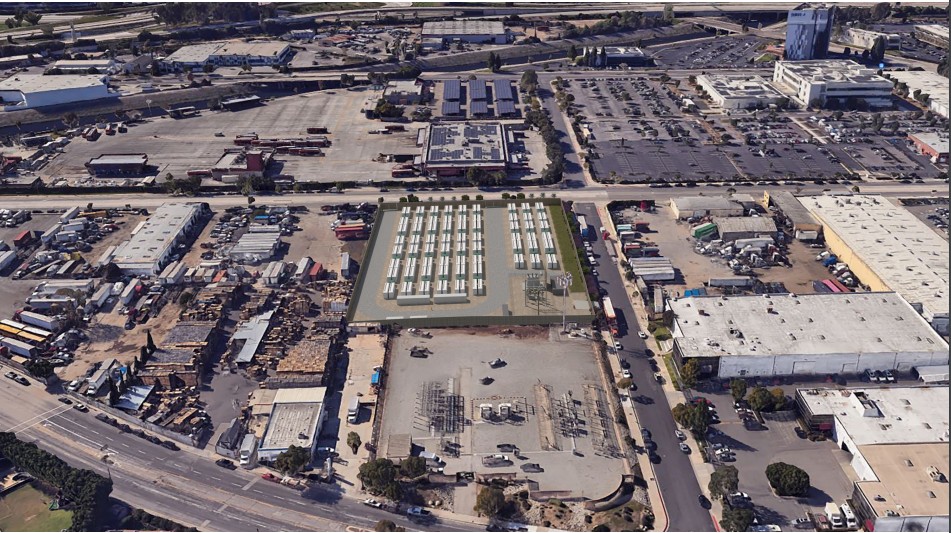
Carson is getting a 100-megawatt lithium-ion Battery Energy Storage System, or BESS, facility.
The BESS facility will act as a large rechargeable battery for the electric grid by storing electricity when supply is high and releasing it to the adjacent Southern California Edison Nola Substation facility when demand begins to outpace supply.
And while environmental advocates support this project, other residents and city officials have butted heads when it comes to potential safety concerns. The project site is a 3-acre vacant lot, 18800 South Broadway Ave., in a light industrial area. The BESS facility meets all city regulations and codes, meaning there is no regulatory reason locally that would prevent the project from moving forward.
The city Planning Commission, however, thought there was too great a risk associated with the project site, since it is relatively near a residential neighborhood, Kaiser Permanente medical offices, Victoria Park and Towne Elementary School. So the commission denied the project earlier this month.
“Lithium battery systems have documented risks of thermal runaway, fire, explosion and toxic gas release,” Kaneca Pompey, a city planning consultant, said in a staff report presented to the Planning Commission. “BESS facilities such as the project carry potential off-site public health and safety impacts resulting from explosions and fires involving the BESS facilities.”
One example presented was the 2025 Moss Landing Power Plant fire. This was one of the largest battery fires in the world and burned for several days. A lithium battery fire cannot be put out, according to Los Angeles County Assistant Fire Chief Richard Stillwagon — only contained.
“The challenge with BESS fires is that they are a container within a container,” Stillwagon said. “As we apply our normal traditional method of extinguishment, water rains down over the overall container, thus not allowing us to penetrate where the active fire is, so that becomes the challenge.”
Because BESS facility fires are so rare, however, it is currently unknown whether the fires cause the release of dangerous chemicals into the air. But studies have shown that when hydrogen gas burns it consumes most of the other chemicals in the burning process, Stillwagon said. L.A. County also has the strictest guidelines when it comes to approving BESS facilities, he added.
“We are leading the nation in safety in this space,” Stillwagon said. “We have higher regulatory requirements than anybody else in the state. Nobody requires a blast wall. We demanded our applicants to provide the explosion modeling to where we could provide a reinforced wall to keep fires and explosions contained within sight. That is a higher-level requirement. We were the first in the nation to require and demand internal gas detection systems and/or smoke systems to get that early warning and to let everybody evacuate the area.”
Nevertheless, the Planning Commission denied the project. The developer, Ormat Technologies, promptly submitted the almost $10,000 appeal, bringing the project to the City Council — which approved the facility last week and made the project exempt from an environmental review.
But not without some conditions.
Councilmember Arlene Rojas proposed a list of conditions and community benefits that the developer accepted.
Here is what the developer will give the city in exchange for the project:
A one-time development impact fee of $189,093.12.
A lump sum of $357,006 for general operations and maintenance expenses of the city.
A battery fee of $1,487,500.
A one-time payment of $40,000 to be used for a paid summer internship program at Carson High School for students interested in renewable energy technology.
A one-time payment of $25,000 to Towne Avenue Elementary School for community gardens and environmental-educational programs.
A one-time payment of $35,000 to the city’s Parks and Recreation Department for youth sports programs.
A one time $100,000 contribution to the Carson Experience — the city’s resident experience of the Los Angeles 2028 Olympic Games.
The developer will ensure that Carson will be the point-of-sale for all project batter purchases for California sales and use tax purposes.
The developer also agreed to increased safety precautions, including a 13-foot perimeter wall around the batteries to contain any potential fires and explosions. There will also be an employee on-site at all times through the duration of the project to monitor the batteries. Additional safety precautions include hosting yearly safety meetings with the community, creating an emergency evacuation plan and establishing a 24/7 project hotline.
“From day one, Ormat has been committed to the community and to the city,” Edgar Khalatian, an Ormat representative, said in response to Rojas’ demands, “as all of the testimony today was evidence of that fact and we are more than happy to agree to all the conditions placed in front of us today and continue to be members of proud members of the community for years to come.”
The council approved the project 5-2, with Mayor Lula Davis-Holmes and Councilmember Cedric Hicks dissenting. Davis-Holmes said she is not necessarily against BESS facilities — but she does not approve of the location.
A couple months ago, in fact, she touted the project as an accomplishment during her State of the City address.
“I will admit that I did not do my due diligence and when I met with the company, I did say yes,” Davis-Holmes said. “But then I opened up the books and saw where it was and did further investigation on the company.”
She said she would have preferred sending the project back to the Planning Commission and getting a full environmental impact report, but she did not have the support from the rest of the council.
This project lies in Councilmember Jawane Hilton’s district and he said he voted in favor of the project to preserve local control and ensure community benefits. Currently, California can take leadership over energy conservation projects, overruling a city’s determination. That would mean that the city would not get all the financial benefits they are set to receive from the developer. The state’s review process, however, is much more rigorous — requiring thorough environmental reviews.
Still, the project passed, and demolition and construction is anticipated to begin before the end of the year.