
The results of the Los Angeles Homeless Services Authority’s 2026 tally of unhoused people across the county were mixed for The South Bay and Southeast L.A. County saw mixed, though statistically negligible changes in its homeless population this year, according to new data.
The Los Angeles Homeless Services Authority released the results of his 2026 tally of unhoused people on Friday, July 24. The data was recorded during LAHSA’s 2024 Greater Los Angeles Homeless Count, conduced over a three-day period in January. The beleaguered agency tallied 73,040 unhoused people across Los Angeles County this year — excluding Long Beach, Pasadena and Glendale, which conduct their own surveys — up slightly from 72,195 in 2025.
That number represents an increase of about 1.2% across the county’s “continuum of care,” which covers 85 of its 88 cities, and an approximately 3.4% increase in the city of Los Angeles itself.
“I am frustrated, like I am sure everyone is. It felt like we had turned a corner these past few years and this latest count feels like a setback,” said LA County Supervisor Janice Hahn, whose Fourth District includes much of the South Bay and Southeast L.A. County. “L.A. County has just recently moved our funding away from LAHSA and we have an opportunity and an obligation to do better. People want to see fewer encampments, more people moving into permanent housing and a system that responds with urgency. That is what I am focused on.”
The increase in Los Angeles’ homeless population is a result of around $70 million in federal cuts for homeless services in the city, alongside a lack of adequate mental health services for homeless people, Mayor Karen Bass said in a Thursday, June 23, statement, after the survey data leaked early.
Long Beach, which has an independent health department and conducts its own homeless count each year, was not included in the countywide data. But that city also released the results of its homeless count this week, which showed a 3.7% increase its homeless population from the year prior.
Long Beach officials, though, said the increase for 2026 is smaller than the one reported in 2025. And despite the increase in the amount of homeless people, Long Beach also reported some encouraging trends in the numbers, including a 15.4% increase in people staying in shelters and the amount of people who are unsheltered declining to 69.4% — the lowest level recorded in the past four years.
Long Beach officials similarly cited the impacts of federal funding cuts by the Trump administration on its resources and ability to provide homeless services, including housing vouchers that many have come to rely on.
Some of Long Beach’s neighboring cities, and towns throughout Southeast L.A., also seem to be feeling the effects of federal funding losses and other economic challenges.
The financial challenges government agencies across the state are grappling with are also mirrored in the lives of everyday people. As inflation, rent prices and the cost-of-living continue rising, while wages remain stagnant, more people than ever are at-risk of becoming homeless.
In Los Angeles County, for example, more than 90% of the renters, totaling around 734,000 people, make under $50,000, and spend more than 30% of their income on rent and utilities, according to a 2025 analysis by USC’s Lusk Center for Real Estate.
Housing availability and costs play a major role in shaping Los Angeles County’s homeless population, according to the study. Housing production has stalled over the decades. Just 152,000 new housing units were certified for occupancy across the county from 2018 to 2024, the study said — a mere 10% of which were accessible for lower-income households.
And while the production of accessory dwelling units has helped propel the availability of housing countywide, the majority of renters are priced out of living in them, the study said.
“Unhoused people in Los Angeles County experience longer durations of homelessness spells compared to unhoused people in other metropolitan areas,” the study said. “The vast majority of unhoused Angelenos lived in Los Angeles County before they fell into homelessness, underscoring the deep connection between the region’s housing affordability and homelessness crises.”
As for the homeless count data released on Friday, the changes compared to 2025 were marginal for the South Bay and Long Beach areas.
In L.A. County’s Service Planning Area 6 — or SPA, a geographical distinction used by the county Department of Public Health to develop targeted services based on the specific needs of each community — there were 14,289 homeless people this year, according to LAHSA. That’s increase of 702 people.
SPA 6 includes Athens, Compton, Crenshaw, Florence, Hyde Park, Lynwood, Paramount and Watts. Of the homeless people in this region, 11,228 were individuals without children, while another 3,054 were in families with children. There were also seven unaccompanied minors included in the count.
About 8,792, or 62%, of SPA 6’s homeless population were unsheltered, according to LAHSA, while 5,497, or 38%, were in temporary shelters.
SPA 7 — which includes Bellflower, Downey, Hawaiian Gardens, Lakewood, Cerritos, East L.A., Signal Hill, Norwalk and other cities — had 5,552 unhoused people this year, up from the 4,778 reported in 2025.
That includes 4,669 people without children and another 849 in families with children, alongside four unaccompanied minors, according to LAHSA. The majority of homeless people in SPA 7 are unsheltered, with just 33%, or 1,817, in temporary shelters.
In SPA 8 — which covers nearly the entirety of the South Bay, including Torrance, Carson, San Pedro, Inglewood, Wilmington, the beach cities, Gardena and others — the number of homeless people decreased by 651 people.

From right, Diana Sanchez and her two children, three-year-old Gabriel Sanchez and eight-year-old Angela Sanchez receive hot meals at the Rescue Mission in Long Beach on Thursday, July 23, 2026. (Photo by Drew A. Kelley, Press-Telegram/SCNG)

From leftt, Diana Sanchez and her two children, three-year-old Gabriel Sanchez and eight-year-old Angela Sanchez receive hot meals at the Rescue Mission in Long Beach on Thursday, July 23, 2026. (Photo by Drew A. Kelley, Press-Telegram/SCNG)

The Rescue Mission offers anyone in need a hot meal in Long Beach on Thursday, July 23, 2026. (Photo by Drew A. Kelley, Press-Telegram/SCNG)

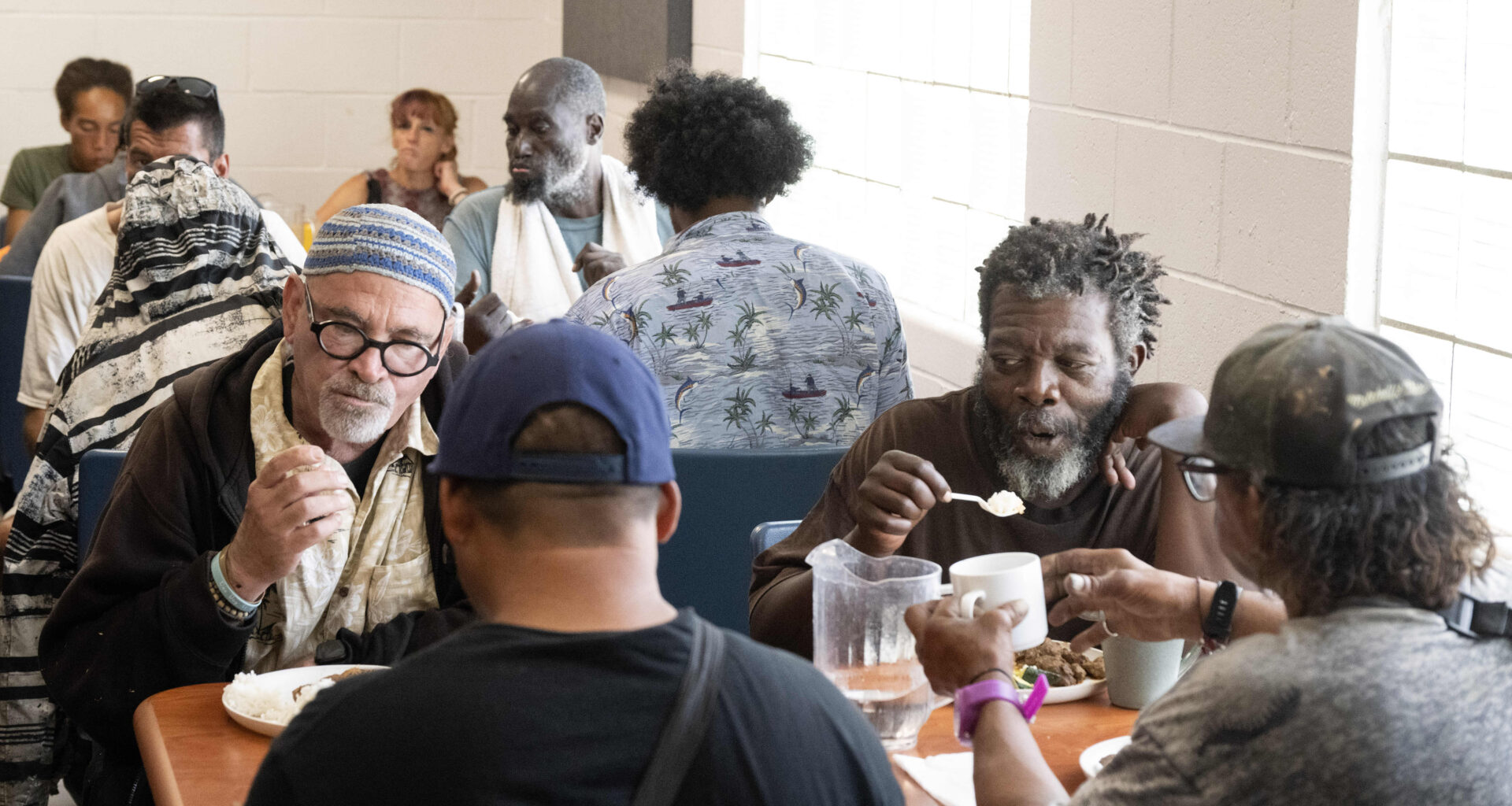
People experiencing homelessness receive hot meals at the Rescue Mission in Long Beach on Thursday, July 23, 2026. (Photo by Drew A. Kelley, Press-Telegram/SCNG)

People experiencing homelessness receive hot meals at the Rescue Mission in Long Beach on Thursday, July 23, 2026. (Photo by Drew A. Kelley, Press-Telegram/SCNG)

Volunteer David Ko, right, prepares hot meals for people experiencing homelessness at the Rescue Mission in Long Beach on Thursday, July 23, 2026. (Photo by Drew A. Kelley, Press-Telegram/SCNG)

William Porrino serves hot meals to people experiencing homelessness at the Rescue Mission in Long Beach on Thursday, July 23, 2026. (Photo by Drew A. Kelley, Press-Telegram/SCNG)

People experiencing homelessness receive hot meals at the Rescue Mission in Long Beach on Thursday, July 23, 2026. (Photo by Drew A. Kelley, Press-Telegram/SCNG)
Show Caption
1 of 8
From right, Diana Sanchez and her two children, three-year-old Gabriel Sanchez and eight-year-old Angela Sanchez receive hot meals at the Rescue Mission in Long Beach on Thursday, July 23, 2026. (Photo by Drew A. Kelley, Press-Telegram/SCNG)
In total, according to LAHSA’s data, there were 4,774 homeless people in SPA 8 in 2026, down from 5,424 the year prior. That total includes 4,140 without children, 633 who are in families with children, and one unaccompanied minor.
Around 3,183, or 67%, of the homeless individuals in SPA 8 were unsheltered, the data said, compared to 33%, or 1,591, housed in temporary shelters.
SPA 8 is one of just three service planning areas in LAHSA’s jurisdiction to report a decrease in the total homeless population this year, alongside SPA 1 and SPA 5, which cover Antelope Valley and West L.A., respectively.
It is of note, though, that the SPA data provided by LASHA does not include city-by-city breakdowns of homeless populations, meaning the picture of homelessness in each individual city is not entirely clear with the release of the data on Friday.
But several cities within SPA 8 have been working to address homelessness in recent years, including in Torrance. Homeless encampments are not common in Torrance because of a strictly enforced anti-camping ordinance. Instead, the city created the 3290 Temporary Housing Village for homeless people.
The pallet shelter, operated by Harbor Interfaith, consists of 40 “tiny homes” that are equipped with air conditioning and shared facilities that provide bathrooms, showers, and washing and drying machines. Residents also receive three free meals per day, case management, permanent housing assistance, job assistance, career development support and childcare assistance.
The city has also increased its outreach efforts. To date, the city’s outreach has resulted in 45 people being permanently housed, 58 getting enrolled in the Venice Family Clinic, 36 people getting matched to housing vouchers and 58 homeless encampments being cleaned up.
Carson, meanwhile, has a homeless outreach team that offers services and resources to unhoused individuals within the city. While the goal is to connect people with housing, the city does not fund or operate any shelters, interim housing or permanent housing.
The City Council and other Carson officials, in fact, have outwardly opposed a new supportive permanent housing apartment complex set to house more than 100 homeless people that recently opened within the city.
The Homekey project, dubbed the Weingart Primrose, has turned the former Extended Stay America hotel on Albertoni Street into an apartment complex with 104 studio apartments designated for qualified homeless individuals within Los Angeles County; there’s also one unit set aside for a building manager.
The City Council even held a protest outside the site in May, saying that if there is to be homeless housing within the city, they want it to be unhoused Cal State Dominguez Hills students.
That isn’t possible though, according to LA County Supervisor Holly Mitchell, because of a requirement that all Homekey projects use a coordinated entry system that matches homeless individuals with appropriate housing sites across the county.
As for Redondo Beach, the largest of the South Bay’s beach cities, officials there have had an Enhanced Response to Homelessness Program since 2019, which has bolstered outreach and services for people living on Redondo’s streets as well as those who are in danger of becoming homeless.
That program has helped create a Pallet shelter in town for people transitioning out of homelessness, which has expanded over the years. It’s also created permanent housing partnerships such as Moonstone, permanent supportive housing units that were converted from a former motel in the city.
These and other efforts, officials have said, have set Redondo on the road to achieve a homelessness rate of “functional zero,” meaning unhoused people are being housed quicker than new people are becoming unhoused.
In Los Angeles City Council District 15, meanwhile, the overall number of homeless people went up by 100 — from 805 to 905. But on a positive note, the number of homeless who were now sheltered also increased, from 426 in 2025 to 617 this year.
“It’s disappointing to see the numbers go up citywide and countywide,” District 15 Councilmember Tim McOsker said in a Friday interview.
But the rise in those now sheltered was a move forward, he said.
Sheltered homeless numbers in CD 15 — covering San Pedro, Wilmington, Harbor City, Harbor Gateway and Watts — went up from 426 in 2025 to 617 in 2026, “which is a significant statistic, that 191 (more) people are sheltered. They are still ‘homeless’ but that is a first step to get to (more permanent) housing,” McOsker said.
One of the district’s Bridge Home shelters — the Avalon shelter in Wilmington — is set to fade out of service, however. It was built on Port of Los Angeles-owned land, which is now scheduled to return to the port.
The lease was for a temporary period, McOsker said, and it is set to close by the end of the year.
“We’ve leased it for as long as we can and it is systematically shutting down,” he said. “They’re relocating people to temporary and permanent supportive housing and to transitional housing.”
The once-pervasive issue of large street encampments, meanwhile, appears to be improving, McOsker said, with several high-profile spots in the Harbor Area — around the Main Post Office in San Pedro and at Lomita Boulevard and McCoy Avenue — no longer a problem after years of effort to get people placed in shelters.
Looking forward, he said, the city may need to pick up some of the work of LAHSA. HUD has frozen funds supporting LAHSA’s role amid reported mismanagement.
“I think it creates an opportunity to turn a potential crisis into a smarter, more efficient way to provide these services,” McOsker said. “I think what we’re going to see over the coming months is (the city) coming up with our own model, our own continuum of care, our own board in our own service areas.”
Staff writers Madeline Armstrong and Tyler Shaun Evains contributed to this report.