
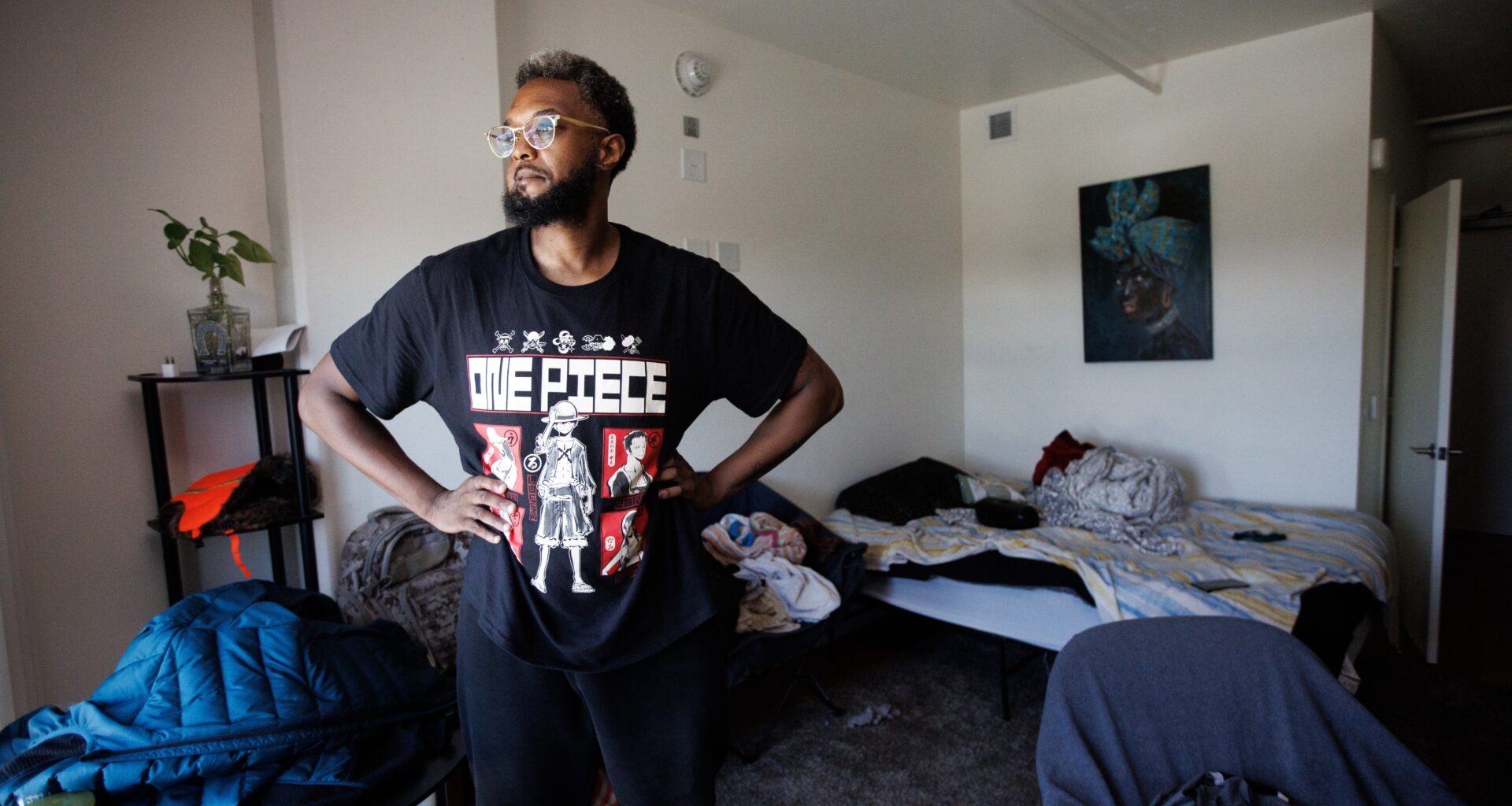
When Tyree McCary moved to the Bay Area two years ago to be closer to friends and family, he knew he needed a housing plan. The Fresno native and anime superfan called a homeless shelter in San Jose to ensure there would be a spot for him when he arrived.
After months in the crowded shelter, sleeping on a bunk bed alongside dozens of other unhoused men, opportunity would indeed arrive.
A case manager told McCary that a sleek apartment complex with 99 affordable units was opening near Happy Hollow Park & Zoo. In January, he took a studio apartment on the sixth floor with sweeping views of the Diablo Range.
His rent? $0 per month for two years.
McCary’s apartment is among thousands newly built in a wave of affordable housing construction in San Jose and Oakland as the cities use voter-approved bond measures to lure developers and jumpstart construction. Low-income housing production nearly quadrupled in San Jose from 2023 to 2025. In Oakland, that rate more than doubled in that time, and the city is on track to break a record this year.
City officials and housing advocates agree that the Bay Area remains far from affordable for people with low and even moderate incomes, and the region’s largest cities are lagging behind state government goals for affordable housing construction. Still, they heralded the influx of affordable units as a sign of positive momentum.
Officially, cities are expected to have built 38% of the state’s decade-long targets for new housing production, known as the Regional Housing Needs Allocation, by now. Both cities are behind the pace: San Jose clocks in at 22% for low-income homes, and Oakland at 16%.
“It is very exciting to see progress in a lot of key jurisdictions,” said Louis Mirante, senior vice president of public policy at the Bay Area Council. “But just because we’re seeing progress doesn’t mean we’re making enough progress.”
New units are just one slice of the suite of solutions needed to make the Bay Area affordable again. More market-rate housing, rental assistance and preservation of existing affordable housing all contribute to a healthier housing market. However, construction of more affordable housing is critical to solving the region’s thorny housing crisis, advocates and experts said.
“Production is really important. We don’t have enough affordable housing. We need more,” said Ryan Finnigan of the UC Berkeley Terner Center for Housing Innovation.
About 950 units for people with low incomes were built last year in San Jose, where thousands of low- and middle-income residents are priced out of a housing market flush with Silicon Valley cash and investment income. The city also issued building permits for nearly 1,270 units for low-income residents, state data shows.
That’s a sizable uptick. Just 30 units for low-income people were built in the city in 2018, when the state’s data collection began. Even so, San Jose was home to roughly 6,500 homeless people in 2024, the most recent count.
“It’s a sign that we’re making progress,” San Jose Mayor Matt Mahan said in an interview. “We still have a pretty foundational challenge with our housing market.”
In Oakland, where gentrification and displacement have pushed Black residents into homelessness at disproportionately high rates, officials set a record in 2025 by bringing nearly 700 low-income units to completion, city data shows.
“Low-income” housing is a broad range. In practice, new developments are built for residents with specific incomes.
On the upper end are residents who earn less than 80% of an area’s median income. In Oakland, that’s about $95,000 per year for a single person — a reflection of the major income inequality in the Bay Area, where tech has brought astronomical levels of wealth to a small share of residents, putting upward pressure on housing costs.
Toward the bottom of the income range is an “extremely low income” resident who earns less than $36,000 per year in the East Bay. In Oakland’s strategy, hundreds of new units are slated for completion in Oakland specifically for homeless people — a response to the ongoing homelessness crisis, said city Housing & Community Development Director Emily Weinstein.
Weinstein credited much of the new construction to Measure U, an $850 million bond measure for streets and affordable housing approved by Oakland voters in 2022.
That measure started to move the needle last year, Weinstein said, allowing Oakland to help fill funding gaps that might have otherwise thwarted new builds. As of May, Oakland had doled out nearly $250 million in Measure U funds, according to a city report.
In May, Oakland Mayor Barbara Lee and others celebrated the completion of a new, 76-unit affordable housing development in the city’s Fruitvale neighborhood that includes a health clinic geared toward Native American residents.
Rent in the new five-story building, Flicker Bird Homes, is subsidized for those earning no more than 60% of area median income, or about $71,000 for a single person. Oakland contributed about $22 million in Measure U funds toward the project.

An exterior view of The Charles, a 99-unit apartment complex for low-income and formerly homeless people, is seen on Wednesday, Aug. 5, 2026, in San Jose, Calif. (Dai Sugano/Bay Area News Group)

An interior view of resident Tyree McCary’s apartment unit at The Charles, a 99-unit apartment complex for low-income and formerly homeless people, Aug. 5, 2026, in San Jose, Calif. (Dai Sugano/Bay Area News Group)

The bathroom inside resident Tyree McCary’s apartment unit at The Charles, a 99-unit apartment complex for low-income and formerly homeless people, Aug. 5, 2026, in San Jose, Calif. (Dai Sugano/Bay Area News Group)

Resident Tyree McCary’s apartment features an electric range at The Charles, a 99-unit apartment complex for low-income and formerly homeless people, Aug. 5, 2026, in San Jose, Calif. (Dai Sugano/Bay Area News Group)

A patio area features benches and a barbecue grill at The Charles, a 99-unit apartment complex for low-income and formerly homeless people, on Wednesday, Aug. 5, 2026, in San Jose, Calif. (Dai Sugano/Bay Area News Group)

A laundry room at The Charles, a 99-unit apartment complex for low-income and formerly homeless people, on Wednesday, Aug. 5, 2026, in San Jose, Calif. (Dai Sugano/Bay Area News Group)

Newsletters for residents are displayed at The Charles, a 99-unit apartment complex for low-income and formerly homeless people, on Wednesday, Aug. 5, 2026, in San Jose, Calif. (Dai Sugano/Bay Area News Group)

Mailboxes at The Charles, a 99-unit apartment complex for low-income and formerly homeless people, on Wednesday, Aug. 5, 2026, in San Jose, Calif. (Dai Sugano/Bay Area News Group)

Janitor Gorge Rojas cleans windows in a common area at The Charles, a 99-unit apartment complex for low-income and formerly homeless people, on Wednesday, Aug. 5, 2026, in San Jose, Calif. (Dai Sugano/Bay Area News Group)
Show Caption
1 of 9
An exterior view of The Charles, a 99-unit apartment complex for low-income and formerly homeless people, is seen on Wednesday, Aug. 5, 2026, in San Jose, Calif. (Dai Sugano/Bay Area News Group)
In San Jose, McCary’s studio is complete with a private bathroom and kitchen. His grandmother lives nearby and swings by to cook meals on the stovetop. A self-described homebody, he bought a big TV and a subscription to the anime streaming platform Crunchyroll when he moved in at the beginning of the year, he said. He also bought himself binoculars to take in the expanse of San Jose from his broad windows.
Thanks to a city rehousing program, McCary said he pays no share of his income toward rent until early 2028. He and other residents in the 99-unit complex described their new homes as comfortable and quiet, with working amenities and helpful staff.
The project was built and is operated by the nonprofit Charities Housing, said Juan Guel Jr., program manager in the Santa Clara County Office of Supportive Housing. Staff offer counseling, resume workshops, credit repair and other services to help residents find their financial footing or keep it, he said.
Just a few hundred feet away, city officials this spring began a series of operations to close the sprawling homeless encampment on Coyote Creek known as the Jungle. Developers named the new complex after Charles Preston, an advocate for unhoused people who was a fixture in the camp until his death in 2017.
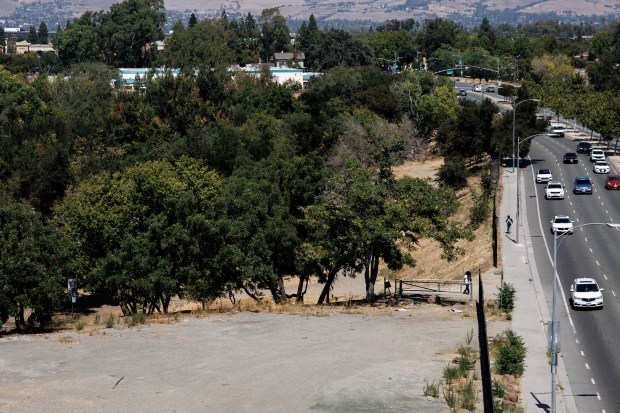 The site of the former large homeless encampment “The Jungle” is visible from The Charles, a 99-unit apartment complex for low-income and formerly homeless people, Aug. 5, 2026, in San Jose, Calif. (Dai Sugano/Bay Area News Group)
Like Measure U in Oakland, a major bond measure in Santa Clara County helped bring the project to fruition. As is typical for affordable housing construction, service providers and local governments split the $87.5 million cost of developing the new complex along the banks of the creek near the Jungle, said Chelsea Muller, a spokesperson for Destination Home. That included a $12.5 million allotment from Measure A — just a fraction of that $950 million bond for affordable housing approved by voters in 2016.
About $402 million of Measure A funding has been awarded to 39 affordable developments totaling more than 4,000 units in San Jose alone, according to county data. That includes nearly 1,000 supportive housing units already in operation.
Countywide, Santa Clara County surged past its targets for affordable housing built with Measure A support. The county planned for 4,800 new homes, but more than 5,700 have been built or are in development, county data shows. Of those, about 2,420 units have already been built.
“We are building lasting affordability and real pathways for residents transitioning out of homelessness,” Santa Clara County Executive James Williams said in a statement.