
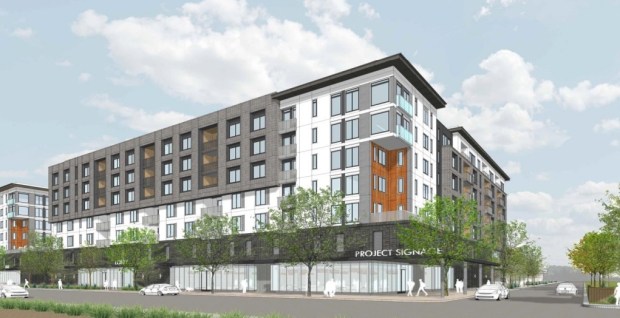
 Workforce housing development at 760 Hillsdale Avenue in San Jose, seen in an image concept. (San Jose Unified School District)
SAN JOSE — School officials are pondering two distinct approaches to create housing in San Jose for teachers and staffers: buy a housing tower or develop homes from the ground up.
Under one option being floated by the San Jose Unified School District, a 288-unit apartment complex would sprout at 760 Hillsdale Ave., a start-from-scratch project next to SJUSD’s seven-building Silicon Valley Education Campus.
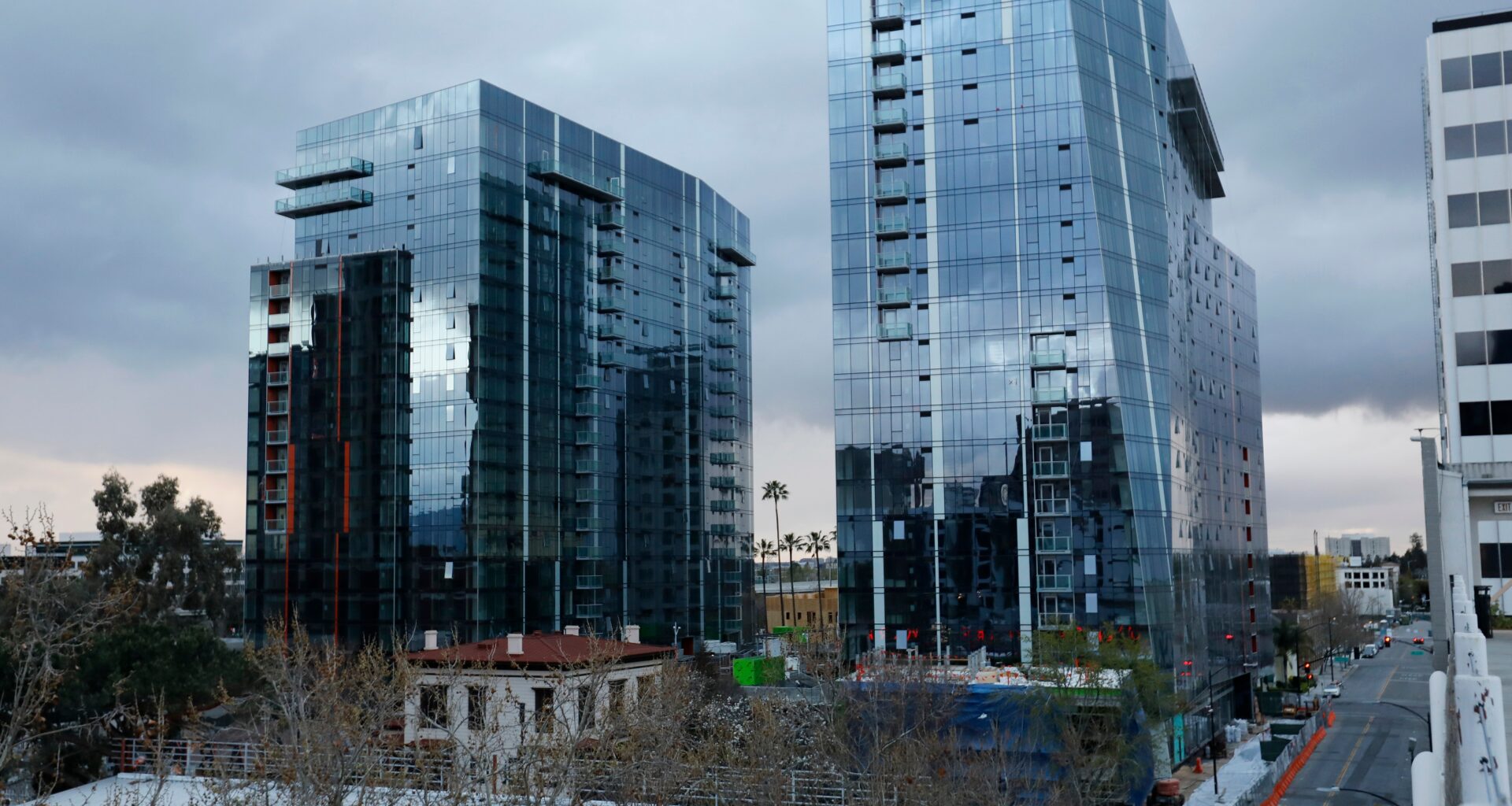
The school district has also begun to craft a plan to buy a downtown San Jose residential tower next to bustling San Pedro Square.
Creative solutions to the housing challenges for the school district are essential, in the view of Renata Sanchez, president of the San Jose Teachers Association.
“Housing and the affordability crisis in the Bay Area are among the reasons we lose staff every year,” Sanchez said. “We lose a lot of teachers every year. People can’t make ends meet.”
San Jose Unified School District administrators are weighing whether to buy the 337-unit eastern tower at 188 West St. James St. at North San Pedro Street. The east tower is next to a 303-unit tower at the same address.
Machine Investment Group, a real estate firm, is attempting to sell the condominiums in the western tower. The eastern tower that has drawn the school district’s attention has never been occupied and remains empty.
“We have a fiduciary duty to the taxpayers to see if a purchase of the property can happen for considerably less than the cost of ground-up construction,” said Seth Reddy, the school district’s chief business officer.
These efforts are happening at a time when the district and its teachers, who by definition are natural antagonists, appear to be acting in a more collegial fashion toward each other, according to a post on the teacher’s association website.
“San Jose Teachers Association and San Jose Unified School District were once bitter enemies but have grown to become collaborative partners,” the union states in a web post.
San Jose Unified employs more than 2,700 people. This means the 337 condos in the east tower could accommodate 12.5% of the district’s workers.
“A purchase of the building could be completed four years sooner than a new development,” Reddy said. “It could mean that more great teachers, great custodians, great staffers, and great bus drivers could stay with us.”
If pursued, the deal would mark one of the region’s more ambitious attempts by a school district to address the housing crisis for educators and staff.
“The district is really thinking outside the box,” Sanchez said. “The SJTA and the other unions have been trying to find a solution for 10 years. I don’t want to get too far ahead of myself, but I’m cautiously optimistic.”
The district has hired CBRE, a commercial real estate firm, to evaluate the property and help determine whether a purchase should move forward.
CBRE would assess the tower’s fair-market value, help craft an acquisition strategy, recommend a price, and prepare a timeline for a possible purchase, school district documents show.
In 2025, Machine Investment gained ownership of the 640-unit double-tower complex through a foreclosure that valued the property at $181.9 million. That would work out to roughly $284,200 per condo.
The potential deal comes after voters in November 2024 approved Measure R, which authorizes San Jose Unified to issue $1.15 billion in bonds over 30 years for facilities improvements.
An estimated $283 million of that amount could be used to create housing for school district staffers.
“If we buy the property, we would do it with general obligation bonds,” Reddy said. “Then the rent payments would be used to cover just the operating costs of the property. We want the rents to be as low as possible for our employees.”
What is certain is that the district won’t pursue both a new development at 760 Hillsdale or the tower purchase at 188 West St. James. The options are one or the other but not both.
“No decisions have been made, but we have an obligation to pursue all possibilities,” Reddy said.
Sanchez, whose mother and grandmother were teachers in the Central Valley, recalls long-gone times when owning a house was much more within reach compared with today.
“They both were able to live the American dream on a teacher’s salary,” Sanchez said. “That is a reality I will never be able to experience due to the affordability crisis in the Bay Area. I don’t even have enough of a savings account for a down payment. Over half of my take-home pay goes toward housing.”
Sanchez has two master’s degrees and is a National Board Certified Teacher, along with being a graduate of Stanford University. That might not always be enough for home ownership in the Bay Area.
“The school district employs a lot of folks who come here from an international location and are on work visas or might not have social security numbers,” Sanchez said. “They have roommates, they rent garages, or they sleep on people’s sofas.”
A purchase of the housing tower could be a game-changer, especially if a viable deal comes together in the not-too-distant future, according to Sanchez.
“Having the possibility of relief just around the corner is something that would be very exciting and life-changing for people,” Sanchez said. “It can make a meaningful impact for our staff.”