
Bay Area voters, threatened with a transportation apocalypse if they don’t approve a billion-dollar-a-year sales tax increase for public transit, should just say no.
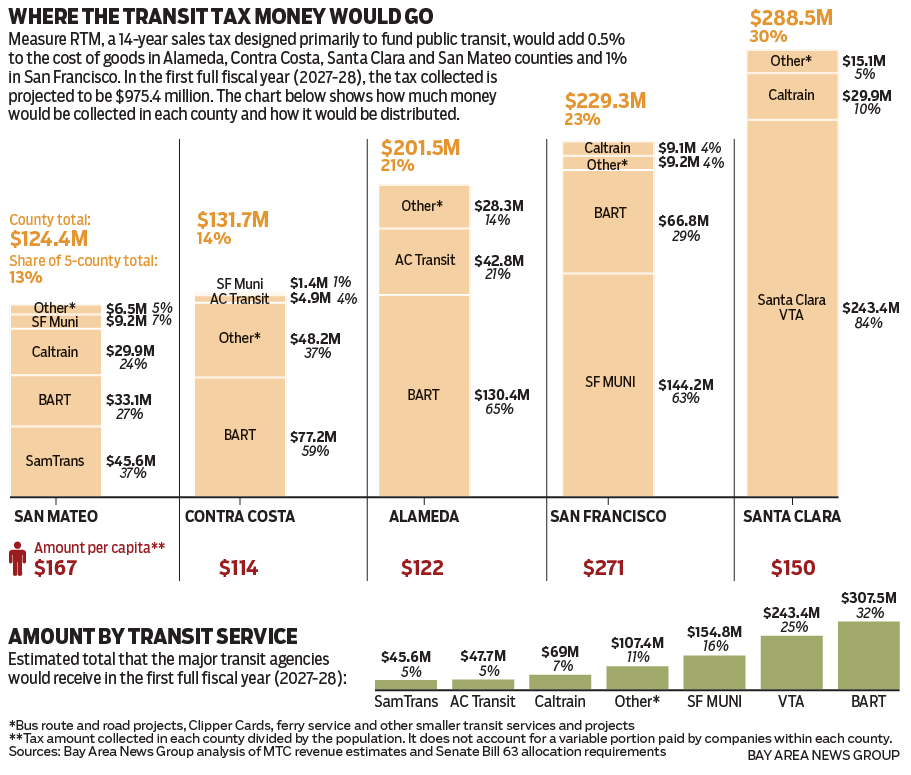
Measure RTM on the Nov. 3 ballot would add 0.5% to the cost of goods for the next 14 years in Alameda, Contra Costa, Santa Clara and San Mateo counties and 1% in San Francisco.
Opposing the initiative is not a vote against public transit. It’s a demand for responsible financial management.
BART, the top beneficiary, serves about half as many passengers as before the pandemic. Yet it keeps running the same number of trains and its operating expenses, after inflation adjustments, remain the same.
In other words, rather than right-sizing service, BART leaders have accelerated toward a fiscal cliff. Instead of tapping the brakes, they are banking on voters to extend the revenue runway. Measure RTM would enable BART to continue spending at about its current irresponsible pace.
Meanwhile, the South Bay faces a very different situation. Ridership for Santa Clara Valley Transportation Authority reached 82% of pre-pandemic levels in fiscal year 2025-26.
VTA, the second-largest beneficiary in Measure RTM, already receives an exceptionally high taxpayer subsidy. Santa Clara County residents currently pay five transportation sales taxes for transportation. And budget forecasts for VTA show it doesn’t need another one.
If BART and VTA leaders want more taxes, they should wisely manage what they have and put forth reasonable plans. Measure RTM isn’t that.
The initiative would increase sales tax rates above 10% in at least 50 of the 69 cities in the five affected counties. Residents in at least seven of those cities would pay above 11% total sales tax — a mark reached nowhere else in California except Los Angeles County.
After tax-collection expenses, Measure RTM would bring an estimated $975 million in the first full fiscal year, 2027-28, for transportation. Of that, about 32% would go to BART and 25% to Santa Clara VTA, according to our analysis. Most of the rest would be divided between San Francisco’s MUNI, Caltrain, AC Transit and SamTrans.
Imposing another regressive sales tax is not the answer to a self-inflicted funding crisis. Vote no.
Manufactured BART crisis
The debate over more tax funding for BART essentially reduces to whether the transit agency should trim service to match demand or maintain current service in hopes of increasing ridership to pre-pandemic levels.
The latter is a pipedream.
The pandemic changed the region’s commute patterns for the foreseeable future, and perhaps permanently — especially along the transbay corridor on which BART so heavily depends for riders.
But BART leaders continue to exacerbate their financial predicament by maintaining the status quo. Train miles, after subtracting out service to two new South Bay stations, are unchanged from pre-pandemic levels. Operating expenses, after adjusting for those new stations and inflation, have increased by about 2%.
Measure RTM would effectively enable BART to continue pre-pandemic service levels, according to the agency’s five-year forecast.
BART says it has high fixed costs, making it hard to trim back service levels to balance the budget. But labor expenses account for two-thirds of its operating budget.
Agency officials threaten to close lines and shut stations if the measure fails. A spokesperson says BART examined alternatives, but she declined to provide a copy of the analysis.
If BART wants more tax revenue despite reduced ridership, it should first show good-faith effort to meaningfully trim ongoing expenses. It has refused to do so.
VTA searches for a need
Whereas BART claims it faces a “fiscal cliff,” VTA confronts no such crisis. Its 10-year projection shows it won’t exhaust operating reserves for at least two years and won’t have a meaningful shortfall until fiscal year 2029-30. Even then, the shortfall would be less than half the money it would collect from the proposed sales tax increase.
Simply put, this is not an agency in need of more money for operations. Which helps explain why, as an Aug. 28 staff memo makes clear, VTA has no concrete plan for how it would spend the new money.
As it is, Santa Clara County residents already pay five transportation sales taxes totaling 1.75%, including 0.125% dedicated to Caltrain. Measure RTM would increase the total to 2.25%.
However, unlike Measure RTM money for BART that would be restricted to operations, VTA could spend its share on any “public transit expenses” — operations or capital.
Which brings us to VTA’s biggest capital project — the ill-fated 6-mile, four-station BART extension through San Jose, for which the cost estimate more than doubled in three years.
The county civil grand jury has sharply criticized the authority’s management of the project and VTA’s own auditor general has called out agency attempts to hide the cost increases.
To fund the extension, now priced at $12.8 billion, VTA plans to tap two of the county’s five existing transportation sales taxes to provide $5.1 billion in funding. That’s $502 million more than the prior local-share estimate, which leaves less for other projects.
VTA insists it would not use Measure RTM funds for the BART extension, but it could legally do so. Or it could backfill existing sales tax revenues diverted to the extension — in essence indirectly using Measure RTM money to subsidize the BART project.
Faux oversight
Backers insist Measure RTM includes meaningful oversight and accountability to ensure Bay Area transit agencies, especially BART, avoid future fiscal crises.
In the ballot guide mailed to voters, arguments in favor of RTM, while different in each county, all claim the measure has “strong accountability and oversight that requires large transit agencies to show cost savings to continue to receive dedicated operating funding.”
Actually, the financial efficiency provisions do not even apply to VTA and, for the others, are riddled with loopholes.
Those provisions, which apply only to BART, AC Transit, MUNI and Caltrain, would be overseen by a committee rife with conflicts of interest: Four of nine committee members are from the transit agencies under examination — think fox guarding the henhouse — and a fifth member used to work at BART and MUNI.
The law governing Measure RTM allows the four transit agencies to reject any recommendation they deem has “an unacceptable impact on transit service or safety or is inconsistent with other documented local policies and procedures.” In other words, the recommendations are essentially voluntary.
And while the law purportedly seeks cost-savings, it discourages cuts to service below pre-pandemic levels. “The Legislature finds and declares that it is beneficial for transit operators to increase the service hours of transit service they are providing …,” the law states.
History suggests that BART, the agency arguably most in need of reform and right-sized service, would resist voluntary efficiency oversight, especially considering the law’s declared intent to increase service hours.
The last time the Legislature and voters tried to impose oversight of BART was in 2018. A voter-approved Bay Area bridge toll increase, which allocated BART an additional $1.1 billion, called for an inspector general to oversee the agency’s expenditures and operations.
But BART directors and staff quickly demonstrated they had no intention of letting the new auditor do her job. They obstructed her attempt to conduct independent oversight and eventually drove her to resign.
Disrespecting voters
In sum, Measure RTM is a regressive sales tax that would reward BART for its failure to make needed cuts and provide a windfall for VTA that could be diverted to the ballooning South Bay BART extension project.
The measure would further drive up the region’s cost of living without providing the oversight that backers tout in ballot arguments.
There is no doubt that Bay Area public transit took a hit during the pandemic. Each of the major transit systems reacted differently — some responsibly and some not.
To lump the systems into one giant ballot measure, regardless of funding needs, was disrespectful to voters. Many Bay Area residents already struggle to make ends meet; they should not be asked to pay more taxes to those agencies that fail to maturely manage their budgets.
As for the two largest recipients, until BART begins to transparently right-size its operation and VTA demonstrates a need for new funding, neither deserves more money. Vote no on Measure RTM.