
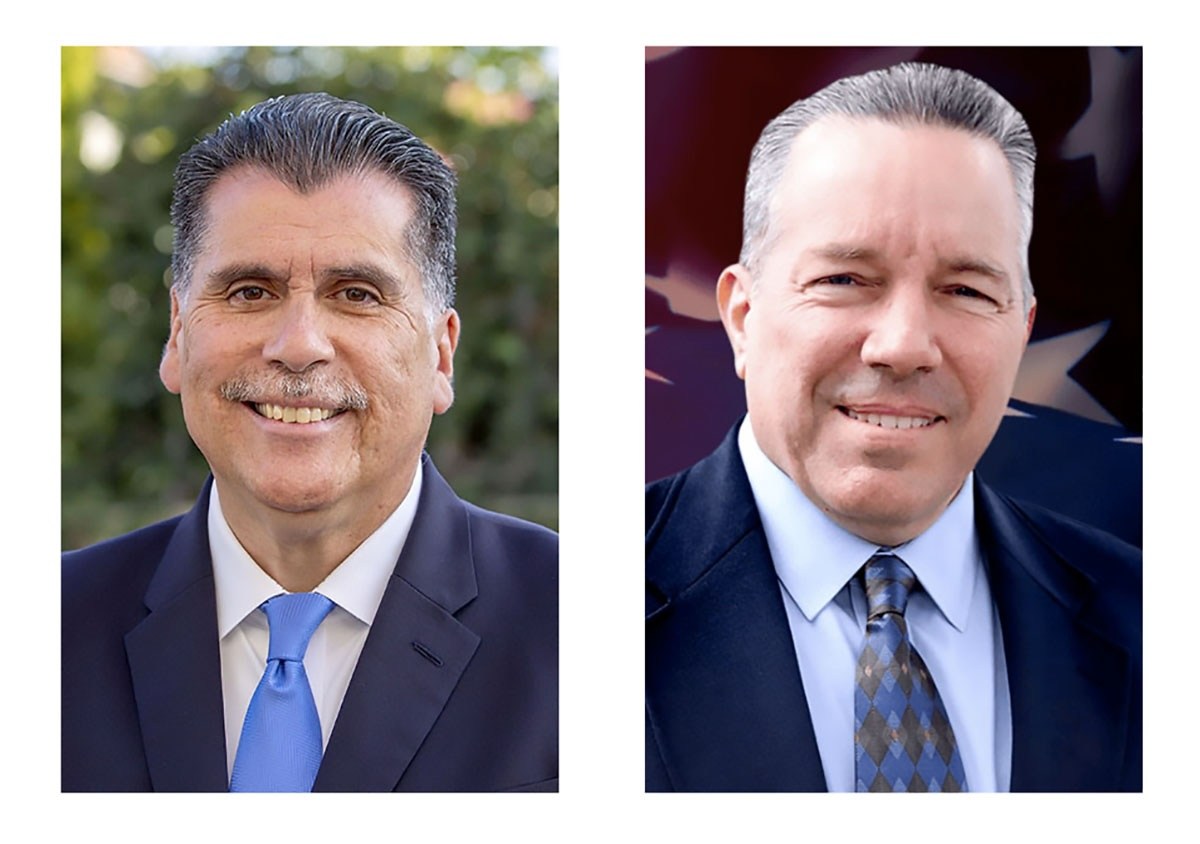
As Los Angeles County Sheriff Robert Luna runs for re-election in November, he has a familiar opponent: Former Sheriff Alex Villanueva.
Luna became sheriff in 2022 by easily handling Villanueva, 61.3% to 38.7%.
One of the main issues in this race revolves around the relationship between the sheriff, who is an elected office holder, and the Board of Supervisors, which sets his department’s budget and has power over issues affecting the department, such as the Board’s desire to close Men’s Central Jail (MCJ) run by the department.
Equally tied to having a working relationship with the five also elected members of the Board of Supervisors is the issue of dealing with deputy gangs or cliques that have been accused of brutalizing inmates, arrestees and intimidated sheriff deputies who don’t want to join. These in-house deputy cliques have identified by wearing the same tattoos and have gone by monikers such as: “the Banditos,” “the Executioners” and “the Cavemen.”
In the issue of Sheriff-Board relations, there is a stark contrast between the two, especially from responses to a Southern California News Group questionnaire, as well as from public testimony before the Board of Supervisors and past events.
In short, during Villanueva’s tenure from 2018-2022, he battled with the board and challenged the Office of Inspector General (OIG) and the board’s Sheriff’s Department Civilian Oversight Committee (COC) — both with oversight powers over the Sheriff’s Department.
Luna, 60, has demonstrated a working relationship, regularly appearing before the board to talk about budgets and eliminating deputy gangs, while also meeting with the Inspector General and the COC on a regular basis, he said.
In the not so distant past, Villanueva, 63, feuded with the supervisors, consistently using anti-board rhetoric. That continued in 2024 when he ran and lost in the primary trying for a board seat but failing to replace Supervisor Janice Hahn.
In responses to the question of working with the board, the two spoke of getting along as a priority.
Villanueva said he was looking forward to “working with the new Board of Supervisors that will be seated in December.” He may have been referring to Hilda Solis leaving the board after being termed out. But she is being replaced by State Sen. Maria Elena Durazo, who easily won the seat in the June primary. He wrote that he would send “a clear message to the board to work with me toward common-sense solutions that benefit the entire community.”
The board will expand to nine members starting after elections in 2032, according to changes put in place with the passage of Measure G in November 2024.
With regard to board relations, Luna said:
“My opponent … brought scandal and dysfunction to his office and created division within the county government, putting public safety at risk. I have working relationships with all five supervisors, who have all endorsed me, along with the CEO, county departments and our other government partners. We do not always agree, but we communicate and work together to solve problems.”
From 2018 to 2023, Villanueva ignored subpoenas to appear before the Civilian Oversight Commission to discuss deputy gangs. He only agreed to testify after being ordered to do so by Superior Court Judge Anne Richardson. The sheriff during his stormy tenure and after, denied allegations he protected deputy gangs while in office.
He often told the media that there were no deputy gangs in his department. He came close at one time, describing the cliques as people who at times “engage in misconduct.” A Rand Corp. report in 2023 found that 15% to 20% of LASD deputies join gangs.
Recently, Luna spoke at length about the problem in a public Board of Supervisors meeting, as part of a motion by Supervisor Holly Mitchell to ascertain a list of deputy gangs or cliques and from what stations they operate. That motion was placed on hold.
Before the postponement, Luna did something that Villanueva never did: Say these deputy gangs do exist. “I recognize the serious issue deputy gangs pose to our department and the community that we serve,” Luna told the board earlier this year.
While Mitchell was concerned that Luna had promised when elected to eradicate them but they still existed in 2026, Luna said he is working with the OIG and the Inspector General on a regular basis to tackle the problem and change the culture of the department.
He told the board all new deputies sign a pledge they will not join a deputy gang or they will be fired. He also created the Office of Constitutional Policing, headed by lawyers familiar with excessive force issues. The Office does investigations into incidents, and turns that over to the Department of Internal Affairs.
Villanueva tangled with the board after it placed a measure on the ballot allowing for the sheriff to be fired for cause by the board. Two years ago, he sued the county for more than $25 million in damages following his placement on a “do not rehire” list for alleged discriminatory remarks aimed at Inspector General Max Huntsman.
On the issue of reducing monetary payouts for deputy misconduct, Villanueva blamed the payouts on simply talking about deputy gangs in the Sheriff’s Department, saying when there is a case about excessive use of force, the plaintiffs begin “claiming they were assaulted by a deputy gang member. This raises the cost of litigation and taints future jury pools.”
Luna said to cut down on officer-involved traffic collisions, which can result in costly payouts, the department has added enhanced lighting and a new siren that provides the driver on the road better ways to see and hear a police car during an emergency response. Young deputies can get more experience at a new vehicle training center in Castaic, he said.
On excessive use of force, incidents have been reduced by 25% in the department since he took office, Luna said.
On the closure of MCJ, both are in agreement that a replacement facility should be built to handle those convicted felons in custody and to treat those inmates with mental health and substance abuse problems. Simply closing the jail without a replacement facility is a bad approach.
Villanueva said: “Pushing 4,500 dangerous felons into the community and crowding the most dangerous into facilities not designed for high-security inmates will result in tragedies both in and outside of the jail system.”
Luna wants the county to support his idea of building a “Correctional Care Facility” first, then closing MCJ.
“Men’s Central Jail is outdated and needs to be replaced. I support closing it, but closing it without an appropriate replacement is not acceptable to the communities we serve. The responsible approach is to create the capacity necessary to safely house and care for those remanded to our custody and then close Men’s Central Jail,” Luna said.
Election day is Tuesday, Nov. 3, but mail ballots are already being delivered.