
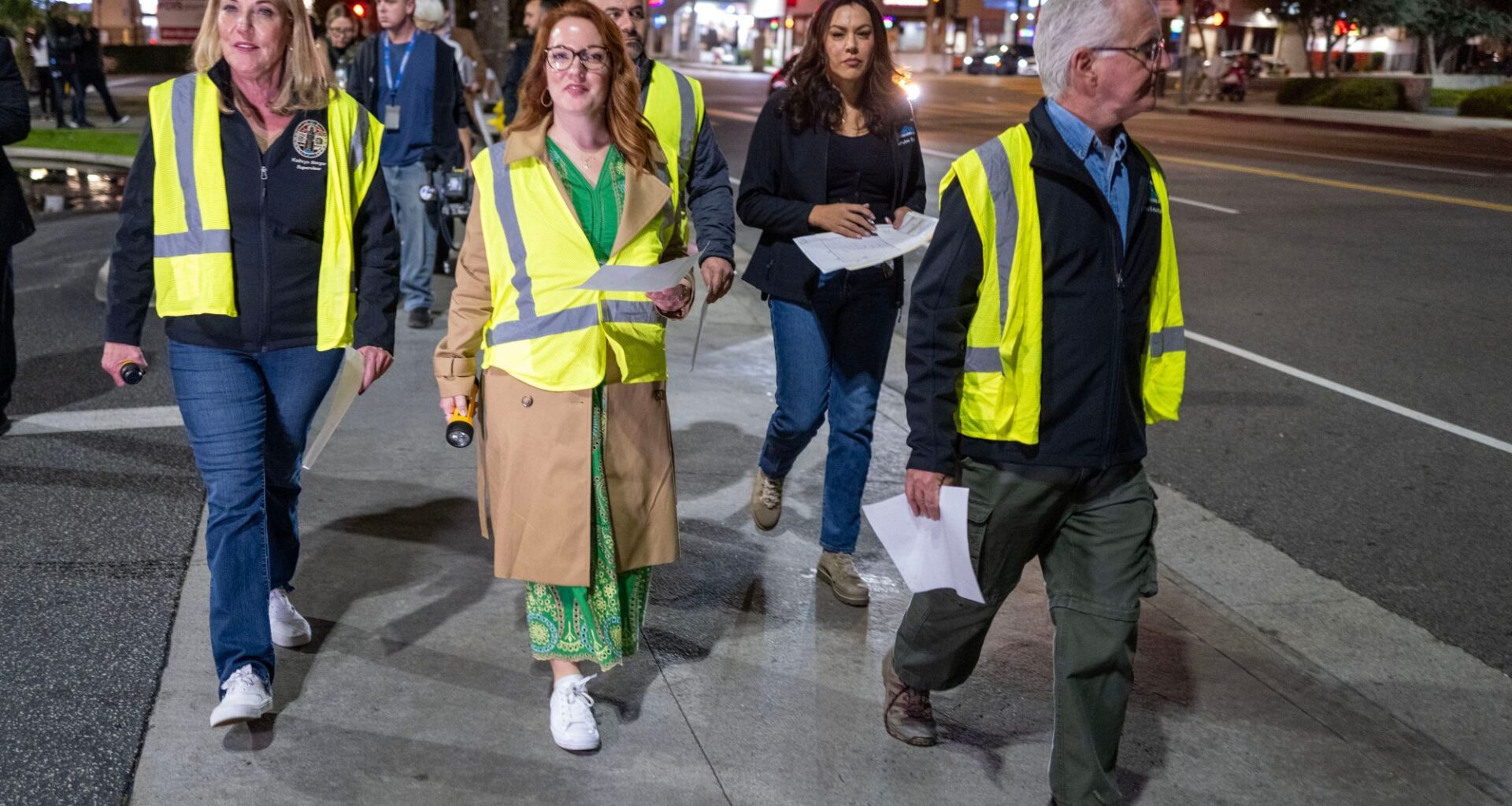
Los Angeles County will be responsible for running the annual homeless count starting in 2028, and also will take the lead on applying for federal funding grants, according to a vote by Los Angeles Continuum of Care members in downtown L.A. on Tuesday, Oct. 13.
Individual members of the L.A. CoC, a collection of government homeless service agencies, nonprofit providers, the county and city of L.A., voted 310 to 9, with 12 abstentions, to give those functions to L.A. County. There was no other applicant.
The vote marks the transfer of two long-held functions from the troubled Los Angeles Homeless Services Authority (LAHSA) to L.A. County, specifically to the county’s Homeless Services and Housing Department (HSH). The changeover marks a sea change in the administering of homeless services in the county.
“HSH applied because we have the capacity and expertise to do the job,” testified Sarah Mahin, HSH director during the meeting of the LA CoC.
LAHSA should continue and perform the next homeless count, tentatively set for January 2027, and work on tallies through the end of the fiscal year, June 30, 2027. HSH will run the point-in-time count in January 2028, county officials reported.
LAHSA has run the count and been the lead on federal dollars since the joint powers agency made up of the city Los Angeles and L.A. County was established by court order in 1993 to address the growing problem of homelessness on the streets of the city of L.A., the county and 84 other cities within the Continuum of Care. (The CoC excludes Glendale, Pasadena and Long Beach, who do their own homeless counts.)
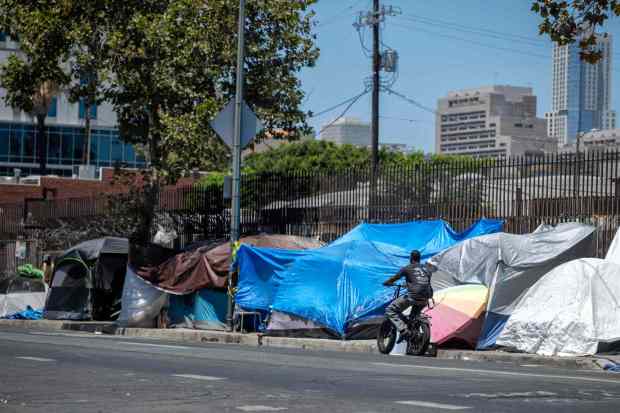 Skid Row in Los Angeles on Wednesday, July 22, 2026. The area spans approximately 50 blocks and has the highest density of homeless people in the country. (Photo by Hans Gutknecht, Los Angeles Daily News/SCNG)
Federal homeless funding in L.A. County amounts to about $240 million per year. On June 11, the U.S. Housing and Urban Development (HUD) announced it was withholding that money already allocated to LAHSA, saying the agency was using the money fraudulently, a charge it denied. If that were permanently taken away, it would remove housing from 11,423 people currently in permanent placements or shelters, LAHSA reported.
While LAHSA has sued to get that money permanently released back, a key court appearance in the matter is set for Oct. 27. By picking a new successor for HUD dollars, this could strengthen the agency’s case by informing the judge it has found a replacement.
“It would protect the LA CoC from a management vacuum that would be created if the court reinstated LAHSA’s suspension,” said Ben Kay, chair of the LA Coc Board, who led the meeting.
Kay said being the lead in the collaborative before HUD and administering the point-in-time count are important roles. One brings in money to fund shelters and housing placements. The other gives cities and the county an idea of where homeless services may be needed most. “The count is an important tool that allows policy makers and decision makers to understand how many and where the homeless are across the region, and what their responses will be,” Kay said.
But Tuesday’s expected transfer of two functions from an exiting LAHSA to the county’s Homeless Services and Housing Department (HSH) is just round one in a fight between the county and the city of Los Angeles over which government body will take over the Homeless Management Information System (HMIS), and the Coordinated Entry System (CES), the next two functions being let go by LAHSA.
While L.A. County received the recommendation from the CoC to take over all four functions forfeited by LAHSA, the city of L.A. has objected and has applied along with the county to manage HMIS and the CES functions, which track homeless individuals and match them to shelters and permanent housing, respectively. No decision has been made.
 Mayor Karen Bass answers questions during a mayoral forum addressing issues facing Los Angeles and its Jewish community at the Skirball Cultural Center in Los Angeles on Tuesday, Sept. 29, 2026. (Photo by Sarah Reingewirtz, Los Angeles Daily News/SCNG)
Mayor Karen Bass and four City Council members have made a case for controlling these two functions, saying the city spends hundreds of millions of dollars on housing but does not have sufficient authority to determine who occupies those units. About 65% of homeless in the county live in the city of Los Angeles.
Bass, along with City Council President Marqueece Harris-Dawson and Councilmembers Ysabel Jurado, Tim McOsker and Imelda Padilla said the city should retain a role in decisions about homelessness programs and housing placements.
“The city must be able to help the people on our own streets by placing them into the housing that we build and fund in order to solve the homelessness crisis,” they said in a statement.
Meanwhile, county officials were appreciative of the vote for transfering the count and overall authority over funding from U.S. Housing and Urban Development. However, that is only part of a broader county strategy to take over the next two homeless tracking functions and thereby consolidate homeless programs under its new homeless department.
The city of L.A. has a different view.
“The current proposal for county-only administration, recommended by the LA CoC Board, leaves no room for those voices to be heard,” the mayor and council members said. “Without collaboration and transparency, management of this complex issue will continue to falter, and worse, our unhoused neighbors will continue to suffer.”
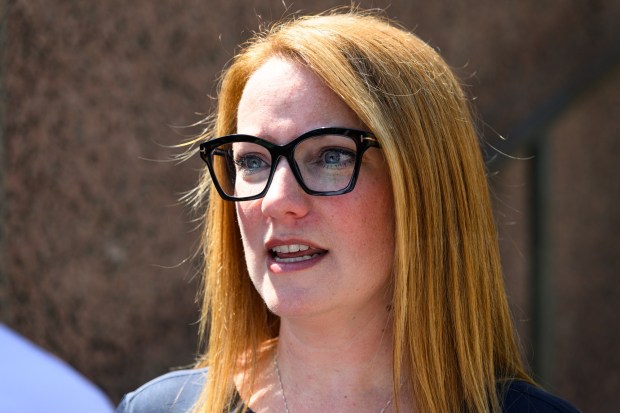 Los Angeles County Supervisor Lindsey Horvath speaks outside the Kenneth Hahn Hall of Administration on Monday, Aug. 31, 2026, about the county lawsuit against State Farm Insurance over mishandling of claims related to the Palisades and Eaton fires. (Photo by Jacob Lewis, Contributing Photographer)
Supervisor Lindsey Horvath, who led the way in the creation of HSH, said the county, its unincorporated communities and the municipalities within the county deserve to be a part of the process and have their voices heard. Many cities felt ignored under LAHSA.
“Los Angeles County is prepared to partner with every city in the county, listen to their concerns, and work toward solutions that address them,” Horvath said in her statement. “We have already committed to the city of LA that, at a minimum, they will maintain the HMIS and CES access they currently have working with LAHSA, and we will continue working with all communities to improve the effectiveness of all functions in the Continuum of Care.”
Meanwhile, most of the public testimony favored L.A. County taking the lead in the first two areas.
“L.A. County can serve the 85 cities. The county is uniquely positioned to do that as a regional authority,” said Meghan Marshall, executive director of the California Interagency Council on Homelessness.
City News Service contributed to this article.