
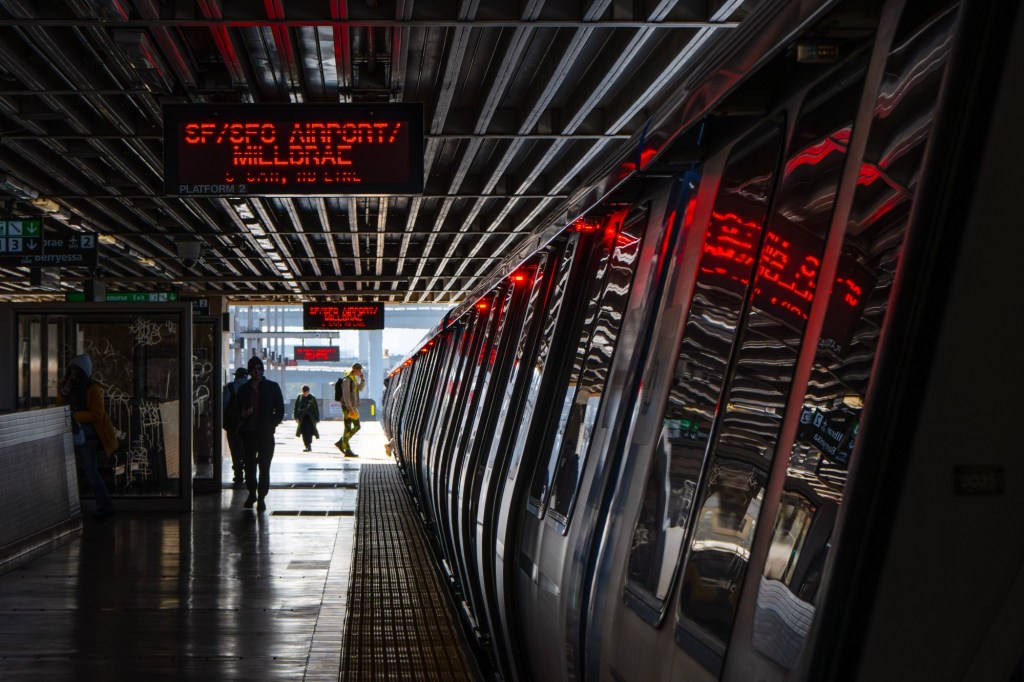
First came a systemwide BART meltdown in mid-May that ground every train to a stop. Just weeks later, twin fires damaged track lines on either side of the San Francisco Bay.
Multiple power outages, myriad equipment issues and a so-called “network storm” — essentially, a complex computer problem — again interrupted BART service throughout the Bay Area.
The spate of service disruptions over the last seven months has left Bay Area Rapid Transit reeling, with technicians scrambling to shore up the system and minimize the impact on commuters, finally using the system in rising numbers again. It’s all coming as voters may be asked to provide billions of dollars for the system and several other Bay Area transit agencies to stave off a fiscal cliff in 2027.
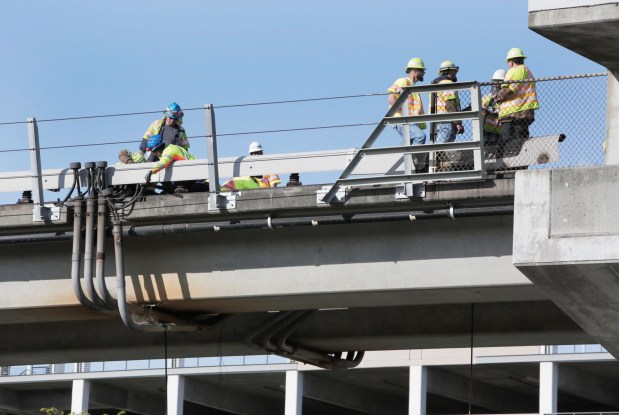 BART workers investigate the source of an early morning rail fire at the San Leandro BART station on Tuesday, May 20, 2025 in San Leandro, Calif. BART service between the Lake Merritt, Berryessa and Dublin stations was stopped at 5:45 when the fire was reported. (Laura A. Oda/ Bay Area News Group)
The latest problems surfaced Monday, when BART’s green and red lines shut down for about two hours amid power issues in San Francisco. It marked at least the fourth Monday since Oct. 20 that BART has had significant delays or interruptions to its operations.
“Just about every day there’s something going on,” said Mike Berry, of Concord, who was waiting for a train last week at the Pleasant Hill station.
BART’s Board of Directors have taken notice, with some speaking out at a meeting in October about the disruptions. Their comments came after the agency’s general manager, Robert Powers, vowed to “get to the bottom of this,” adding “we got to do better than what we’re doing right now.”
“When I look at this and all the incidents happening so close in time, I get a little worried,” said the board’s vice president, Melissa Hernandez, a former Dublin mayor and councilmember. With several BART department heads in the audience, she added: “There comes a point in time where: Do we have the right people working for BART? And that’s a question I have for myself.”
Edward Wright, a board member representing San Francisco, echoed those concerns, suggesting that “it’s taken us too long” to root out and fix systemic issues causing some of the disruptions.
“I don’t want to play into this idea that BART is not reliable — I think on the whole, we’re delivering a great service,” Wright said. But he later offered a caveat: “The degree and severity and the frequency of the major service disruptions that we’re having … is unacceptable.”
The disruptions come despite data showing BART ridership on the rise, as the agency’s leaders tout rising timeliness and consumer satisfaction scores amid ongoing recovery from the pandemic.
In October, an average of nearly 200,000 weekday riders swiped into BART’s 50-station system — a 10% increase from the same time last year, but less than half its ridership levels of 2019. Its high-water mark came on Oct. 18, when the agency boasted 150,000 trips and the highest Saturday total since the pandemic. In all, BART logged more than 5.3 million trips that month.
In addition, more than 93% of passenger trips ended with on-time arrivals from July through September, a 5 percentage point boost from the year before, BART spokesperson Alicia Trost. said The agency’s customer satisfaction rate reached 89% that same quarter, nearly 6 percentage points above the same point in 2024.
“Reliability is our brand,” Trost said. “We have to be reliable to continue to serve the region, and we have been reliable, despite this string of very public incidents.”
Minor disruptions are nothing new for BART or other major urban transit systems, with stations occasionally closed for medical emergencies, crime and occasional instances of people being hit by trains. But the nature of those delays has shifted in recent months.
On May 9, all 50 BART stations across the Bay Area shut down for nearly five hours after a network connectivity problem prevented controllers from seeing train locations on the tracks. The stoppage happened just as the morning commute swung into gear, prompting gridlock on the region’s freeways as riders scrambled into their own cars or sought rides on Uber and Lyft.
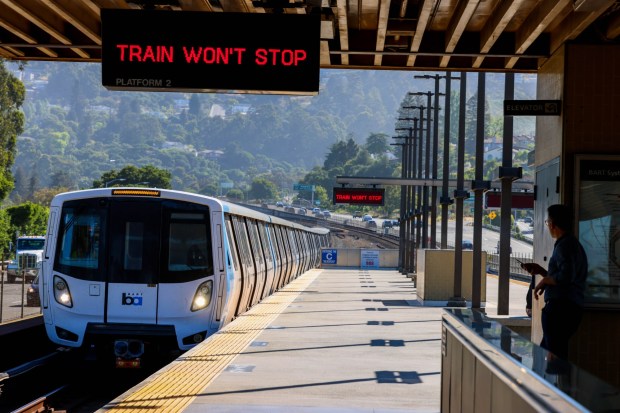 A BART train won’t stop at the Rockridge BART station due to a systemwide closure that affected all BART stations early Friday, March 9, 2025, as seen from Oakland, Calif. The train ran an inspection to verify the systemwide before carrying passengers at BART stations before 9:20 am, when the closure ended. (Ray Chavez/Bay Area News Group) (Ray Chavez/Bay Area News Group)
At the time, BART officials said the issue was not related to the age of its equipment, but rather the ability for its network devices to property connect to one another. It served as an overture for myriad issues over the following months — many seemingly without a common root cause.
Later in May, a fire near the San Leandro station shut down the agency’s green line between Lake Merritt, Berryessa and Dublin stations for a week. The first day it re-opened, another track fire across the Bay temporarily shut down service south of San Francisco.
The following month, unscheduled track maintenance caused delays for trains moving through San Francisco. Separate power issues then affected riders on the yellow and red lines in July and August — the latter causing delays for commuters on the same day that the agency unveiled its new Tap and Ride payment system.
Another systemwide shutdown ground BART’s trains to a halt on Sept. 5, when routers and switches connecting BART’s systems erupted into a feedback loop that cascaded across much of the agency. The problem — termed a “network storm” by BART — began shortly before trains began running at 5 a.m. and lingered into the afternoon.
Since then, equipment problems have caused temporary disruptions at least a half-dozen times across the system, including in the Transbay Tube, West Oakland and again along its Berryessa line.
Everyday riders voiced fatigue last week at the drumbeat of problems. While numerous commuters told this newspaper they feel safer than ever riding BART — a major concern in recent years, reaching a fever pitch after the brutal murder of Nia Wilson in 2018 — many of them appeared exasperated at the ongoing delays.
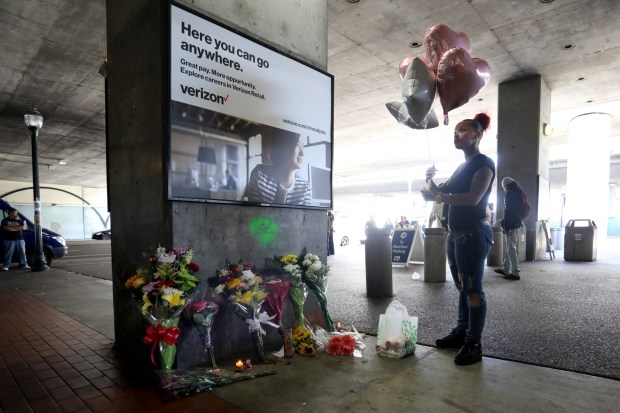 Nina Knox adds balloons to a memorial for BART stabbing victim Nia Wilson, Monday, July 23, 2018, at the McArthur BART station in Oakland, Calif.. one day after Wilson’s death. (Karl Mondon/Bay Area News Group)
Berry said he takes BART daily into San Francisco for work reasons, said: “It’s not always a major thing, but there are always 5-minute, 10-minute delays here or there.”
Jennifer Schlecter, another regular rider, lamented that BART service interruptions happen “more than I would like.”
“Reliability is a big one for me,” she said. “Would I call BART reliable? Yes. But could they be more reliable? Also yes.”
BART officials say they have taken each outage seriously. After the Sept. 5 breakdown, for example, officials brought in a team from its networking vendor, Cisco, while embarking on a massive project to help its system avoid similar problems. In addition, it’s moving major system upgrades and changes to its longer service windows — often, between Saturday nights and Sunday mornings — while positioning people at various places throughout its system to better respond to future “network storms.”
More details on work being done to address the disruptions are expected at the agency’s January board meeting, Trost said.
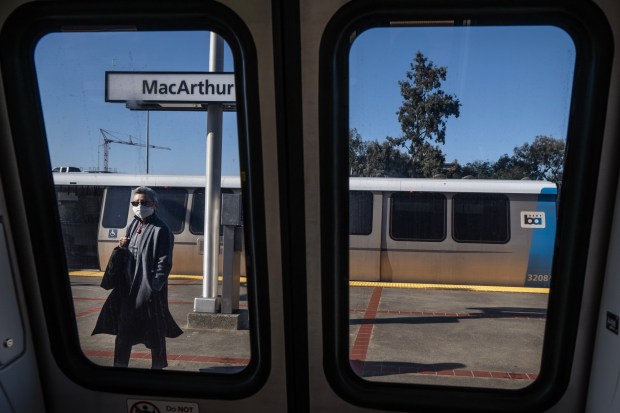 A passenger waits on the BART platform at the MacArthur Station in Oakland, Calif., on Monday, Dec. 8, 2025. (Jose Carlos Fajardo/Bay Area News Group)
Adina Levin, executive director of Seamless Bay Area, a nonprofit transit-advocacy group, described the issues as “concerning,” particularly for a region that’s so dependent on public transportation to keep its freeways passable. Still, she voiced confidence that BART officials are working hard to address the problems.
“It isn’t good but they are really taking the issue seriously — analyzing what is causing the problems and working on systematic fixes to the problems,” Levin said.
Doing so is key. The disruptions hit at an important issue for transit agencies across the nation, said Jason Henderson, a professor of transport geography at San Francisco State University. Even he has noticed students being late to his classes with greater frequency, often blaming BART issues.
“Reliability is probably the single most important variable in transportation — more important than speed and frequency,” Henderson said.
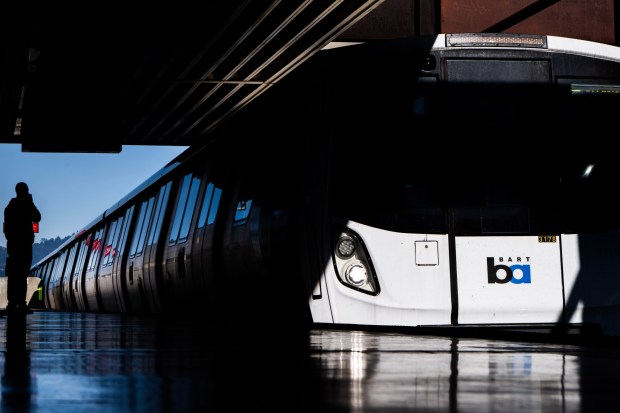 A passenger prepares to board a San Francisco bound BART train at the MacArthur Station in Oakland, Calif., on Monday, Dec. 8, 2025. (Jose Carlos Fajardo/Bay Area News Group)
Staff writer Katie Lauer contributed to this report.