
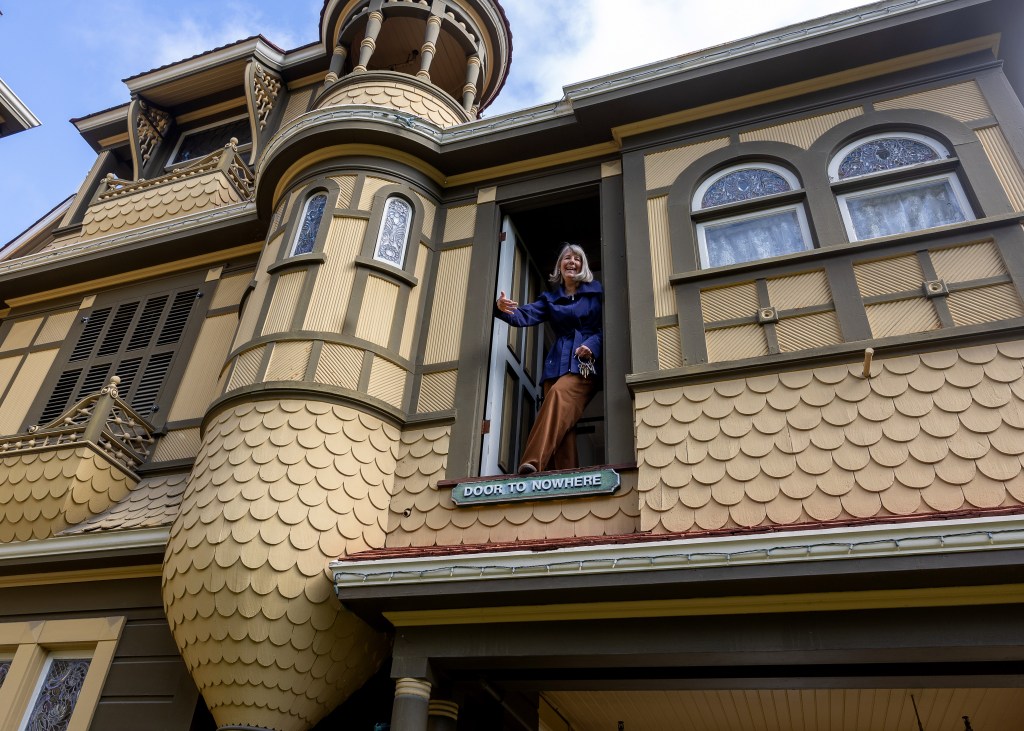
Forget ghosts. Forget seances. Forget mazelike passageways constructed to confuse vengeful spirits. The real mystery of the Winchester Mystery House is how it’s such a fascinating study in contradictions.
Though we all grew up with the supernatural legends surrounding the San Jose house, they’re simply not true. As definitively explained in South Bay author Mary Jo Ignoffo’s 2012 book “Captive of the Labyrinth,” the mansion’s namesake Sarah L. Winchester never gave any indication in her lifetime that she was haunted by any ghosts, let alone angry ones who had been killed by the rifles that her family produced. She probably never held a séance or had any interest in spiritualism at all.
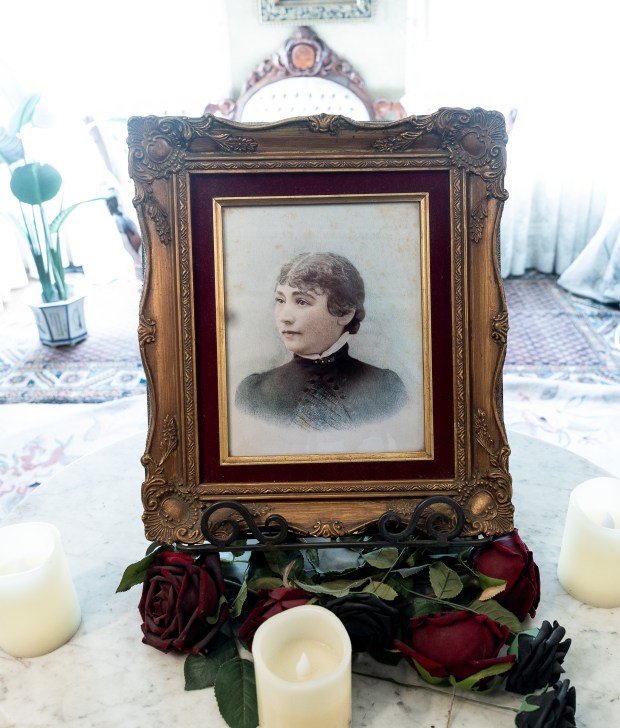 A framed portrait of Sarah Winchester stands guard at her bedroom on the second floor of the Winchester Mystery House in San Jose, Calif., Thursday, May 1, 2025. (Karl Mondon/Bay Area News Group)
Pretty much all of the spooky mythology around her started to spread around 1895, according to Ignoffo — long after she had moved to the Santa Clara Valley from New Haven, Connecticut, and begun transforming a simple two-story, eight-room farmhouse into a never-ending construction project in 1886 — and intensified after her death in 1922. First spread by distrustful locals and the San Jose newspapers (seriously, our bad), the stories were meant to paint the independent and extremely reclusive Winchester as an outsider and a freak – and later, as a means of promoting the house as a tourist attraction.
So, pretty terrible, right? Except … well, if it weren’t for those stories, there is almost zero chance that the Winchester Mystery House would still be standing a century later, allowing us to still visit this unique piece of San Jose’s past. Fake history has allowed for the preservation of real history – and considering how thoughtlessly the Santa Clara Valley’s rich heritage has been erased over the last several decades, we need all the history we can get.
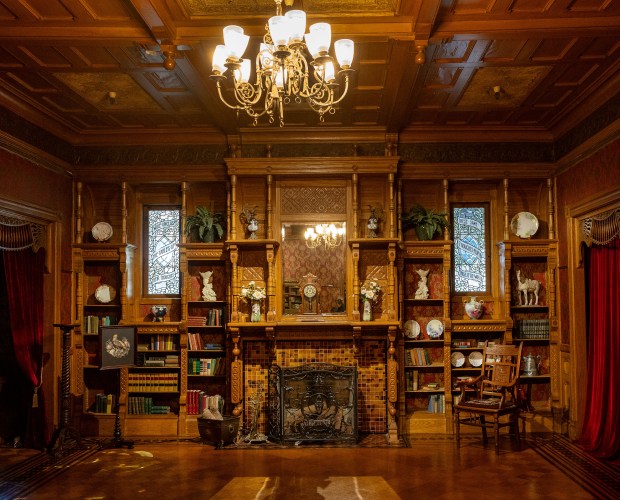 The Grand Ball Room in the Winchester Mystery House awaits visiting tourists to the famed home in San Jose, Calif., Thursday, May 1, 2025. (Karl Mondon/Bay Area News Group)
There’s another paradox that’s perhaps even more striking: Despite the focus on the house’s wild idiosyncrasies over the last hundred years, what might be most important about it now as a piece of South Bay architectural history are the ways that it wasn’t different from other homes that were being built in San Jose at the time. Those elements allow us a rare, gorgeously preserved window into what homeowners in the late 1800s were building in this area.
Because, to be honest, Sarah Winchester was a bit of a trend chaser, and the styles of the time that she went out of her way to procure tell us a lot about architecture in San Jose a century ago.
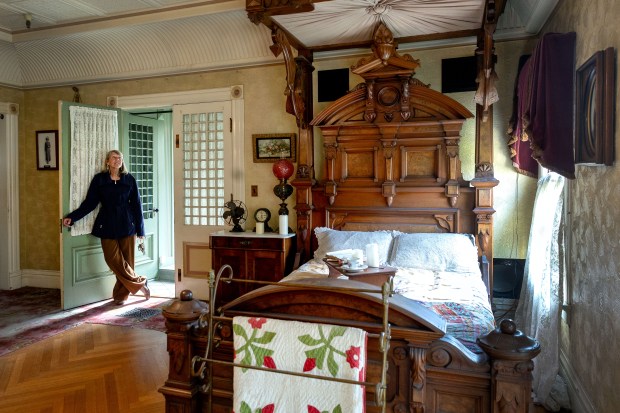 Winchester Mystery House historian Janan Boehme shows off the bedroom of Sarah Winchester on the second floor of the famed home in San Jose, Calif., Thursday, May 1, 2025. (Karl Mondon/Bay Area News Group)
“It became a pretty classic Queen Anne Victorian,” says Winchester Mystery House’s official historian Janan Boehme, noting that it falls within the American definition of the architectural style, not the British one. “Because it had, you know, the big, broad wraparound porch, the asymmetrical front — quite asymmetrical. It’s got the different textures on the different floors. It has the turrets and towers, all the finials, all the standard stuff that you have on a Queen Anne Victorian in this country. When it was at its full height and its full beauty, it was pretty elaborate.”
This was before the San Francisco Earthquake of 1906, which did a huge amount of damage to the house. Winchester’s mansion had seven stories by that time, and she was eating up the large balcony spaces she had originally designed, filling them in with new rooms and fancier woodwork.
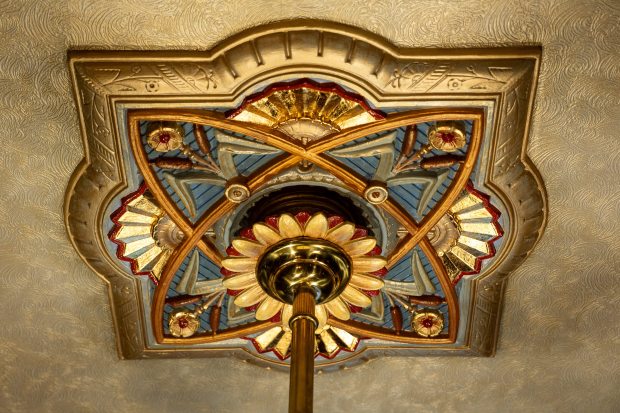 An ornate ceiling medallion graces the formal dining room at the Winchester Mystery House in San Jose, Calif., Thursday, May 1, 2025. (Karl Mondon/Bay Area News Group)
“As she was making changes, she would make them much more elaborate,” Boehme says in an interview.
A lot of that was lost in the quake, as the building was mostly reduced to four floors, though some remnants of the others remained. While you may have marveled at the stairs and doors that lead to nothing —and they are very cool — almost all of them are a result of earthquake damage, rather than eerie design. An exception to this is the famous “Door to Nowhere” near the front of the house, which was added after the earthquake and is thought to be a rather innovative solution for loading and unloading supplies to the upper floors.
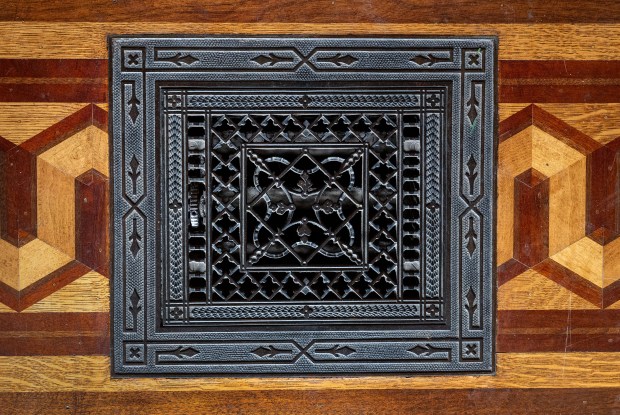 Among the intricate detail works found at the Winchester Mystery House are intricate iron floor grill works installed among elegant wood inlay flooring, Thursday, May 1, 2025, in San Jose, Calif. (Karl Mondon/Bay Area News Group)
The house’s most devoted fans, however, know there is still plenty of beauty to take in throughout the house, from incredible stained glass to the art tiles on the house’s remarkable number of fireplaces to the design motifs that were in vogue at the time, like sunbursts.
“I started to count them one day,” says Boehme, “and then I stopped because I was busy doing something else, but I think I got to about 40. They’re hidden all over.”
Of course, it’s the unconventional architecture of the house itself that continues to capture the cultural imagination. Other than two people she hired early on to help her with plans before going it alone, Winchester designed the house herself. Her father was a successful carpenter who made decorative pieces for Victorian homes, which might explain where she got her first taste of architecture and construction.
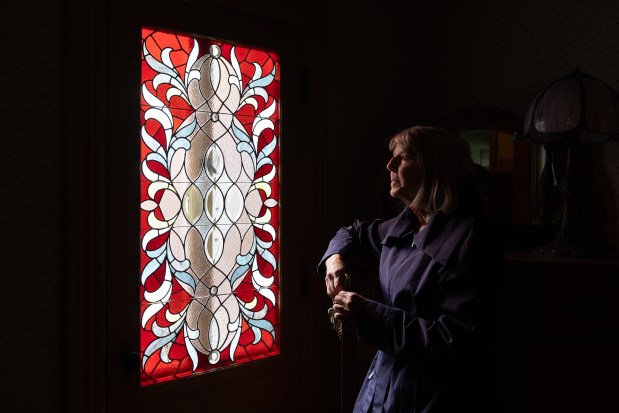 Winchester Mystery House historian Janan Boehme shows off a stained glass window in a downstairs parlor of the famed home in San Jose, Calif., Thursday, May 1, 2025. (Karl Mondon/Bay Area News Group)
“When she was growing up, that stuff was going on basically right in the backyard,” says Boehme. “Her father had a shop right there on the adjoining property. Sometimes I wonder if this was kind of an homage to her dad.”
Ignoffo, who wrote “Captive of the Labyrinth,” also thinks Winchester’s husband, William Wirt Winchester, could have inspired Sarah with his own love of architecture. He died in 1881, after they had been married for 19 years.
When considering the question of why Sarah would take on this perpetual building project by herself, Ignoffo puts it in a larger cultural context; in the 1880 and 1890s, the nation was having what she describes in her book as an “architectural awakening.” Interest in the craft was running high, and for a person of means, architecture was not necessarily an outrageous hobby to pursue.
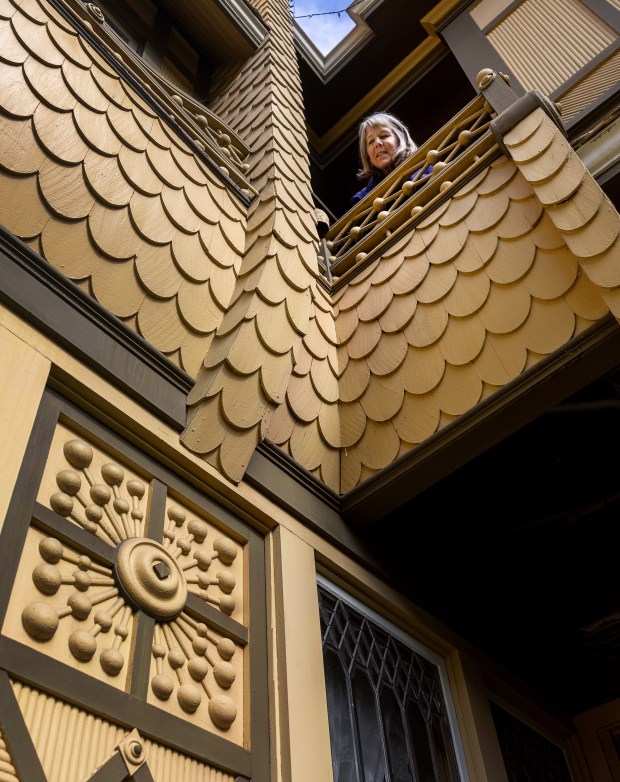 Winchester Mystery House historian Janan Boehme views the exterior architectural details at the famed home in San Jose, Calif., Thursday, May 1, 2025. (Karl Mondon/Bay Area News Group)
“I mean, there wasn’t even such thing as a professional architect yet,” says Ignoffo in an interview. “Certainly, people had been designing amazing things for thousands of years, but to go to school and get educated to be an architect was a new thing.”
So how did Winchester do? Well, in her own estimation, not great.
“After the earthquake, she told her niece’s husband how ashamed she was of her skills,” says Ignoffo. “These are not the words she would have used, but maybe it would have been a good idea to have an engineer, you know.”
But perhaps that’s yet another paradox in the Winchester Mystery House story: Sarah’s approach to architecture may have been unconventional, but the fact that there’s nothing like what she built is a big part of what continues to make it so compelling.
In 2020, the Winchester Mystery House celebrated 100 years of being open to the public. The couple who first turned it into a tourist attraction, John and Mayme Brown, were extremely controversial, even in their time. They amplified the false rumors that had been spread about Sarah Winchester, and basically solidified them in the public consciousness. On the other hand, they took a property that was considered to have absolutely no value and turned it into a place that continues to draw visitors from around the world.
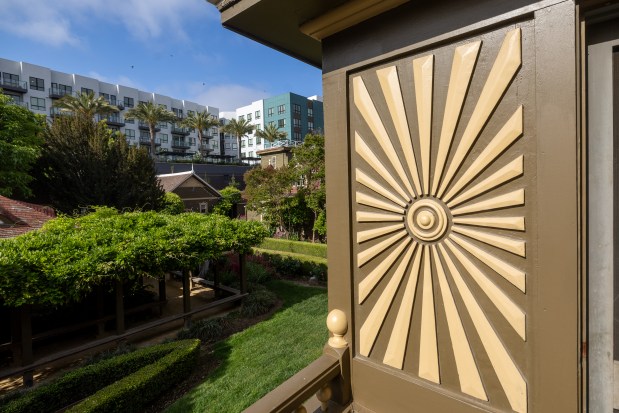 A solar design found repeatedly throughout the Winchester Mystery House in San Jose, Calif., stands in contrast to the residential highrises encircling it on Thursday, May 1, 2025. (Karl Mondon/Bay Area News Group)
“I guarantee this house would not still be here if it weren’t for them,” says Boehme.
Is the majority of interest in the Winchester Mystery House still centered around goofy ghost stories? Absolutely. However, with Boehme just installed as the house’s first official historian within the last decade — though she first started working there in 1977 as a tour guide — the approach to the real role that the Winchester Mystery House has played in San Jose’s history seems to be growing in importance. While tour guides still talk about ghosts, and ghost hunters still come looking for them, there seems to be a shift away from centering the haunted history around Sarah Winchester and toward what people say they’ve experienced themselves in the house. It’s a subtle change, but an important one, and Ignoffo — who hammered previous management’s approach to the house’s history in her book — is glad to see it.
“Who are we to say what somebody experiences or doesn’t?” she says about the many claims of ghostly sensations made by visitors and staff to this day. “But I’ve always felt like the historical, three-dimensional Sarah Winchester is more interesting than the caricature.”
Details: The Winchester Mystery House is located at 525 South Winchester Boulevard, San Jose.