

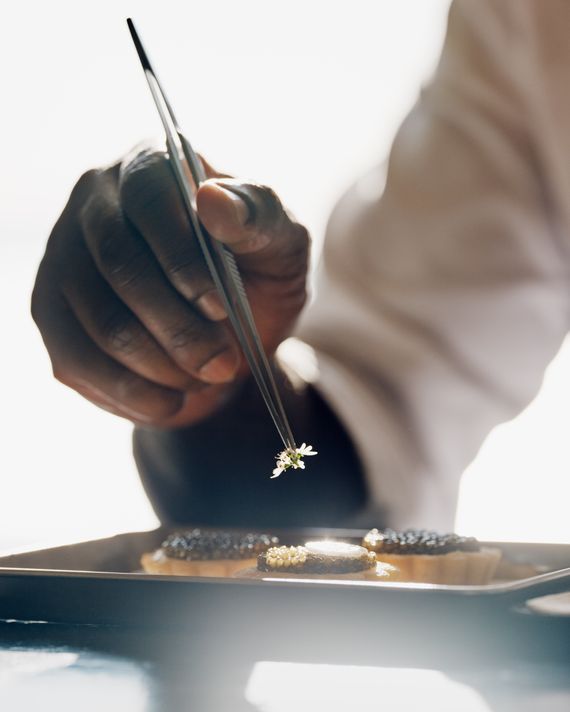
Chef Charlie Mitchell preparing a dish at Saga.
Photo: Thomas Prior
The tasting menu has long represented the pinnacle of chefly ambition. And for years now, restaurant critics have complained about it. In 2012, Pete Wells described the “trapped, helpless sensation” he felt facing “a marathon of dishes chosen by the restaurant.” Three months later, Corby Kummer, in Vanity Fair, decried the “subjugation to the will of the creative genius” that is required to enjoy a degustation. Adam Platt, my predecessor, memorably wrote about his own “tasting mennui” in 2022. Chefs keep at it anyway.
There are logistical reasons tasting menus work well, but there are interpretive ones, too: The tasting menu is a sign of seriousness, an implicit declaration of brilliance. Flynn McGarry of Cove, in the developing Hudson Square, and Charlie Mitchell of Saga, rebooted last year at the top of an Art Deco skyscraper, are two young chefs who subscribe to this particular paradigm. At their previous restaurants, Gem (McGarry) and Clover Hill (Mitchell), these tastings made a striking claim: that small rooms run by non-name-brand chefs could play in the big leagues. Now, they’ve ascended — in Mitchell’s case, literally, 63 stories — to bigger rooms, bigger kitchens, and larger staffs. Part of the reason these multicourse menus endure over grouchy critical objections is that international star-granting mandarins tend to reward them. But what’s good for Michelin isn’t always great for New York. In their new homes, the demands of this format mostly serve to undermine the chefs’ talents.
Over ten courses at Cove, whose pale-wood-paneled rooms manifest the salubrious calm of a Scandinavian spa, McGarry puts on a show of technique in a guise of serenity. He’s a skilled technician, steeping, fermenting, freezing-then-shaving, dehydrating. (McGarry has been honing his touch for the form since he first began serving dinners out of his parents’ house in Eureka, California, at 12.) He performs all his labors onstage — the kitchen, in the central room, is wide open — and delivers many of the dishes himself, sweatless. Beholden to the seasons (McGarry maintains a kitchen garden at the Long Island farm of Isabella Rossellini, one of his admirers) even in the doldrums of January, his dishes are clever and often beautiful. “Northeastern sashimi” is Rhode Island mackerel in a piney ponzu made with Douglas-fir needles, sprinkled with a snowy mix of horseradish and frozen quince. Winter squash is brushed with ume and soy and tempura-battered, served with Maine uni and grilled chard; aside from the fact that the squash and the uni are both orange, I struggled to find a reason they should be served together.
“Was that an ‘mmm’?” I asked my dinner date hopefully when the dish arrived about halfway through our $210 tasting. “That was a ‘hmmm,’ ” he replied. For every dish I lapped up (chief among them a Dungeness-crab chawanmushi with baby artichokes and fried capers), there was another I found merely interesting. McGarry may have picked up his hay-smoking technique for his pièce-de-resistance squab working in a restaurant in Belgium, but his bird — already a hard sell for any pigeon-wary New Yorkers — put me in mind more of the animal’s essential animalness than I’d have liked. It came with bitter lettuces dressed with squab vinaigrette and a mushroom fricassee scattered with chips of dehydrated squab jus. By the time the curious desserts started arriving — parsley-and-gooseberry granita with rose-scented cream, an apple mille-feuille whose pastry had been swapped for cinnamon-toast tofu skin — we were exhausted.
Saga is a different sort of restaurant, the hautest expression of the Kent Hospitality Group, founded by Jamal James Kent, who brought it to two-star Michelin acclaim before his untimely death in 2024. It comes with years of expectation and history, but to Mitchell’s credit, rather than imitating the Saga of yore, he’s brought his own history to bear. Basquiat and Biggie decorate the walls; Jazmine Sullivan and vintage 112 are on the soundtrack. The cooking, as intricate as ever, is now rooted in the foodways of Black America and the food of his grandmother’s house in Detroit.
That’s a tantalizing prospect. So why did Saga leave me wanting more? If I wish McGarry were a little more intent on the whims of his customers, I wish Mitchell were a little less. His cooking is so much more interesting than the tired playbook of tasting-menu voluptuousness dictates. It’s a snappy and fabulous sally to open a menu with cornbread, in the form of a scallop-edged tartlet, a fine confit of chicken in its golden heart. It’s dutiful, and a little boring, to then spackle it with caviar.
It’s hard to blame Mitchell for this, exactly. The gastrotourists who make it to the 63rd floor, who order the first-growth bottles and the grands crus, expect to be egged. They expect a tiny tartare of shima aji flown over from the fish markets of Tokyo and a little sliver of white salmon — the rarest type of king — with a polite segment of citrus. The trouble is, this paradigm ends up bending what’s wonderful about Mitchell’s food all out of shape. His fried fish has been so upscaled — Japanese madai, tempura-fried, dusted with dehydrated hot-sauce powder — that it seems like a ghostly shadow of itself, neither salty nor spicy enough. And (to paraphrase the old joke) such small portions.
To include these reworkings of Black American cooking at all is a welcome endeavor, and Mitchell refuses to tokenize them. Potato salad becomes a warm, foamy kind of casserole with Marcona almonds. Spinach drapes regally over brioche-crusted fluke. When one of his dishes hits every mark — like Japanese Spanish mackerel on dirty rice with ham-hock broth — you could levitate. But a bite or two is all he can offer you. The tasting-menu form wants ten perfect tricks of its magician, who has to leave you wanting more.
I did want more, and less. More food, with more bite, and less ceremony. If I could have ordered seconds of the Spanish mackerel or the fluke, I would have. If I could have had them as entrees, I’d have been happier still. I’d have traded half the service — attentive to absurdity — and all the caviar. What would that look like? It might look like a restaurant that is busier, louder, a little less bloodless. There would be fewer high-touch opportunities (I received both a welcome note on my table when I arrived and a thank-you note from my server in my email after I left) and, quite possibly, fewer Michelin stars. But a less ambitious restaurant might also look like a more desirable one.
What if Saga offered an à la carte option, to allow more people in? (At present, the ten-course tasting is $315 a person; a shorter, six-course tasting is $215.) Cove does, from experience — “We switched the Gem menu from tasting only to à la carte, and we were 15 times busier than we had ever been with the tasting menu,” McGarry told this magazine a few years ago — and left to my own devices, I was able to experience Flynnism with a little more agency and found I preferred it as such. Untethered from the restaurant’s ambitions, individual dishes could shine: earthy slices of duck coated in rye XO sauce, or Nobu-style black cod sweetened smokily under its paste of barley miso. That meal felt more like a conversation, less like a performance. The artist was present. But so was the diner.
Thank you for subscribing and supporting our journalism.
If you prefer to read in print, you can also find this article in the February 9, 2026, issue of
New York Magazine.
Want more stories like this one? Subscribe now
to support our journalism and get unlimited access to our coverage.
If you prefer to read in print, you can also find this article in the February 9, 2026, issue of
New York Magazine.
Related