
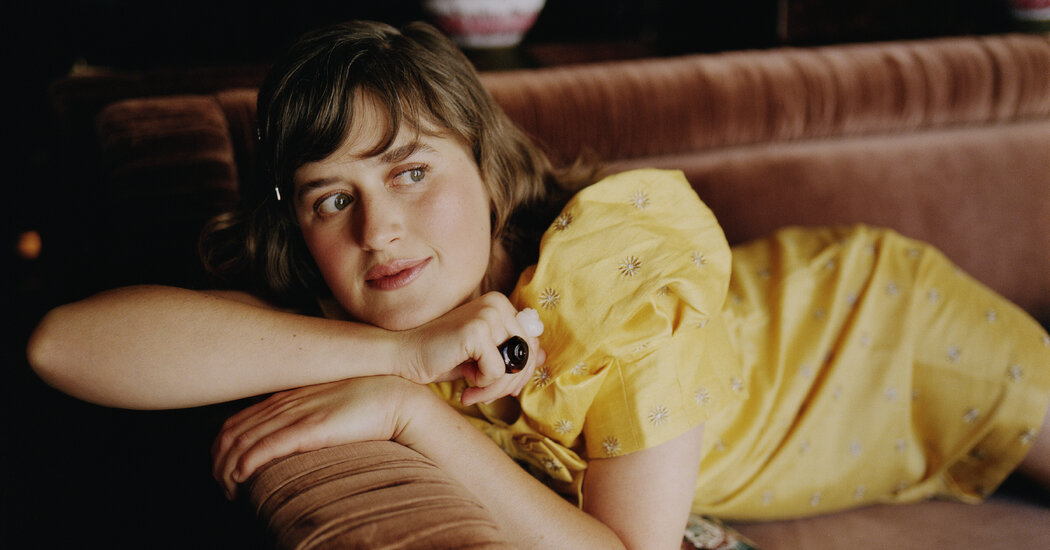
Ella Bruccoleri was looking for the Virgin Mary.
On a bright April morning, Bruccoleri, an Italian English actress, wandered the streets of Manhattan’s Little Italy neighborhood in search of a votive statue. Though Bruccoleri often plays nuns, she is no longer a practicing Catholic. The statue was intended as a decorative item, an adornment for the London home she had recently bought. She had visions of a bathroom done up in candles and what she called “Catholic kitsch.”
“I do just love the iconography,” she said.
She rejected one statue as too pink. In another, the baby Jesus pulled focus. A third was too expensive. Finally, she gave up on finding an ideal Mary and settled instead on a red T-shirt adorned with a cartoon of spaghetti.
On “The Other Bennet Sister,” which premiered this month on BritBox, Bruccoleri (“Call the Midwife,” “Paddington in Peru”) plays a different, less easily adored Mary: Mary Bennet. A minor character in Jane Austen’s “Pride and Prejudice,” Mary is variously described as a pedant, a prig, a show-off, a klutz and a really bad singer. While Austen marries off three of her four sisters, the book leaves Mary loveless.
By contrast, the 10-episode series, based on Janice Hadlow’s 2020 novel, imagines a future of romance, novelty and self-acceptance for Mary. It is Bruccoleri’s first starring role.
“God, I love her so much,” Bruccoleri said of the character. “She’s not trying to be like other people.”
Bruccoleri, the daughter of an Italian father and an English mother, grew up in the north of England. When she was 4 her family moved to a rural community, and Bruccoleri was enrolled in a drama class to help her to make new friends. After the first day she told her mother that she wanted to be an actor and she has never really wavered, even though she was rejected from drama schools for seven years. (She thinks it may have had something to do with her choice of audition monologue. She played a male pedophile.)
Eventually, after a year spent working at a family pizzeria in Sicily and two years training at a mime school in Paris, she was accepted into an accelerated acting program. Soon after graduating, she landed a role as a young nun on the beloved BBC drama “Call the Midwife.” The casting didn’t surprise her.
“I have kind of a twee face,” she said. “Nuns, maids, that was my thing.”
In 2022, after four years on the show, she left to pursue other roles, mostly supporting characters. She was asked to audition for “The Other Bennet Sister” on the same day that she received a request to read for the upcoming Netflix adaptation of “Pride and Prejudice,” also for the role of Mary Bennet.
While Netflix went with another actress for Mary, they asked her to return and read for Charlotte Lucas, another Austen also-ran. But “The Other Bennet Sister” did want her, which allowed Bruccoleri to use her chops and personal charm to make a case for Mary as ultimately lovable — a welcome stretch for the actress.
“It was my first romantic lead,” Bruccoleri said as she glanced into the window of a souvenir shop. “I don’t play romantic leads. People think I don’t have that face or the persona.”
Jane Tranter, an executive producer on the series, felt that Bruccoleri’s persona and face were just right. “She wasn’t frightened of showing Mary as someone who’s uncomfortable in her own skin,” Tranter said. “She didn’t play Mary for likability, and she didn’t play Mary for pity. She played Mary for exactly who Mary was.”
In person, Bruccoleri is not a pedant or a prig. She has more natural ease and confidence than Mary. But she is drawn to difficult characters (that pedophile) and she knows what it’s like to not fit in. Bruccoleri believes that if she had lived in Regency England, she might have been a lot like her character.
“Mary doesn’t understand the rules of the game,” she said. “She doesn’t understand how to exist within this period; she doesn’t understand the femininity.”
Bruccoleri had never been much of an Austen fan. (As a Northerner, she is team Brontë.) But Mary taught her to love Austen, even as Austen has little love for Mary. That day in Little Italy, in tribute, Bruccoleri had accessorized her outfit with a “Pride and Prejudice” purse.
That purse gave her a very English look, but Bruccoleri is also proud of her Italian ancestry. “It’s been an active effort my entire life to feel more Sicilian,” she said. She had been keen to visit Little Italy owing to an obsession with Italian American culture dating back to her teens. An old online password: “Al Capone.” She admired a moka pot in a Sicilian pattern and peered into Umberto’s Clam House, the site of a notorious mafia killing.
“So this is where they got out the violin cases,” she said.
She was cooler to the touts trying to lure her into restaurants. “This is very Italian,” she said resignedly. “Bordering on harassment.”
She wandered into a historic latteria, Di Palo’s Fine Foods (“torture as a vegan” she said), flirted with some Feast of the Seven Fishes nail art and flipped through a book on Italian folk magic. In Ferrara Bakery, she inspected the torrone and the cannoli, also not for vegans, before sitting down at an outdoor table at a nearby cafe and ordering a dairy-less pasta dish.
As she waited for the meal, she talked about how she’d prepared for “The Other Bennet Sister,” learning calligraphy, piano and how to ride sidesaddle (“Not recommended,” she said). A movement coach taught her about posture in Regency England, though she decided that Mary should slouch. And because she is somewhat obsessive in researching roles, she also tried to read every book Mary mentions, including deadly tomes like “Fordyce’s Sermons.”
“Which is the driest, most anti-feminist piece of work ever created,” she said.
When Bruccoleri first became an actress, she struggled with how she looked onscreen. “The first year of seeing myself on camera, I was just miserable because I was like, ‘I don’t think that looks like me,’” she said. But on “The Other Bennet Sister,” she was happy to lean away from vanity, relishing her character’s unflattering haircut and geeky glasses and the rest of Mary, too.
The story of an overlooked and undervalued young woman finally realizing her worth, it resonates with her.
“I relate to her a lot, and I see a lot of her in me,” Bruccoleri said, forking up a bite of eggplant pasta. “She just can’t be anything other than herself.”