
Coral from the sea is being used in knee surgeries in New York City.The innovative, new procedure using natural coral is being used to help those suffering from knee osteoarthritis who may not need a total knee replacement. “Hearing that this was an option … felt like a miracle,” said Tanya Iacono, 47, who has been an athlete all her life. Her passion for competitive powerlifting started in 2019 and took her to nationals back in June. It was a tough journey to get there. “I finished fourth in my weight and age class,” Iacono said. “So that’s pretty cool.” While training, she experienced extreme discomfort in her knee, excessive swelling, and mixed advice from doctors.”I was basically told by some to just not move,” Iacono said. “For somebody that’s really active, you know, that can be really crushing.”She was also told she would need a knee replacement.Then she learned of the new, innovative procedure at the Hospital for Special Surgery. “Hearing that this was an option really, truly felt like a miracle,” Iacono said. Iacono spoke with CBS News New York ahead of her procedure, which uses a tiny cartilage repair implant called Cartiheal Agili-C. It’s made from coral from the sea. The treatment is useful for early arthritis, doctors say. “Coral, at baseline, is over 90% identical to bone, to be honest. The same chemical building blocks, it’s almost the same structure. So it’s already very similar, and then the body fully integrates that and makes it your own,” Dr. Andreas Gomoll of the Hospital for Special Surgery said. Gomoll and Dr. Sabrina Strickland said it offers a less invasive option for patients who may not need or be ready for knee replacement. “There are some patients who have, for example, a very long, skinny cartilage defect, which really hurts,” Strickland said. “And for that type of defect, we didn’t really have any great options before.” “If you are at a stage where everything is destroyed in your knee, essentially, a new replacement is still by far the best option. This is really for the person with what we call early arthritis,” Gomoll said. The first step of the process is to remove the damaged cartilage, which had detached from the bone. Doctors said that can leave behind what they call a “pothole,” which can eventually lead to arthritis. “Cartilage, it doesn’t heal on its own. So this is a way to help the body heal and reform cartilage,” Gomoll said.The next step is to create a hole in the bone in order to insert the small implants. The procedure takes about half an hour. “‘s nowhere near ready to have a knee replacement, and so by putting these coral plugs in, it stimulates the body the grow over the coral cartilage, which hopefully gives her a knee that’s going to last a whole lot longer,” Strickland said. “Much, much less pain. Much smaller incision. I would say most patients at six weeks look pretty good.” The surgeons were part of the clinical trial that got Cartiheal FDA approval in 2022. They have done nearly 80 of the procedures outside of the clinical trial and follow their patients closely. Heidi Jones had the surgery a year and a half ago. “I’m box jumping. I’m running. I’m squatting. I just did a 12,000-foot mountain. I’m just elated to have had it done and to be resuming everything I wanted to do on the other side,” Jones said. Iacono can’t wait to get back to the gym, but says her main motivation is her son. “I think any parent of a special needs child is always looking for ways to be indestructible, because you have to be around for your kid as long as possible,” she said.
WCBS —
Coral from the sea is being used in knee surgeries in New York City.
The innovative, new procedure using natural coral is being used to help those suffering from knee osteoarthritis who may not need a total knee replacement.
“Hearing that this was an option … felt like a miracle,” said Tanya Iacono, 47, who has been an athlete all her life. Her passion for competitive powerlifting started in 2019 and took her to nationals back in June. It was a tough journey to get there.
“I finished fourth in my weight and age class,” Iacono said. “So that’s pretty cool.”
While training, she experienced extreme discomfort in her knee, excessive swelling, and mixed advice from doctors.
“I was basically told by some to just not move,” Iacono said. “For somebody that’s really active, you know, that can be really crushing.”
She was also told she would need a knee replacement.
Then she learned of the new, innovative procedure at the Hospital for Special Surgery.
“Hearing that this was an option really, truly felt like a miracle,” Iacono said.
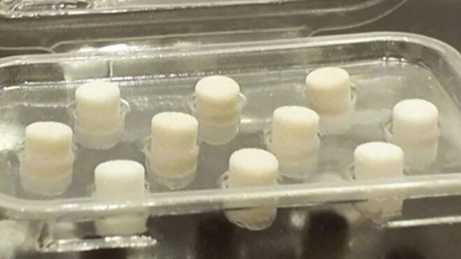
Iacono spoke with CBS News New York ahead of her procedure, which uses a tiny cartilage repair implant called Cartiheal Agili-C. It’s made from coral from the sea.
The treatment is useful for early arthritis, doctors say.
“Coral, at baseline, is over 90% identical to bone, to be honest. The same chemical building blocks, it’s almost the same structure. So it’s already very similar, and then the body fully integrates that and makes it your own,” Dr. Andreas Gomoll of the Hospital for Special Surgery said.
Gomoll and Dr. Sabrina Strickland said it offers a less invasive option for patients who may not need or be ready for knee replacement.
“There are some patients who have, for example, a very long, skinny cartilage defect, which really hurts,” Strickland said. “And for that type of defect, we didn’t really have any great options before.”
“If you are at a stage where everything is destroyed in your knee, essentially, a new replacement is still by far the best option. This is really for the person with what we call early arthritis,” Gomoll said.
The first step of the process is to remove the damaged cartilage, which had detached from the bone. Doctors said that can leave behind what they call a “pothole,” which can eventually lead to arthritis.
“Cartilage, it doesn’t heal on its own. So this is a way to help the body heal and reform cartilage,” Gomoll said.
The next step is to create a hole in the bone in order to insert the small implants.
The procedure takes about half an hour.
“[Iacono]’s nowhere near ready to have a knee replacement, and so by putting these coral plugs in, it stimulates the body the grow over the coral cartilage, which hopefully gives her a knee that’s going to last a whole lot longer,” Strickland said. “Much, much less pain. Much smaller incision. I would say most patients at six weeks look pretty good.”
The surgeons were part of the clinical trial that got Cartiheal FDA approval in 2022. They have done nearly 80 of the procedures outside of the clinical trial and follow their patients closely.
Heidi Jones had the surgery a year and a half ago.
“I’m box jumping. I’m running. I’m squatting. I just did a 12,000-foot mountain. I’m just elated to have had it done and to be resuming everything I wanted to do on the other side,” Jones said.
Iacono can’t wait to get back to the gym, but says her main motivation is her son.
“I think any parent of a special needs child is always looking for ways to be indestructible, because you have to be around for your kid as long as possible,” she said.