
Quince jam in a poached pear playfully evokes sunny eggs in a dessert.
Shannon Lee/For the Times Union
Despite being so very full, I couldn’t help but tempt just one more bite of the pear, fragrant and heady from a long bath in rosemary-infused white wine. Cleaved in two, its halves required one to first shatter the brulée of glassy sugar glazing its surface before spooning into its luscious interior. At the center of each was a sultry orange dollop of jammy quince, playfully suggesting two sunny eggs in a winking rendition of breakfast for dessert at The Feathers tavern, the restaurant of The Six Bells inn in Rosendale.

This clever effect was underscored by a milky pool of almond and mascarpone cream and a scatter of granola that had been roasted in honey and honeycomb sourced from the bees down the road, tended to by Pollinator Spirits in the Catskills. Our server was particularly excited to extol this latter fact, explaining how the use of the whole honeycomb by The Feathers’ chef, Larkin Young, renders a more complex, deeper honey flavor and chewier texture to what might otherwise be simply granola.
Article continues below this ad
The Feathers at The Six Bells
Address: 435 Main St., Rosendale
Prices: $14 to $16 starters and sides to share; $30 to $48 entrees; wine, $15 to $19 by the glass; cocktails, $17 to $20; beer and cider, $7 to $10
Hours:Dinner, 5 to 8:30 p.m. Wednesday to Sunday; brunch, 10 a.m. to 2 p.m. weekends
Info: 845-658-2047 and thesixbellshotel.com/restaurant
Etc.: Hotel parking. ADA-accessible. Reservations recommended.
Content and tucked cozily into a merlot-red velvet L-booth seat, I considered these merits of whole honey, feeling entirely like a particular storybook bear: “‘Well,’ said Pooh, ‘what I like best,’ and then he had to stop and think. Because although Eating Honey was a very good thing to do, there was a moment just before you began to eat it which was better than when you were, but he didn’t know what it was called.”
Indeed, at The Feathers, eating honey is a very (very) good thing to do — and so is eating everything else on the menu.
In a dining landscape saturated with New American restaurants, Young deems his style of cooking Early American, taking a farm-to-table and ingredient-first approach to traditional, primarily Pennsylvania Dutch-inspired cooking. This subtle difference in culinary philosophy is felt: The menu, developed with consultation with Westerly Inn’s Molly Levine, is comforting but never cloying, historical but not stodgy. It feels akin to other recent gestures toward country-living romanticism, particularly Clare de Boer’s much-lauded Stissing House in Pine Plains — even the menu’s typeface, a scratchy handwritten serif, is nearly identical.
Article continues below this ad
Make the Times Union a Preferred Source on Google to see more of our journalism when you search.
Add Preferred Source
Young’s take is a tidy balance of familiarity and originality. To that end, he deploys potatoes abundantly, with distinction at every turn. As potato croquettes, they were velvety, subtly sweet and piping hot, encased in a crisp, barely there breading and punched up with a sprinkle of cured egg yolk shavings and chives. The tuber stole the show as mashed potatoes, an ostensible supporting act accompanying tender strips of flatiron steak, luxuriously cloaked in a uniquely fragrant, smoked-eggplant demiglace. Two roasted rounds of potatoes functioned as wholesome, fluffy palate cleansers for an unctuous spread of crispy duck breast and seared duck rillette in a rich jus. Each iteration of potato announced itself proudly as purposeful and unmissable.
Potato croquettes are dusted by cured egg yolk and chives. The kitchen excels in all of its varied preparations of potatoes.
Shannon Lee/For the Times Union
Duck breast is accompanied by duck rillettes atop potato rounds and garnished with endive and watercress.
Shannon Lee/For the Times Union
Save for a fabulous-looking mushroom pot pie, there weren’t many vegetarian entrees on the menu. This, however, was offset by a vegetable-forward selection of sides and starters sized to share.
Article continues below this ad
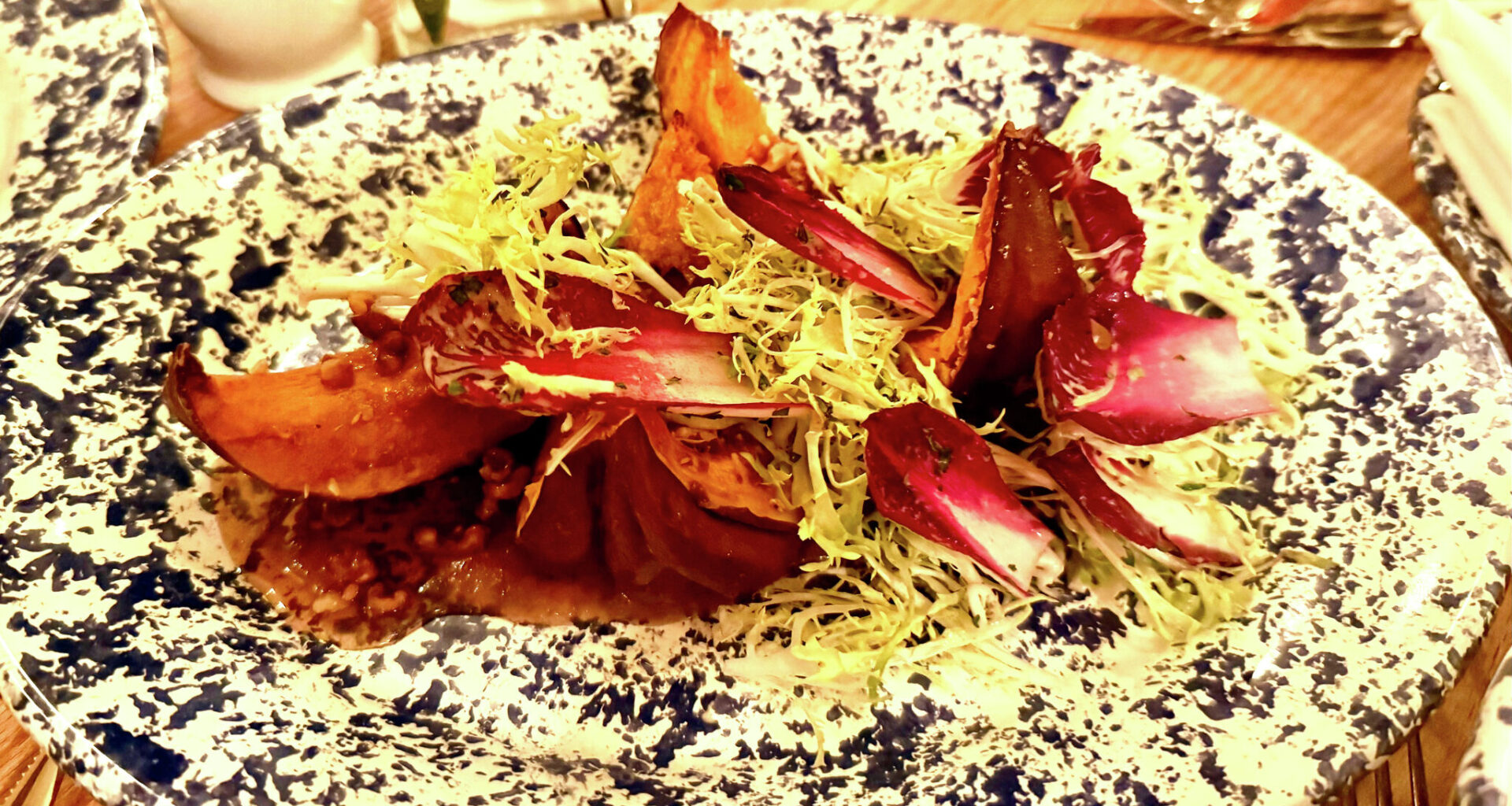
I can’t remember the last time a salad dressing made as profound an impression on me as pear-balsamic vinaigrette did at The Feathers. Slightly tangy but with rounded depth, it clung to the undulating red oakleaf folds with miraculous precision, not a drop left to pool on the plate. Black Futsu, a rare Japanese squash variety, showcased the season’s bounties beautifully when roasted in maple and tossed in spiced apple butter and a cinnamon-apple cider vinaigrette.
A salad of red oakleaf lettuce boasts a remarkable pear-balsamic vinaigrette.
Shannon Lee/For the Times Union
Black Futsu, an uncommon Japanese squash variety, is roasted in maple and tossed in spiced apple butter and a cinnamon-apple cider vinaigrette.
Shannon Lee/For the Times Union
Like the food menu, the tavern’s beverage offerings are focused, with beer and cider trending toward local selections from West Kill Brewing, Keegan Ales and Return Brewing. The wine list feels contemporary but classic, seeming to favor the siltier, mineral-forward terroirs of Italy, France, Austria and Oregon’s Willamette Valley — and for an establishment catering to millennial tastes and trends, there is surprisingly only one skin-contact (orange) wine.
Article continues below this ad
The greater priority here seems to be the craft cocktails, which are developed seasonally by bartender Ryan Schoenau. While a more lively sprig of rosemary would have been preferred over the one we were served in the bouCharred Cherub, the drink itself proved lovely, its smokiness pairing perfectly with our meal. I also enjoyed mulled cider, which was spiced more than sweet.
Mulled cider, left, skews more spiced than sweet. At right is the Charred Cherub cocktail.
Shannon Lee/For the Times Union
Signature blue-and-white sponge-painted enamelware formed the not-so-blank canvas for each dish. Though attractive at first, or pretty to look at when empty, I found the look a bit busy after a while, distracting from Young’s already festive plating. Still, I get the gambit: The Six Bells began, after all, as a home-goods shop in Brooklyn selling a particular vision of a simpler life — Grandma Moses but sexy, toeing the line of trad-wife fantasy and laborless domesticity. It is a vision crafted meticulously by designer Adam Greco and Audrey Gelman, the latter a millennial tastemaker and founder of The Wing, a women-only workspace that collapsed in a pandemic- and controversy-fueled whirlwind in 2021.
Part of me is embarrassed to admit how much I thoroughly enjoyed my time at The Six Bells, open for about six months. Decked in boughs of holly and ribbon for the holidays, its cozy-cottage aesthetics and old-world charms feel (and were) developed specifically to prey on sentimental millennials like myself, exhausted by the AI-driven detachment of the present and future, craving sensory pleasures. As Gelman told the New York Times over the summer for a feature story on the inn, “Preserving things that feel human in a world where everything is becoming automated. … Creating anything analog today is like a stand of its own.”
Article continues below this ad
An escape into fantasy is all too tempting; Gelman makes good use of the moment.
Open since June, The Six Bells, an 11-room inn on Main Street in Rosendale, was created by designer Adam Greco and millennial tastemaker Audrey Gelman in a hotel building built in 1850. Its country tavern/restaurant is called The Feathers.
Shannon Lee/For the Times Union
Originally built as a hotel in the 1850s, the stately, ivy-covered brick building housing The Six Bells is located on Rosendale’s Main Street — at least, it is physically. In Gelman’s world-building, The Six Bells “draws its inspiration” from the fictional setting of Barrow’s Green, a quaint kind of British town of 640 residents, “depending on who is dying and how many babies are being born.” The invention is as charming as it is ingenious.
Sitting in the (real) convivial front room of The Feathers, we learned that The Six Bells was hosting a murder-mystery party for hotel guests that weekend. You can even pick up a copy of The Green Evening Chronicle, the weekly newspaper of Barrow’s Green, wherein readers may learn of the latest goings on (regrettably, there is no dining section).
Article continues below this ad
Though The Feathers doesn’t boast a large dining room, it has a thoughtful variety of environs for guests to enjoy. There is the aforementioned front room, with low-slung booth seating that inspires conviviality among patrons. A quieter, darker and more formal dining area is set toward the back. Between these spaces and alongside the bar are a couple of intimate booths designed for privacy and strictly for two. In warmer months, an outdoor patio promises a serene retreat surrounded by greenery and soundtracked, perhaps, by the rush of the nearby Rondout Creek.
Among the multiple seating areas at The Feathers tavern is the bar, with intimate booths for two.
Shannon Lee/For the Times Union
There is a type of person who wouldn’t like the Euro-Americana pastiche and “storybook you can sleep in” schtick of The Six Bells. There are those who would find the old-timey muffled warbling of Tin Pan Alley jazz, velvet dust-ruffled booth seating, hand-painted wall accents, Tyrolean chairs with quilted seat cushions (again, with ruffles) and Shaker-style carpentry too chintzy, too indulgent, too whimsical.
Article continues below this ad
Still, even this person would be hard-pressed to find fault in The Feathers, which manages to bring Gelman’s nostalgic-inflected fantasy to life while also elevating it into something entirely contemporary. Within the fairytale of The Six Bells, I look forward to assuming the role of a recurring character, sitting in a plush booth, full as a bear and thinking about honey.