
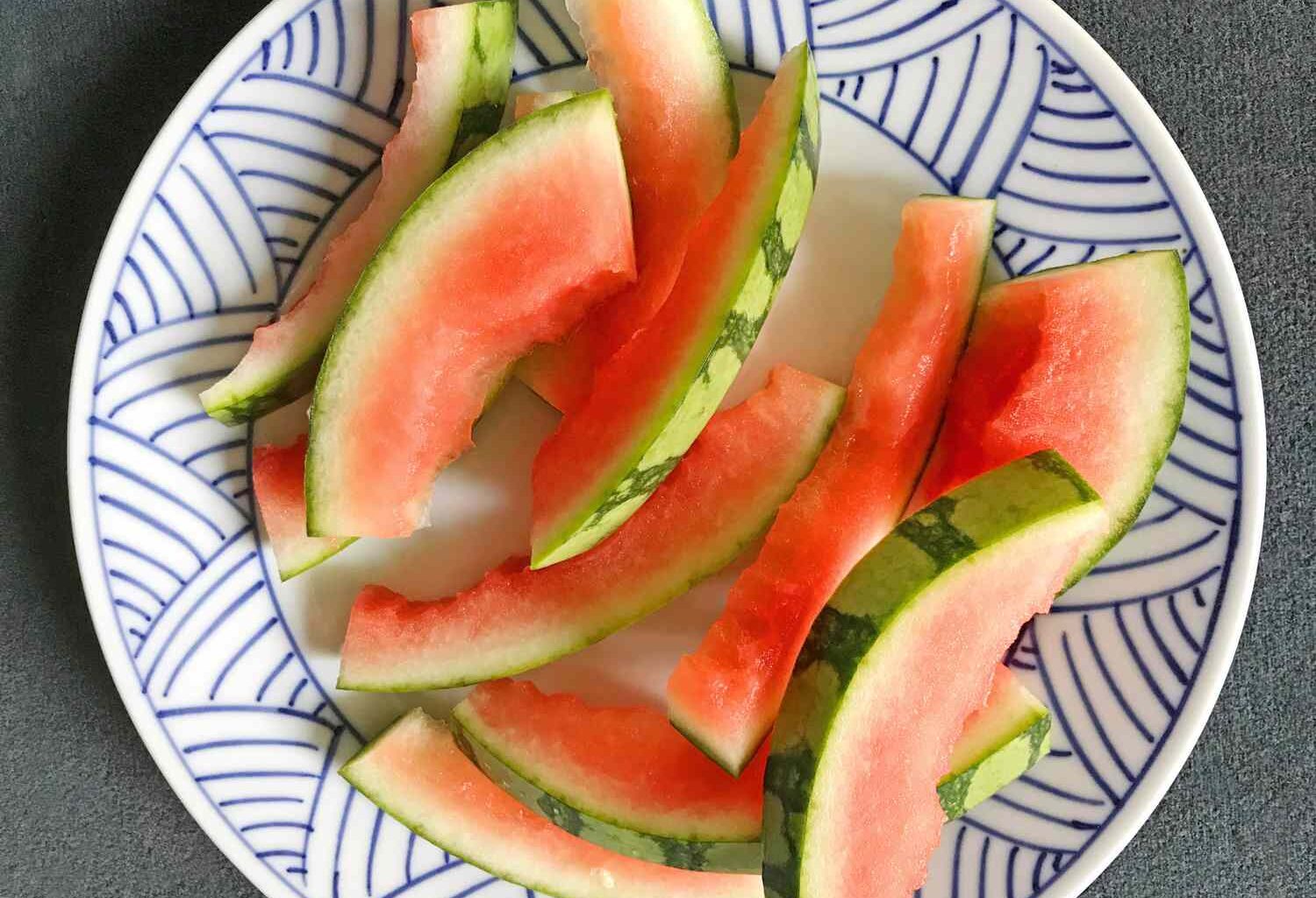
Watermelons are a hydrating summer fruit packed with vitamins, minerals, and antioxidants. But if you only eat the red flesh, you’re missing out on additional nutrients found in the rind, including fiber and amino acids.
1. Watermelon Rinds Are a Good Source of Fiber
Fiber supports regular bowel movements and lowers the risk of colon cancer and heart disease. Most U.S. adults would benefit from eating more fiber-rich foods, like watermelon rinds.
“The rind is very high in fiber, which makes it very different than the inside of the watermelon,” said Julie Stefanski, MEd, RDN, LDN, a Baltimore-based registered dietitian and spokesperson for the Academy of Nutrition and Dietetics.
Stefanski added that most of the fiber in the rind is insoluble, which helps promote bowel movements. It also contains some soluble fiber, which helps lower cholesterol levels.
Because watermelon rind is so fibrous, it might take time for your digestive system to adjust. Eating too much at once may cause gas or bloating.
2. Watermelon Rinds Are Rich in Citrulline
Watermelon rinds contain citrulline, an amino acid that may support exercise performance and enhance blood flow. For this reason, some social media users suggest blending watermelon rinds into a pre-workout drink.
“One cup of watermelon has about 250-300 mg of citrulline. The rind does have about 60% more than the red flesh,” Sherry Gray, MPH, RD, a registered dietitian and a nutrition educator at the University of Connecticut, told Verywell.
Adding a cup of watermelon rinds to a smoothie can help you get more citrulline. However, Gray noted that you’d need about 3-6 grams of citrulline per day for cardiovascular and muscular performance benefits.
3. Watermelon Rinds May Be More Nutritious Than the Flesh
Watermelon rinds have vitamin C, vitamin B6, beta-carotene, calcium, fiber, zinc, and phosphorus—an important mineral that supports normal nerve and muscle function.
“In some ways, it is more nutritious than the flesh, which is also a nutritious fruit. The rind has some unusual properties that make it very nutritious,” Gray said.
She added that you’d need to eat about 1 to 1.5 cups of rind to get meaningful amounts of these vitamins, minerals, and antioxidants.
Are Watermelon Rinds Really Safe to Eat?
Always wash a watermelon under running water before cutting into it, even if you’re only eating the flesh. Scrubbing the outer green skin with a vegetable brush can help remove dirt and other debris.
“Your knife passes through the outside onto the inside, so even if you’re not using the watermelon rind, you always want to wash the outside of a melon really well, so that your knife doesn’t pass bacteria or dirt from the outside into the inside,” Stefanski said.
Clean watermelon rinds are generally safe to eat, but they’re high in fiber, so it’s best to introduce them gradually to avoid digestive issues like bloating, gas, or diarrhea.
If you plan to eat the rinds, be sure to refrigerate them, as they’re perishable, Gray said.
Different Ways to Prepare Watermelon Rinds
If you have never eaten a watermelon rind, try peeling off the green skin and consuming the white part between the pink fruit and the outer skin. You can eat the raw rind, but you may not enjoy the taste.
Watermelon fruit tastes sweet, but the rinds have a different flavor profile. The green skin has a bitter flavor, and the white part of the rind tastes like cucumber, according to Stefanski.
To enhance the flavor, pickle the rinds or add them to stir-fries, chutneys, salads, and smoothies.
“The watermelon rind can be a good addition to the diet, but you have to think about how it’s prepared,” Stefanski said. “A lot of recipes have a lot of added salt for pickling or a lot of added sugar if it is a recipe that’s supposed to be a candy or a sweetened rind.”
Some food scientists are working on ways to incorporate watermelon rinds into food products, such as combining powdered watermelon rinds with wheat flour to increase the fiber content of baked goods.
Verywell Health uses only high-quality sources, including peer-reviewed studies, to support the facts within our articles. Read our editorial process to learn more about how we fact-check and keep our content accurate, reliable, and trustworthy.
University of Arkansas System. Surprising health benefits of watermelon.
University of Massachusetts Amherst. Watermelon.
Harvard Health Publishing. Should I be eating more fiber?
Michigan State University. Get your fiber without the flatulence.
Gu I, Balogun O, Brownmiller C, Kang HW, Lee SO. Bioavailability of citrulline in watermelon flesh, rind, and skin using a human intestinal epithelial caco-2 cell model. Applied Sciences. 2023;13(8):4882. doi:10.3390/app13084882
Kang Y, Dillon KN, Martinez MA, Maharaj A, Fischer SM, Figueroa A. L-citrulline supplementation improves arterial blood flow and muscle oxygenation during handgrip exercise in hypertensive postmenopausal women. Nutrients. 2024;16(12):1935. doi:10.3390/nu16121935
Figueroa A, Jaime SJ, Morita M, Gonzales JU, Moinard C. L-citrulline supports vascular and muscular benefits of exercise training in older adults. Exercise and Sport Sciences Reviews. 2020;48(3):133-139. doi:10.1249/JES.0000000000000223
Harvard T. H. Chan School of Public Health. Phosphorus.
Arivuchudar.R. Nutritional and sensory characterization of watermelon rind powder incorporated crackers. Biosciences Biotechnology Research Asia. 2023;20(1):263-269. doi:10.13005/bbra/3087
U.S. Food and Drug Administration. Selecting and serving produce safely.
Imoisi C, Iyasele JU, Michael UC, Imhontu EE. The effects of watermelon rind flour on the functional and proximate properties of wheat bread. JCSN. 2020;45(5). doi:10.46602/jcsn.v45i5.537

Thanks for your feedback!
What is your feedback?
Helpful
Report an Error
Other