
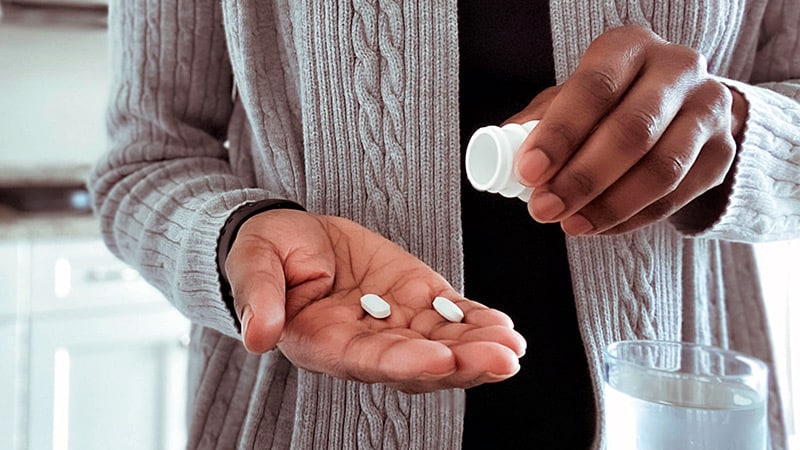
Over-the-counter (OTC) pain medications were as, or more effective, than prescription opioids at relieving dental pain after wisdom tooth extraction, new research showed.
The pain relief was consistent across both sexes, which is notable because women report more postsurgical pain.
In a large trial of more than 1800 patients, investigators found that patients who took a combination of ibuprofen and acetaminophen experienced less pain and had fewer adverse events than their counterparts who took a combination of hydrocodone with acetaminophen.
“We feel pretty confident in saying that opioids should not be prescribed routinely for dental procedures. Our nonopioid combination really should be the analgesic choice,” principal investigator Cecile Feldman, DMD, MBA, and dean of Rutgers School of Dental Medicine in Newark, New Jersey, said in a news release.
The research letter was published online on November 6 in JAMA Network Open.
Limiting Dental Opioid Prescriptions
In 2023, opioids were involved in 76% of all drug overdose deaths. Although opioid prescribing by dentists in the US has declined, rates remain far higher than in other countries, prompting professional organizations to issue guidelines urging greater caution in when prescribing these medications.
The current study is a subgroup analysis of the randomized clinical trial by the Rutgers investigators which showed that OTC pain medications provided better pain relief than opioids. In this analysis, the researchers aimed to assess whether results were consistent in both sexes as women report higher pain levels after surgery.
Of participants who underwent third molar surgery (N = 1815; mean age, 25.7 years; 50.1% women; 19.7% White individuals), 909 were given a nonopioid combination (ibuprofen 400 mg and acetaminophen 500 mg) and 906 received hydrocodone 5 mg with acetaminophen 300 mg.
Patients were randomized by sex and site to receive the blinded pain medication. Primary outcomes were pain experience (assessed by noninferiority testing) and medication satisfaction.
Secondary outcomes included sleep quality, adverse events, the need for rescue medication and ability to perform daily activities. Patients reported the outcomes twice a day for a week following surgery in an electronic dairy.
OTC Meds Offer Superior Pain Relief
On the first day, nonopioids provided better pain relief for women (mean difference, -0.63; 99.375% CI, -1.04 to -0.21) and men (mean difference, -0.75; 99.375% CI, -1.17 to -0.33). Over the rest of the postoperative period, nonopioids matched opioid pain relief.
Those who took nonopioid drugs reported being more satisfied: 82.8% of women and 87.8% of men were “extremely satisfied or satisfied” compared with 76.2% and 81.6% in the opioid group (women: odds ratio [OR], 1.51; 97.5% CI, 1.04-2.20; men: OR, 1.59; 97.5% CI, 1.04-2.44).
Adverse events requiring emergency visits were lower in the nonopioid group for both sexes. Sleep quality did not differ significantly across both groups.
In the full results, patients taking opioids were twice as likely to require additional pain medications.
“The results actually came in even stronger than we thought they would,” Feldman said. “We expected to find the nonopioid to be noninferior, so that at least it was no worse than opioids. We were surprised to see that it was actually superior.”
A limitation of the analysis was that it only considered treatment effects within sex subgroups without examining sex-based differences between groups.
“The consistency of treatment effects across male and female participants supports the robustness of the trial’s findings, underscoring the clinical utility of nonopioids as first-line therapy,” the investigators wrote.
The full list of disclosures can be found in the study. The research was supported by grant UH3DE028860 from the National Institute of Dental and Craniofacial Research of the National Institutes of Health.