
You’re well aware the importance of core strength, which enables you to generate force and perform movements from heavy lifts to everyday activities. Core stability – your ability to control and resist movement while keeping the spine still – is equally important, yet receives much less airtime. Unsure how to train the latter? Meet the Alekna exercise.
Related Story
Named after Olympic discus thrower Virgilijus Alekna, the exercise is a core stability drill that targets total-body tension and anti-extension control, according to Daniel Booth, performance coach at MyoLab. A more advanced version of a deadbug, the Alekna is ‘deceptively simple. Arms and legs move away from the body while your spine stays locked in place,’ Booth explains. ‘But the challenge comes from managing long levers without losing trunk stability.’
It’s one of the PT’s go-tos when training athletes. ‘I’ve used this exercise extensively in my work with elite British and US sprinters as part of their core conditioning. It’s one of the most reliable ways to develop the trunk stiffness and coordination required for producing high force at high speed.’
Muscles worked by the Alekna exercise
The Alekna is an anti-extension exercise that primarily recruits the muscles of the core: the rectus abdominis, which prevents the lower back from arching; the transverse abdominis, the deepest-lying abdominal muscle that wraps around your trunk like a corset; and the internal and external obliques, which maintain ribcage–pelvis alignment and prevent rotation. However, according to Booth, the exercise also engages
Hip flexors: Which control long lever leg movement.Serratus anterior and lats: Which stabilise the overhead arm path.Glutes: Help anchor the pelvis to resist extension.
‘This combination makes it one of the most complete anti-extension drills in training,’ says Booth.
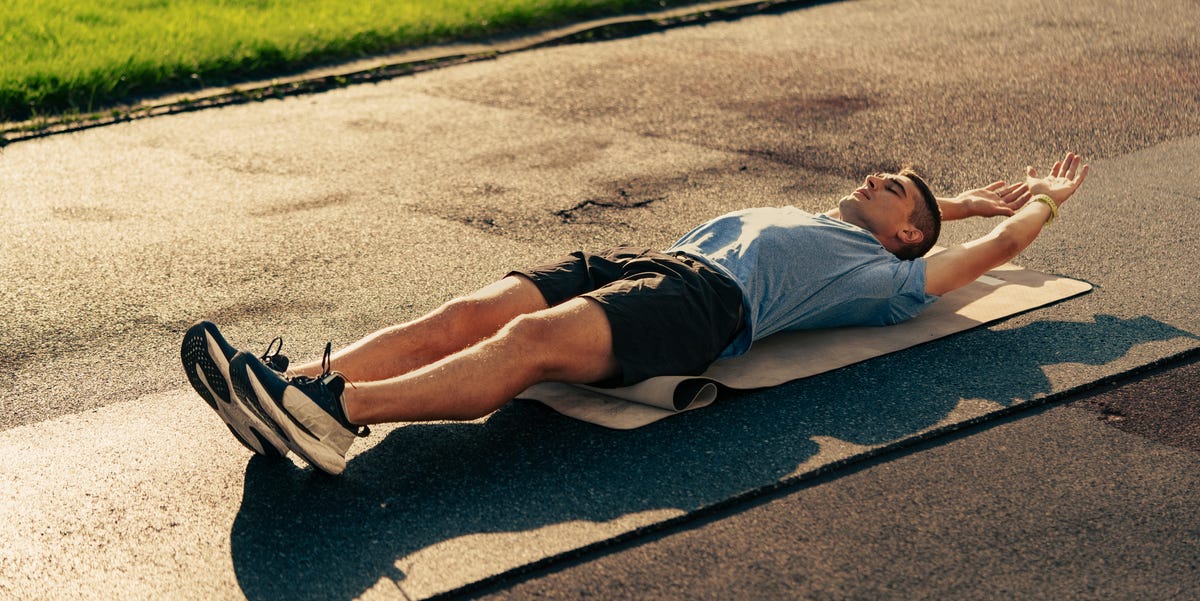
How to do the Alekna exerciseLie on your back with knees bent, arms pointed to the ceiling. Take a breath in and create tension around the trunk.Lower arms overhead while extending legs forward at the same time. Only move as far as you can keep your lower back glued to the floor.Hold 1–2 seconds at your end range.Bring arms and legs back to the start – no momentum.
To make the exercise slightly easier, Boost advises bending your knees. When you’re ready to progress the Alekna and increase the level of challenge, he recommends holding a light plate overhead or introducing tempo work. ‘The load should be dictated by your ability to maintain the brace – not by how far the limbs move,’ he emphasises.
4 benefits of the Alekna exercise1. Elite-level trunk stiffness
This is why the exercise is a favourite for Booth, and why he so often programmes it for top-level sprinters. ‘Maximal speed demands a rock-solid midline so force can travel efficiently through the body,’ he says.
2. Improved athletic power transfer
Better anti-extension strength enhances:
Sprint mechanicsOverhead liftingSquat and deadlift bracingCycling postureRotational power
Regardless of your sport, the Alekna exercise develops core strength and stability, which helps to facilitate improved performance.
3. Improved coordination and timing
‘The core must link the upper and lower body,’ says Booth. ‘This is critical in sprinting, weightlifting, combat sports, and field sports.’
The Alekna exercise teaches your body how to maintain core stability when your limbs are moving. Having a stable centre allows you to better control movements and subsequently improves coordination.
4. Safe, spine-friendly abdominal strength
‘It’s high stimulus without overloading the lumbar spine,’ explains Booth.
Common mistakes to avoid
Although generally safe, Booth advises steering clear for the time being if you have acute lower-back issues – particularly where extension-sensitive pain is present.
A common mistake many make while learning how to do the Alekna exercise is not maintaining tension in the trunk. ‘If the ribs flare or the back arches, shorten the range immediately,’ warns Booth. He recommends getting comfortable doing dead bugs before progressing to Aleknas if you’re completely new to the movement pattern.

Abbi Henderson is Acting Nutrition writer who covers health, fitness, women’s sport and lifestyle for Women’s Health and Men’s Health. Before settling in a British seaside town, she spent a couple of years living in Canada, where she contributed to publications such as Best Health, Foodism and Canadian Living, and discovered she is, in fact, a little outdoorsy. With a desire to help make healthcare, exercise and sport more accessible to women, she writes about everything from the realities of seeking medical support as a woman to those of being a female athlete fighting for equality. She has a personal trainer qualification, a couple of medals from her short time in competitive Irish dancing, and an Arsenal Women season ticket. When she’s not in front of a screen working, she enjoys weightlifting, going for walks and stopping for little treats (matchas and pastries), and trying new recipes (that are almost always pasta-based).