
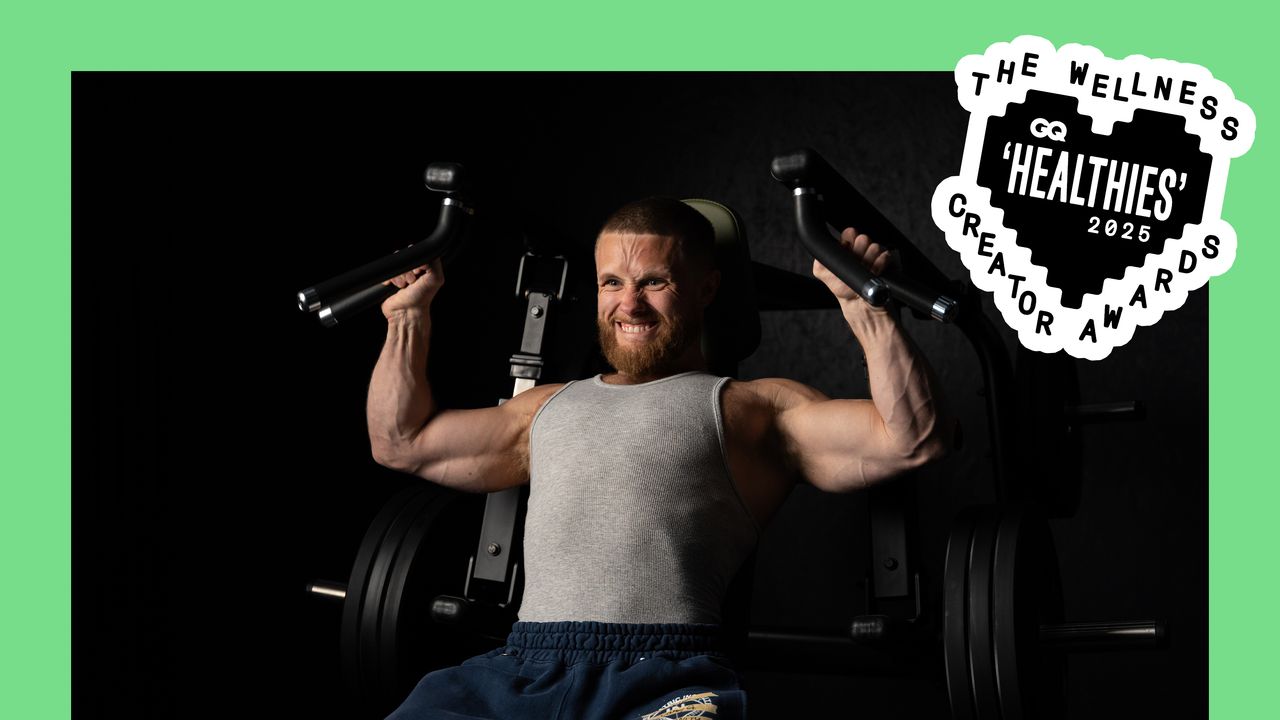
Jeff Nippard is part of our 2025 Wellness Creator Awards, a.k.a. The Healthies. See the full list here.
Somewhere in Toronto sits one of the most advanced gyms in Canada. With plate-loaded machines that let you adjust the resistance curve to niche isolation equipment (we’re talking a vintage Dorian Yates–style lat pullover machine and an Arnold Schwarzenegger–inspired Icarian donkey calf raise machine), this is the Pumping Iron enthusiast’s wet dream. Few know its location, however, and those who do aren’t going in to get their usual pump. You see, the Muscle Lab is not your typical commercial gym. Rather, it’s a nearly $3 million 4,000-square-foot research facility belonging to Jeff Nippard, a 35-year-old natural bodybuilder with a 7.9 million following on YouTube.
Since 2014, Nippard has been the face (and, er, body) of the fast-growing science-based lifting movement. The antithesis to “bro science,” in which gymgoers base their workout regimens on anecdotal evidence or personal experience, science-based lifting uses actual scientific research to maximize results and decrease the likelihood of injury. The fitness philosophy has been around for decades. In 1973, Nautilus (now Bowflex) founder Arthur Jones conducted the Colorado Experiment, in which, using the basic tenets of science-based lifting, he trained bodybuilder Casey Viator for 28 days. Viator reportedly emerged from the experiment 63 pounds heavier from the muscle he’d gained. Though the extraordinary results were met with skepticism, the event doubles as one of the most well-known events in science-based lifting history, and a foreshadowing of the passionate criticism it would inspire.
Online debates on how one should tailor their workouts based on the results of scientific studies are seemingly neverending. But there’s no argument on whether or not Nippard is the de facto spokesperson for the philosophy. His videos—which include explainers on various exercises and training programs, personal lifting testimonials, and workout collabs with other fitness influencers—are often the first to pop up if you Google “science-based lifting” or any of its related terms. The association isn’t lost on him. “An attack on science-based lifting is basically an attack on me,” he said in a video he posted almost a year ago.
Though he’s been consistently hitting the gym for 20 years, Nippard hasn’t always pledged allegiance to the scientific method. He says he was a self-described “bro” before discovering in 2014 that there was a research-backed way to get swole. It was then that he fell in love with the idea that “there were people actually doing research on how to build muscle and lose fat and get healthier and stronger,” he says. Nippard began posting on YouTube around the same time, mostly filming his workouts before he got into translating advanced vernacular into digestible facts for viewers, a skill he says he gained from the “general scientific literacy” his biochemistry degree from Memorial University of Newfoundland bestowed him. Much like he’s aced the art of building muscle, he’s also built a successful career as a fitness creator. With nearly 8 million YouTube subscribers, his videos regularly clear the 2 million viewer mark, and sometimes reach beyond 10 million. He’s also branched out beyond social media. In 2024 he published an instructional book called The Muscle Ladder: Get Jacked Using Science, which is a number one bestseller on Amazon for books on sports and health safety. He also sells training programs through his website, and, in 2021, launched the paid app MacroFactor for tracking nutrients. But loading up the rack and hitting record numbers so viewers can see the work behind his ripped physique is still at the center of his operation.