
The food pyramid released last week is inverted, showing red meats and vegetables at the top with grains and breads at the bottom.
WASHINGTON — Last week, the U.S. released its updated federal dietary guidelines, guided by Secretary of Health and Human Services Robert F. Kennedy Jr.
The new “food pyramid” is the latest update to dietary guidance in the U.S., since the guidelines were established with the iconic pyramid shape in 1992.
But the 2026 version deviates significantly from decades of established nutritional advice, raising concerns from dieticians and other doctors about how healthy it will actually make Americans.
What’s in the new food pyramid?
The new food pyramid puts an emphasis on what it calls “whole foods,” including meat and dairy, while calling for a sharp reduction in processed foods and sugary meals.
Unlike previous food pyramid diagrams, the one revealed last week is inverted, putting red meat, cheese, dairy and vegetables at the top.
The top of the food pyramid has meat, including steak and turkey, along with veggies like broccoli and carrots.
Fruits, nuts and seafood are situated in the center of the pyramid, downplaying their importance in meals.
At the bottom are grains and breads, although the federal guidelines say Americans should continue to eat those over highly processed foods.

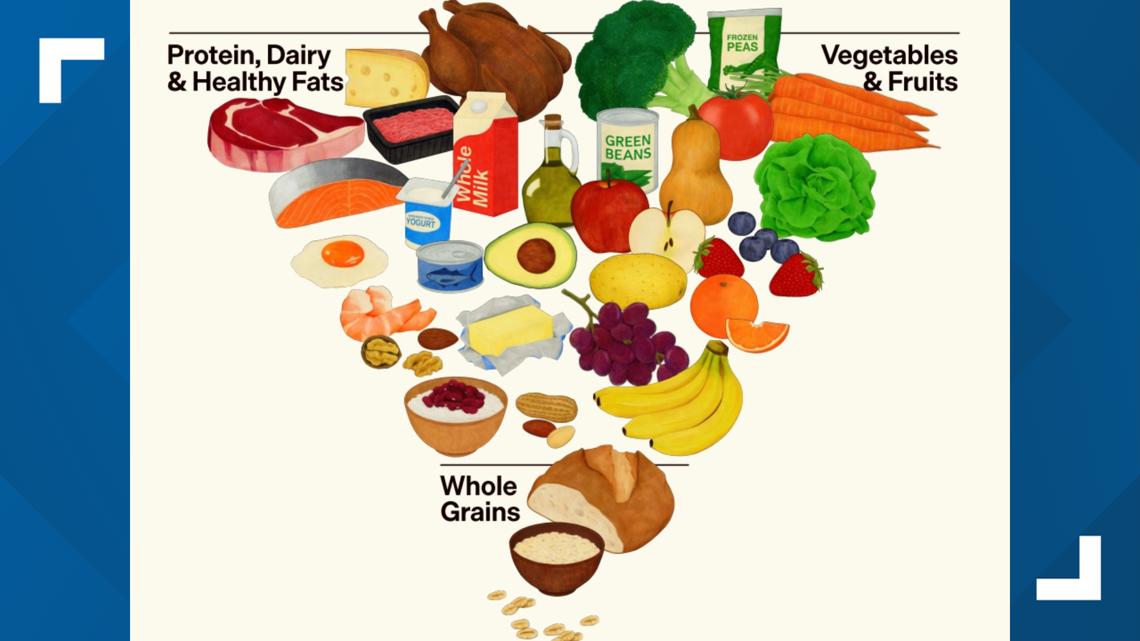
The food pyramid isn’t a formal recommendation from the federal government. Instead, it’s a visual aid designed to help people understand the underlying health guidelines being put forward. However, in the decades it has been in use, the pyramid has become the de facto symbol of diet guidelines in the U.S., and is often used as a shorthand for those guidelines.
That’s why, health officials say, having one that clearly represents the eating habits being promoted is important.
Why was the food pyramid changed?
At a White House briefing, Kennedy said he wanted Americans to eat “real food,” saying that the pyramid and guidelines it represents prioritize high quality protein, healthy fats, fruits and vegetables.
It’s in line with his “Make America Healthy Again” plan, which Kennedy has been attempting to implement across the federal government’s guidelines on everything from food to vaccines.
The 2026 change wasn’t out of the blue. Every five years, federal officials change and update dietary guidelines to reflect current understandings of what food contributes to a healthy lifestyle.
This update isn’t the first time the food pyramid was changed, or even dropped, in the U.S.
In 2011, the pyramid was replaced by MyPlate, a diagram of a plate sectioned off proportionally with various food groups. That change was made because the original pyramid and its later versions were too complicated and didn’t show portion size well.
What are experts saying?
Dr. Marion Nestle, the Paulette Goddard Professor Emerita of Nutrition, Food Studies and Public Health at New York University, told CNN that some of the new pyramid’s goals would be good for Americans.
“There’s some really good things about it that can really make a difference,” she said.
But Nestle cautioned that the return to a pyramid shape, especially one that’s inverted instead of the traditional visual people are familiar with, leads to guidelines that are “muddled, inconsistent, ideological, retro and hard to understand.”
Cristina Palacios, professor and chair of the Department of Dietetics & Nutrition at Florida International University, was one of the people responsible for the 2025 Dietary Guidelines Scientific Report, a study that examined best practices for healthy eating.
“Most of the committee’s recommendations were ignored,” she wrote in an article for The Conversation.
Kennedy’s high recommendation for red meat in particular is one experts highlight as bad and potentially dangerous food science.
Numerous studies, including a Harvard report from 2020, link red meat and their associated saturated fats to potentially deadly health complications. The Harvard study specifically points to red meat being the culprit behind higher risk for heart disease, cancer, diabetes, and premature death.
“Some of the changes in the 2025-2030 guidelines, such as limiting ultraprocessed foods, are beneficial,” Palacios wrote. “But the problem is that it’s not possible to determine whether the necessary scientific rigor was applied in developing them.”