
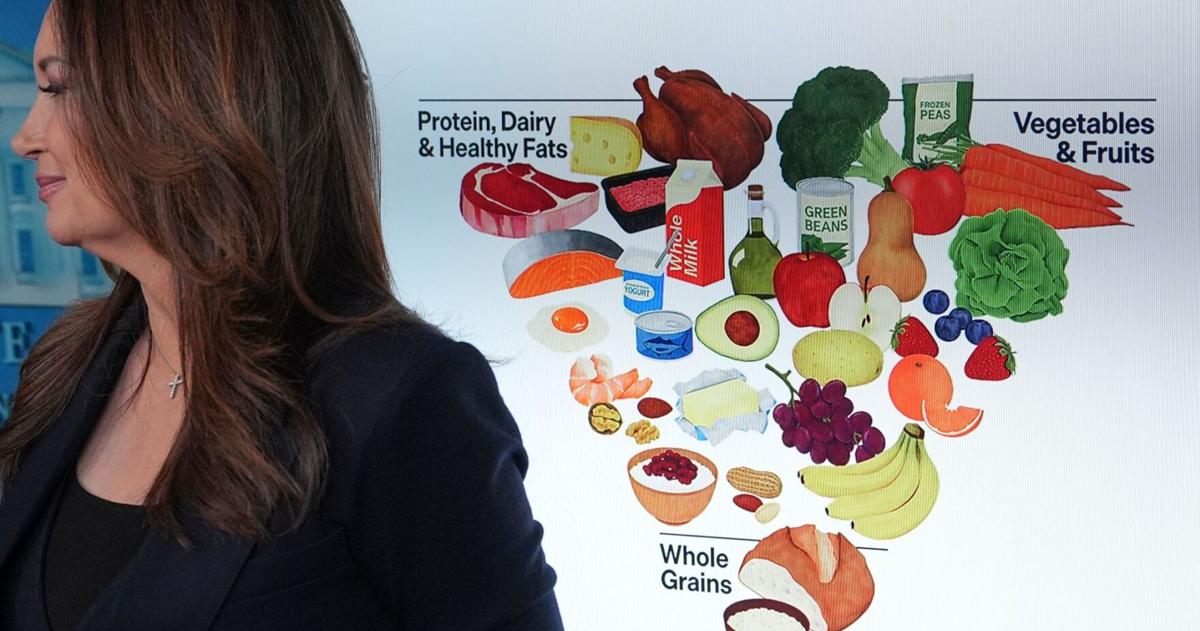
New dietary guidelines flipped the food pyramid upside down, making changes to the recommended American diet including smaller portion sizes, more protein and fewer whole grains.
On Jan. 7, Health Secretary Robert F. Kennedy Jr. and U.S. Secretary of Agriculture Brooke Rollins issued the 2025-2030 U.S. Dietary Guidelines for Americans, required by law to be updated every five years. The guidelines provide the foundation for federal nutrition programs and policies.

The old (1995) and new (2026) food pyramids — showing a transition from a high-carbohydrate diet to a high-protein diet recommendation for Americans.
Graphics provided by U.S. Dietary Guideilnes
The new, inverted pyramid is made up of three sections, rather than the six from the previous food pyramid. The new food groupings include:
Protein, dairy and healthy fats: targeting 1.2 to 1.6 grams of protein per kilogram of body weight per day — that’s around 80 to 100 grams of protein for a 150-pound adult.Vegetables and fruits: targeting three servings of vegetables per day and two servings of fruits per day.Whole grains: targeting two to four servings a day.
“In my opinion, the (original) food pyramid never caught on. I think people were confused and could never really grasp what they should eat,” said Catherine Champagne, a nutritional expert at Pennington Biomedical Research Center in Baton Rouge and developer of the acclaimed D.A.S.H. diet. “It’s going to be even more confusing for people upside down.”
Rather than a pyramid, Champagne prefers the MyPlate because it is simple and easy to follow, showing people how much of a plate should be filled with fruits, vegetables, grains, dairy and protein.
“My overall take on this is that the pyramid is not a good educational mechanism to teach people how to eat,” Champagne said. “But, I am happy that we are talking about making whole foods a part of the diet and decreasing the consumption of ultra-processed foods.”
A clear message: Eat real food
The guidelines take a new stance on “highly processed” foods, and refined carbohydrates, urging consumers to avoid “packaged, prepared, ready-to-eat or other foods that are salty or sweet, such as chips, cookies and candy.”
That’s a different term for ultra-processed foods, the super-tasty, energy-dense products that make up more than half of the calories in the U.S. diet and have been linked to chronic diseases such as diabetes and obesity.
FILE – Fruit are displayed at Iovine Brothers Produce in Philadelphia, May 29, 2007. (AP Photo/Matt Rourke, File)
Matt Rourke
“We’re not talking about all processed foods,” Champagne said. “Even cheese has to be processed from milk.”
Champagne says one primary concern are snacks, like chips and other ultra-processed items “that have ingredients lists that take up half the page.”
Ultra-processed food: What is it and how bad is it?
These foods are typically high in energy density due to their sugar and fat content, according to Candid Rebello, director of the nutrition and chronic disease program at Pennington Biomedical Research Center. Processed foods lead to excess calorie intake within and across meals.
“The guidelines promote an inadvertent reduction in calorie intake, an approach that has been clearly shown to lower overall food intake and body weight,” Rebello said.
Protein, protein and more protein
The new guidance backs away from revoking long-standing advice to limit saturated fats, despite signals from Kennedy and Food and Drug Commissioner Marty Makary that the administration would push for more consumption of animal fats to end the “war” on saturated fats.
Instead, the document suggests that Americans should choose whole-food sources of saturated fat — such as meat, whole-fat dairy or avocados — while continuing to limit saturated fat consumption to no more than 10% of daily calories.
The guidance says “other options can include butter or beef tallow,” despite previous recommendations to avoid those fats.
The previous recommended dietary allowance called for 0.8 grams of protein per kilogram of body weight, about 54 grams daily for a 150-pound person — the equivalent of about one large 10-ounce steak.
The new recommendation is 1.2 to 1.6 grams of protein per kilogram of body weight, 108 grams daily for a 150-pound person — that’s nearly twice the previously recommended limit — the equivalent of about four hamburger patties or about 12 ounces of peanut butter or more than five cups of cooked lentils, according to protein content estimations from Johns Hopkins Center for Bariatric Surgery.
Champagne has a problem with the emphasis on protein.
She says the real number to reach the new recommended protein levels is be too much. Proteins require more energy to metabolize than sugars. Increasing protein intake may put unneeded stress on metabolism.
Catherine, “Cathy,” Champagne celebrates 35 years at Pennington Biomedical Research Center in Baton Rouge, La.
Photo provided by Catherine Champagne
“(Americans) are probably already getting enough protein,” Champagne said.
New guidelines also stress the consumption of red meat. However, according to Champagne, the saturated fat associated with red meat can be a risk for cardiovascular disease.
“Some of that high-level historical research is not being addressed in saturated fat and animal proteins, particularly red meats,” Champagne said.
The guidelines additionally advise avoiding or sharply limiting added sugars or nonnutritive sweeteners, saying “no amount” is considered part of a healthy diet.
No one meal should contain more than 10 grams of added sugars, or about 2 teaspoons, the new guidelines say. In general, most Americans consume about 17 teaspoons of added sugars per day, according to the U.S. Centers for Disease Control and Prevention.
Alcohol limits removed
The new guidelines roll back previous recommendations to limit alcohol to 1 drink or less per day for women and 2 drinks or less per day for men.
Instead, the guidance advises Americans to “consume less alcohol for better health.” They also say that alcohol should be avoided by pregnant women, people recovering from alcohol use disorder and those who are unable to control the amount they drink.
Changing over 45 years
The dietary guidelines, required by law to be updated every five years, provide a template for a healthy diet. But in a country where more than half of adults have a diet-related chronic disease, few Americans actually follow the guidance, research shows.
The new document is just 10 pages, upholding Kennedy’s pledge to create a simple, understandable guideline. Previous editions of the dietary guidelines have grown over the years, from a 19-page pamphlet in 1980 to the 164-page document issued in 2020, which included a four-page executive summary:
The first three federal dietary guidelines, 1980, 1985 and 1990, encouraged eating a variety of foods, avoiding saturated fats and cholesterol, getting adequate fiber and limiting “too much” sugar and sodium. They included how many calories per hour a person loses for various physical activities — including ballroom dancing, cleaning house, cross-country skiing and shoveling snow.The 1995 dietary guidelines introduced the “food guide pyramid” with an emphasis on bread, cereal, pasta and rice. Grains were recommended as the “foundation” of all meals.In 2000, 2005 and 2010, the guidelines mentioned obesity as an “epidemic” for the first time. These three guidelines also put significance on measuring body mass index, or BMI, and how to use the figure to adjust dietary needs with an emphasis on counting calories.In 2015, the dietary guidelines addressed unhealthy beverages and sugary drinks. In 2020, the guidelines took “budgetary” and “cultural” choices into consideration in the recommendations.
The guidance will have the most profound effect on the federally funded National School Lunch Program, which is required to follow the guidelines to feed nearly 30 million U.S. children on a typical school day.
The Agriculture Department will have to translate the recommendations into specific requirements for school meals, a process that can take years, said Diane Pratt-Heavner, spokesperson for the School Nutrition Association. The latest school nutrition standards were proposed in 2023 but won’t be fully implemented until 2027, she noted.