
ANNOUNCER: NPR.
[COIN SPINNING]
[THEME MUSIC]
WAILIN WONG: This is The Indicator from Planet Money. I’m Wailin Wong.
DARIAN WOODS: And I’m Darian Woods. You might have seen earlier this month, the Trump administration introduced a new food pyramid. The government flipped the old pyramid upside down, literally.
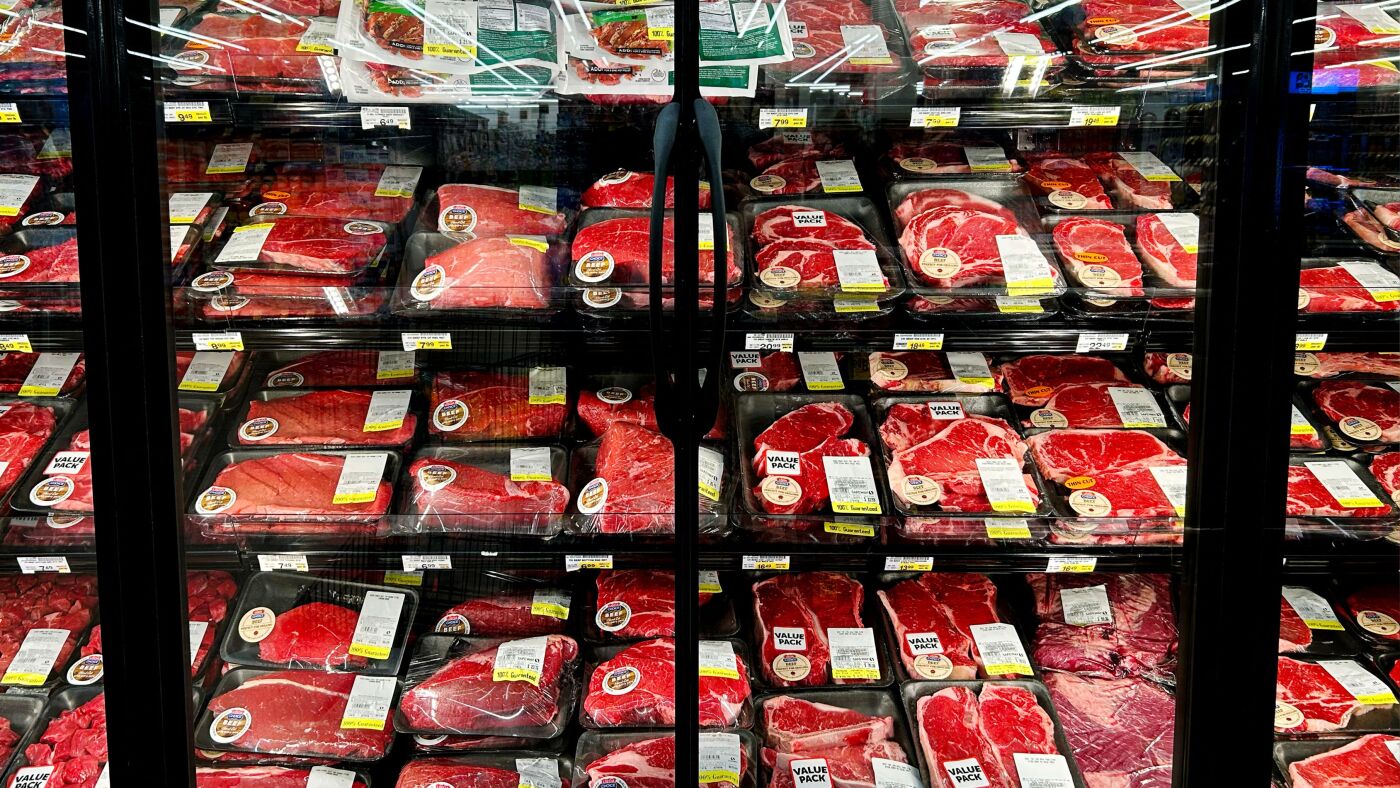
WONG: Yeah, the new pyramid is inverted, so the widest part is now at the top. And occupying the top row are foods like a thick cut of steak and a wedge of cheese. There’s also broccoli and carrots, but fruits and vegetables are given as much importance as what the pyramid labels as protein, dairy, and healthy fats.
WOODS: Health Secretary Robert F. Kennedy, Jr. is arguably the country’s highest profile carnivore. He said in a recent press conference that he’s fixing incorrect guidance from previous administrations.
[AUDIO PLAYBACK]
ROBERT KENNEDY: Protein and healthy fats are essential and were wrongly discouraged in prior dietary guidelines. We are ending the war on saturated fats.
[END PLAYBACK]
WOODS: The Secretary is talking about the fats found in red meat, butter, and cheese. So it looks like beef is back on the menu. But did it ever really leave?
WONG: Today on the show, we trace the rise of beef consumption in the US to see how the industry and government have long shaped the American diet.
[AARON COPLAND, “HOEDOWN”]
WONG: Beef has always been a huge part of the US diet, no matter the food pyramid looks. Joshua Specht dates America’s love affair with beef back to the late 1800s. Joshua is a history professor at the University of Notre Dame who studies ranching and meatpacking.
JOSHUA SPECHT: My story starts in the late 1800s, and that’s when affordable, high-quality beef became a kind of expectation for people.
WOODS: Beef production and consumption used to be local. If you lived near a cattle ranch, you had better access to meat than someone living across the country.
WONG: This changed dramatically in the 1800s. The US government took away land from Native Americans in the Western part of the country, and opened it up for cattle ranching.
WOODS: Over in Chicago, meatpackers and railroads built state-of-the-art facilities for processing pigs, sheep, and cattle. Refrigerated rail cars whisked cuts of meats to other parts of the country. And this meant that somebody living far from where the cattle was raised could still eat beef regularly.
[AUDIO PLAYBACK]
SPECHT: It kind of goes from what I say is delicacy to daily fare. And the measure of a successful person and a successful man and a successful American becomes your ability to have beef all the time.
[END PLAYBACK]
WONG: Joshua says Americans understanding of nutrition at this time and into the early 1900s was pretty limited. Concerns over heart health and red meat wouldn’t become part of the conversation until decades later.
WOODS: On a September day in 1955, President Eisenhower ate a hamburger for lunch and then felt what he thought was indigestion. He woke up after midnight with severe chest pain. It turned out he had suffered a heart attack.
WONG: Hannah Cutting-Jones is a food historian at the University of Oregon. She says Eisenhower’s heart attack was a wake-up call.
[AUDIO PLAYBACK]
HANNAH CUTTING-JONES: For the first time Americans were really freaked out. He was a middle-aged man. He ate a lot of meat. And they were just starting to come out with this idea of the diet heart hypothesis, linking diets high in saturated fat to heart disease and heart attacks.
[END PLAYBACK]
WONG: Hannah says that studies at this time suggested a correlation between the diets of many middle-aged American men and rates of heart disease. Even so, American beef consumption kept climbing. It hit a peak in the 1970s. Americans ate an average of 86 pounds per capita during the decade.
WOODS: So all that counterculture of vegetarianism of the ’60s and ’70s were no match for the carnivores.
WONG: No, not according to the statistics. But Hannah says concerns over heart health were on the minds of lawmakers when they set up the first congressional committee on nutrition in the late ’60s.
WOODS: Later on, climate concerns bubbled up. In 1989, the Environmental Protection Agency put out a report saying animals were an important source of methane emissions.
[AUDIO PLAYBACK]
CUTTING-JONES: For the first time, there was a global consensus that climate change was tied to methane production from the beef industry.
[END PLAYBACK]
WONG: It was also around this time that the US government was working on its first official set of dietary guidelines, what would eventually become the first food pyramid. Hannah says the beef industry was really motivated to take back the narrative. It didn’t want beef to get villainized as this unhealthy, planet-destroying food.
WOODS: So the industry did two important things. First, it pushed for friendlier wording in dietary guidelines. This language was incorporated into the first official food pyramid, which came out in 1992.
[AUDIO PLAYBACK]
CUTTING-JONES: And so they go from “eat less red meat” to “avoid saturated fat,” “eat less solid fat,” things like that that were pretty vague for Americans to understand.
[END PLAYBACK]
WONG: And secondly, farmers and ranchers launch an ad campaign to encourage Americans to eat more beef. Since the 1980s, they had been making mandatory contributions to a shared pot of money. The US Department of Agriculture and Beef Board oversee this program, and the funds are earmarked for promotion. The ranchers use the money for radio and TV commercials that started airing in 1992.
[AUDIO PLAYBACK]
ROBERT MITCHUM: Another day is drawing to a close. And all kinds of people all over the country are heading home for dinner.
[END PLAYBACK]
WOODS: What are they gonna do there?
WONG: [LAUGHS] I’m a child of the ’90s, and I vividly remember these commercials. The music is from the ballet Rodeo by American composer Aaron Copland.
WOODS: OK.
WONG: Yeah. Rugged American actor Robert Mitchum is the narrator. And one version of the intersperses idyllic scenes of American farmland with suburban families putting dinner on the table.
[AUDIO PLAYBACK]
MITCHUM: Beef it’s what’s for dinner.
[END PLAYBACK]
WOODS: It’s your only option.
WONG: [LAUGHS]
WOODS: Hannah says the ads were targeted at men, and that you can see their effect today. About 12% of Americans are responsible for about 50% of beef consumption on any given day.
[AUDIO PLAYBACK]
CUTTING-JONES: And out of that percentage, most of those are men.
[END PLAYBACK]
WOODS: We mentioned before that beef consumption peaked in the 1970s. Americans ate around 86 pounds per capita then. In recent years, that’s dropped to around 60 pounds a year. Americans eat way more chicken, about 100 pounds per capita.
WONG: It’s just so many nuggets, Darian, you can’t imagine. Still, Hannah says beef has never really been in serious decline in the US. And today, red meat lovers have a new champion in RFK, Jr. The government’s guidelines call for Americans to nearly double their protein intake from what was previously recommended. And they mention beef tallow alongside olive oil as a healthy fat for cooking.
WOODS: And despite the declared end to the war on saturated fats that we heard from at the start of the show, the guidelines do keep in place a previous recommendation to limit saturated fats to 10% of total daily calories. Hannah says this guidance is confusing. How is someone supposed to limit saturated fats while eating more animal protein?
WONG: The National Cattlemen’s Beef Association, for its part, praised the new guidelines as simpler and more consumer-friendly than past versions. It’s worth mentioning that the organization has ties to the panel that reviewed scientific research for the new dietary guidelines. Three of the nine panelists disclosed that they received money from the National Cattlemen’s Beef Association for research or consulting.
WOODS: We reached out to the Department of Health and Human Services about whether these ties represented a conflict of interest. Press Secretary Emily Hilliard said the panel’s conclusions were driven by evidence and scientific rigor.
WONG: And historian Joshua Specht says beef has proven very hard to dethrone as an American symbol, is now a marker of political identity for some people. Republicans have talked about Liberals wanting to take away hamburgers.
WOODS: Hamburglers, they call them.
[AUDIO PLAYBACK]
SPECHT: For cultural reasons, I think there is no effective substitute. So much of our identity is tied up in what we eat that shifts in diet are very slow.
[END PLAYBACK]
WONG: And, you know, the guidelines get revised every five years. So things could change again before too long.
WOODS: I hope they address this upside-down pyramid because, like, is the bottom– it’s smaller, but is it the base of diet. I’m so confused.
WONG: You’re concerned about, like, the structural integrity of this pyramid.
WOODS: Yeah, as it might fall over.
WONG: It’s balanced on a single oat.
WOODS: Yes.
[AARON COPLAND, “HOEDOWN”]
Copyright © 2026 NPR. All rights reserved. Visit our website terms of use and permissions pages at www.npr.org for further information.
Accuracy and availability of NPR transcripts may vary. Transcript text may be revised to correct errors or match updates to audio. Audio on npr.org may be edited after its original broadcast or publication. The authoritative record of NPR’s programming is the audio record.