
STEVE INSKEEP, HOST:
A lot of people want to eat fewer ultra-processed foods. Studies show they raise the risk of health problems like diabetes, cardiovascular disease, even depression. But how do you know if the food is ultra-processed? Michaeleen Doucleff has one answer.
MICHAELEEN DOUCLEFF, BYLINE: The ultra-processed food test comes from Dr. Dariush Mozafarian. He heads the Food is Medicine Institute at Tufts University.
DARIUSH MOZAFFARIAN: What I call the water test.
DOUCLEFF: The water test, he says, is especially useful for figuring out if carbohydrates are ultra-processed. So that includes breads, crackers, pretzels, puffed corn and potato snacks.
MOZAFFARIAN: When people ask me about ultra-processed foods, they’re often most confused about grains and carbohydrates and starches – how to choose more healthful versions.
DOUCLEFF: Essentially, he says, you take the carbohydrate – say a chunk of bread or a few pieces of granola bar – and…
MOZAFFARIAN: Put it in a cup of water and come back three or four hours later. What is it going to look like?
DOUCLEFF: Specifically, he says, look to see whether or not it dissolves.
MOZAFFARIAN: If it’s still kind of mostly intact, that’s going to be slowly digested.
DOUCLEFF: And slowly digested food gets further into your gut, where it feeds your microbiome, which you need to be healthy. But ultra-processed carbohydrates digest quickly because of the way they are manufactured. Companies, in effect, predigest the grains, corn or potato.
MEROE MORSE: It’s ground down to its individual ingredients and then repackaged and glued together.
DOUCLEFF: That’s Dr. Meroe Morse at MD Anderson Cancer Center. She says when you put an ultra-processed carb into water, it melts quite rapidly. And that’s what happens in your gut.
MORSE: It gets digested really quickly and it can create a glucose spike. And when you have a glucose spike, insulin levels tend to rise.
DOUCLEFF: Over time, these spikes can contribute to insulin resistance and eventually diabetes. So when you’re choosing carbohydrates, you want to go for ones that will hold together in water. And that’s where the water test comes in. I tried it with my daughter, Rosy.
ROSY: Hello.
DOUCLEFF: Rosy is how old?
ROSY: Ten.
DOUCLEFF: Ten. We have two types of bread with us. We have a French baguette that we bought at the grocery store. It has what in it, Rosy?
ROSY: White flour, dextrose, wheat gluten.
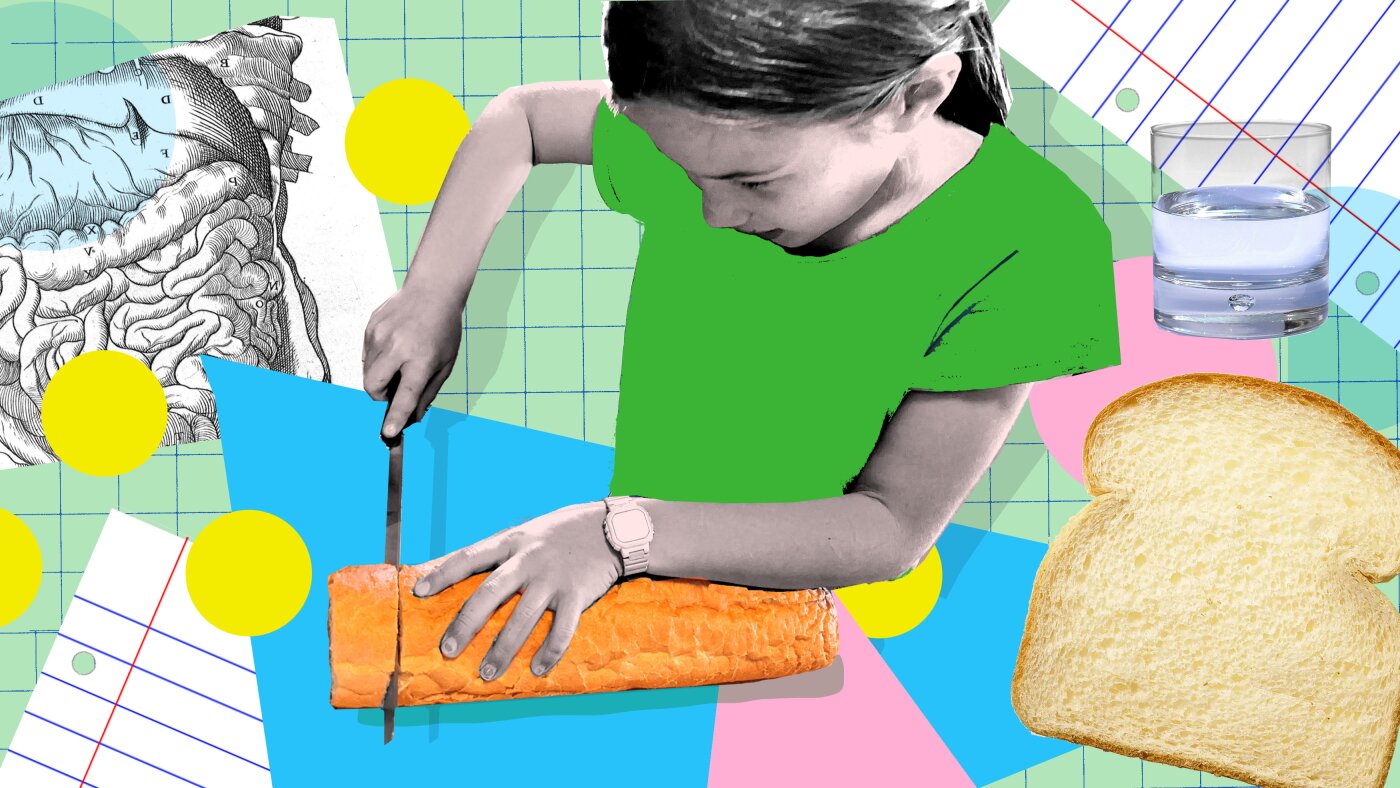
DOUCLEFF: So a bunch of preservatives and additives. We also have a whole wheat bread that we made in our kitchen. So we’re going to take a big chunk of each of these breads, and we’re going to put those chunks into a glass of water.
DOUCLEFF: Three hours later, Rosy and I first examined the homemade whole wheat bread.
Does it still look like bread?
ROSY: Yes.
DOUCLEFF: Is it still intact?
ROSY: Yes.
DOUCLEFF: Has it dissolved?
ROSY: No.
DOUCLEFF: No, it hasn’t dissolved.
So our homemade bread passed the water test. It’s minimally processed. On the other hand, the baguette…
ROSY: Oh, wow.
DOUCLEFF: (Laughter).
ROSY: I can barely pick it up. It’s like a sponge.
DOUCLEFF: …It has absorbed an enormous amount of water. And look inside the water. What’s happening to it?
ROSY: It’s dissolving.
DOUCLEFF: So the baguette failed the water test. It’s clearly ultra-processed.
ROSY: It’s kind of gross. Bread should not be like that.
DOUCLEFF: And it shouldn’t dissolve so quickly inside our bodies.
For NPR News, I’m Michaeleen Doucleff.
(SOUNDBITE OF MUSIC)
Copyright © 2026 NPR. All rights reserved. Visit our website terms of use and permissions pages at www.npr.org for further information.
Accuracy and availability of NPR transcripts may vary. Transcript text may be revised to correct errors or match updates to audio. Audio on npr.org may be edited after its original broadcast or publication. The authoritative record of NPR’s programming is the audio record.