

Hard though it is to believe, some people don’t enjoy jogging. That’s why online fitness coach Jeremy Ethier conducted an experiment into which cardio exercises rival or beat jogging for fat burn.
Jeremy was joined by his friend Dennis, who has a significantly lower fitness level than him. Fitness level impact fat burn – those with superior fitness are typically better able to convert stored fat into energy– so this experiment offers a useful insight into how the ‘best’ cardio exercises might differ depending on someone’s base fitness. Scroll for each of their rankings.
How they tested
Each activity was tested using a metabolic mask to measure calorie expenditure – considered the gold standard for such data collection outside a lab setting. It works by measuring the air you breathe in and out during exercise, tracking how much oxygen you use and carbon dioxide you produce to calculate your calorie burn, and whether those calories derive more from fat or carbohydrates. That’s markedly different to smartwatches or gym machines, which estimate calorie burn based on metrics such as heart rate, speed and body weight.
Sex also affects fat-burn efficiency. In fact, researchers from the University of Bath recently found that biological sex and fitness levels are the biggest predictors of people’s ability to burn fat. They also found that fit women burnt fat more efficiently than men during endurance exercise – one of the reasons touted for women’s prowess over ultramarathon distances.
So, while this experiment is still accurate, it’s worth noting that sex as well as fitness level can affect the results.
The resultsSkipping (10 mins)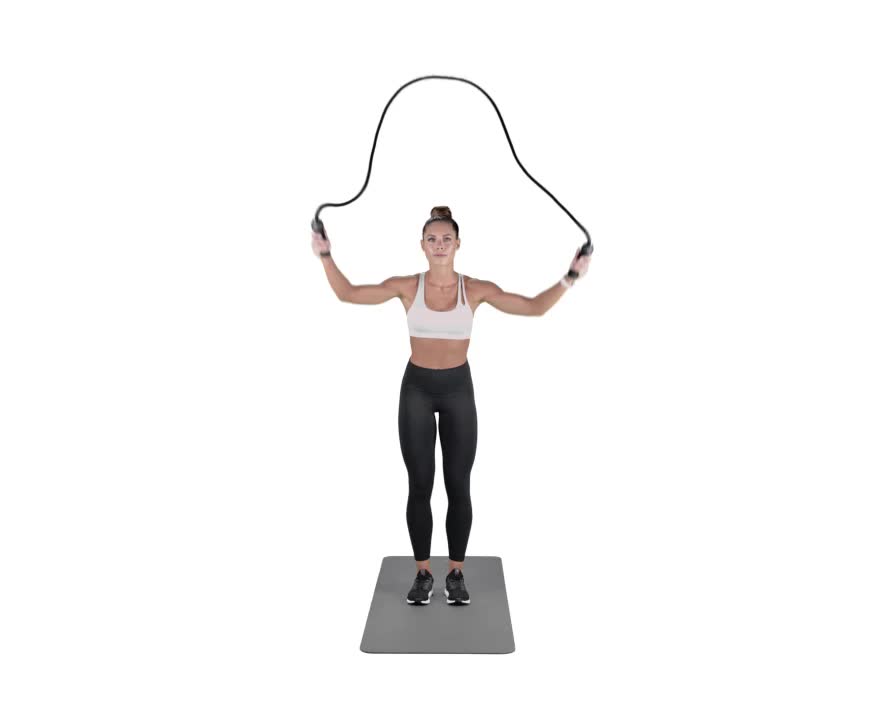
First up, that warm-up staple, skipping. ‘The jump rope workout we’re doing is considered HIIT: high-intensity interval training. You push hard, rest briefly, then repeat,’ said Jeremy in the video documenting the experiment. ‘This type of cardio exploded in popularity because of the so-called “afterburn” effect.’ He’s referring to your body’s ability to continue burning additional calories hours after your workout due to the exertion.
Jeremy burnt 160 calories, with 28 extra ‘afterburn’ calories (measured 20 mins post-recovery) and Dennis burnt 69 calories, with 8 afterburn.
HIIT (10 mins)
On the topic of HIIT, Jeremy and Dennis next tried a YouTube HIIT workout. ‘To boost the intensity without relying on coordination, we turned to one of the most popular YouTube HIIT workouts,’ says Jeremy.
Jeremy burnt 136 calories, with 24 afterburn calories and Dennis burnt 100 and 16 respectively.
However, Jeremy notes that for both skipping and HIIT, his heart rate didn’t reach what is ‘high enough to classify as “actual” HIIT.’
‘Which means we’re gonna go more intense,’ he adds.
Sprint interval training (10 mins)
Which brings us to…fast sprints. They did 10-15 seconds of all-out sprints, followed by 30-60 seconds of walking. ‘Some researchers claim that just one minute of all-out effort can give you the same benefits as 50 minutes of normal cardio.’
Jeremy burnt 178 calories, with 48 afterburn, and Dennis hit 148 and 27 calories respectively.
‘However, one thing I noticed about the data is that 97% of the calories I burnt were from carbs, and only 3% from fat. We’ll talk more about what this means when we compare it to walking later on,’ said Jeremy.
Jogging (20 mins)
Now onto the lower-intensity cardio workouts, beginning with the classic: jogging.
‘Even though our jog was twice as long as our sprint workout, I was not expecting the calorie burn to almost double as well, with me burning 350 calories and Dennis burning 260 calories,’ said Jeremy. ‘But when you look at our heart rate chart, it starts to make sense. Jogging keeps the heart rate consistently elevated in the high range, whereas HIIT only spikes it briefly during intense intervals.’
Fasted jogging (20 mins)  Emilija Manevska//Getty Images
Fasted jogging burnt the same number of calories as regular jogging
Noting a study from the British Journal of Nutrition, which suggests that if you run first thing in the morning on an empty stomach, you burn twice the amount of fat compared with doing the exact same workout after eating, Jeremy explained that they wanted to test the effectiveness of fasted cardio. Indeed, they ‘burnt about the same number of calories as our regular jog – but this time, a bigger chunk of those calories came from fat.’
He cites the work of top exercise science researcher Dr Eric Helms to explain: ‘When you don’t eat before a workout, your body doesn’t have as many carbs to use – so it turns to fat for energy instead.’ However, this isn’t always necessarily a good thing. When you don’t have as much fuel on board, your body uses ‘the available fat stores in your body, which sounds great. But then the rest of the day, you’re going to be relying on other sources of fuel.’ Whereas, if you do a high-intensity session, you’ll primarily burn carbs, depleting glycogen, meaning you’ll use body fat and fatty acid oxidation for the remainder of the day.
‘In both of those two scenarios, the amount of fat loss you achieve or fat mass gain you achieve is going to be dependent upon the net surplus or deficit, not what happened in those 30 minutes,’ explained Helms. In other words, the bigger picture is important – eg, diet and exercise frequency.
‘What he’s saying is backed by long-term studies, which have found no long-term fat loss benefit to doing cardio fasted, but for some people, fasted cardio still might be the better choice,’ said Jeremy. ‘It’s about doing what you’ll be more likely to stick to, and in our case, our joints were starting to take a beating from all our jogging.’
‘It’s about doing what you’ll be more likely to stick to’
Adequately fuelling your body remains crucial – even if weight loss is your goal – which is why it’s always advisable to consult an expert for advice and guidance where possible.
Kangoo jog (20 mins) frantic00//Getty Images
Kangoo boots in action
And now for something completely different ‘[Kangoo Jumps] are banned in races. They look ridiculous. But supposedly, they reduce joint impact by 80% and burn 25% more calories than regular jogging. So could it be the best cardio for losing weight?,’ said Jeremy. Well, Jeremy and Dennis burnt around 315 and 235 calories respectively.
‘Although they definitely felt better on the knees, we ended up burning 10% fewer calories than regular jogging, which might be the weight of the boots [which cost around £200] limiting how fast we could run,’ said Jeremy
Swimming (20 mins)
‘While the mask and drysuit limited our ability to properly swim, just a few minutes in, our heart rates were climbing,’ said Jeremy. ‘After 20 minutes of walking each other like dogs, we ended up burning way more calories than I expected: 276 calories for me, and 223 for Dennis.’
While your swimming session would likely be more efficient than this thanks to the lack of a metabolic mask, it highlights how beneficial the workout is. ‘Unlike most exercises, swimming works nearly every major muscle group at once. More muscles working equals more calories burnt,’ said Jeremy. ‘Plus, water pulls heat away from your body faster than air does, so your body has to burn extra calories just to stay warm, especially in a cooler pool.’
Walking (30 mins)
Arguably the most accessible exercise on this list, it was important to include walking in this experiment. ‘After 30 minutes at 3.2 miles per hour [on the treadmill], we both burnt almost 200 calories each,’ said Jeremy. ‘But the fat burn is where it gets interesting – 81% of the calories we burnt were from fat – the highest so far. Jogging had only 40% fat burn, and sprints were just 3%.’
Again, though, he flags that fat burn and fat loss are not the same. ‘Just like fasted cardio, what really matters is your total calorie burn,’ says Jeremy. ‘And while walking wasn’t the highest burner, it can quickly add up,’ he adds, highlighting a study that found people who added 2.5 hours of extra walking per week (around 20 mins a day), experienced an extra 3.5 pounds of fat loss in 12 weeks.
Incline walking (6%, 30 mins)
One way you can increase the total calorie burn of your walk? Add an incline. ‘Compared to flat walking at the same speed, we both burnt about 50% more calories,’ says Jeremy. That’s a steep improvement.
‘We also tested walking with a 20-pound [9kg] backpack to see if it could be the best cardio for losing weight,’ says Jeremy. Also known as rucking, this exercise had different results for each individual.
‘For me, it only burnt 13% more than regular walking,’ says Jeremy. ‘But for Dennis, since 20 pounds is a bigger jump for his body weight, he burnt 30% more,’ he added, noting that the difference helps explain why people can plateau with fat loss.
‘As you lose fat, it’s like taking off a backpack full of the fat you’ve been carrying around all day. So you burn fewer calories, even if nothing else changes. So to keep fat loss moving, you’ll eventually have to eat a bit less, move a bit more – and ideally, lift weights to prevent muscle loss and keep your metabolism high,’ said Jeremy.
StairMaster (20 mins)
The pair also tested two activities classed as moderate intensity, starting with the StairMaster – a marmite gym machine for many. ‘After 20 minutes of watching our favourite shows, the machine said I burnt 223 calories, and Dennis burnt 190,’ said Jeremy. However, ‘cardio machines use generic algorithms to estimate calorie burn, and have been known to be off by up to 10-30%, which explains why, according to the mask, I actually burnt 256 calories and Dennis burnt 215.’
So, if you’re just going on your machine’s number, know that it’s likely conservative.
Boxing (20 mins)
So you’re probably not going to be able to watch your favourite TV show while doing this activity – and if you don’t enjoy it, you might be better off returning to the StairMaster. ‘It felt brutal, but with all the rest between rounds, after 20 minutes, it became clear it wasn’t the best cardio for losing weight; the calorie burn was actually about the same as the StairMaster – 270 for me, and 215 for Dennis,’ said Jeremy.
For a visual ranking of all the activities, see the figures below
Jeremy total calories burntJogging (20 mins) – 350 kcal
Fasted jogging (20 mins) – 335 kcal
Kangoo jog (20 mins) – 320 kcal
Incline walking, 6% (30 mins) – 295 kcal
Swimming (20 mins) – 276 kcal
Boxing (20 mins) – 270 kcal
StairMaster (20 mins) – 256 kcal
Weighted walking, +20 lb (30 mins) – 225 kcal
Regular walking, 3.2 mph (30 mins) – 196 kcal
HIIT sprints (10 mins) – 178 kcal
Jump rope (10 mins) – 146 kcal
HIIT bodyweight (10 mins) – 136 kcal
Dennis total calories burntJogging (20 mins) – 260 kcal
Incline walking, 6% (30 mins) – 250 kcal
Fasted jogging (20 mins) – 250 kcal
Kangoo jog (20 mins) – 240 kcal
Weighted walking, +20 lb (30 mins) – 226 kcal
Swimming (20 mins) – 223 kcal
Boxing (20 mins) – 218 kcal
StairMaster (20 mins) – 215 kcal
Regular walking, 3.2 mph (30 mins) – 175 kcal
HIIT sprints (10 mins) – 148 kcal
HIIT bodyweight (10 mins) – 100 kcal
Jump rope (10 mins) – 69 kcalJeremy – calories burnt per minuteHIIT sprints – 17.8 kcal/min
Jogging – 17.5 kcal/min
Fasted jogging – 16.75 kcal/min
Kangoo jog – 16 kcal/min
Jump rope – 14.6 kcal/min
Swimming – 13.8 kcal/min
HIIT bodyweight – 13.6 kcal/min
Boxing – 13.5 kcal/min
StairMaster – 12.8 kcal/min
Incline walking (6%) – 9.8 kcal/min
Weighted walking (+20 lb) – 7.5 kcal/min
Regular walking (3.2 mph) – 6.5 kcal/min
Dennis – calories burnt per minuteHIIT sprints – 14.8 kcal/min
Jogging – 13 kcal/min
Fasted jogging – 12.5 kcal/min
Kangoo jog – 12 kcal/min
Swimming – 11.2 kcal/min
Boxing – 10.9 kcal/min
StairMaster – 10.8 kcal/min
HIIT bodyweight – 10 kcal/min
Incline walking (6%) – 8.3 kcal/min
Weighted walking (+20 lb) – 7.5 kcal/min
Jump rope – 6.9 kcal/min
Regular walking (3.2 mph) – 5.8 kcal/min Try our marathon plans for free
Fancy giving our marathon plans a try? For a limited time only, we’re giving customers the chance to unlock 14 days of free access to our complete training plan library on the Runner’s World UK app.
Related Story