

It’s a familiar story: you want to get better at running so you start hitting a couple of hell-for-leather 5ks each week. But a few months in, your body feels beaten up and the time you’re running starts to plateau.
The primary fix is introducing a varied training week containing different types of runs to develop specific speed-boosting traits. But there are also ways you can improve your running ability without adding any extra running into your week, according to top endurance coach and Adidas ambassador Chris Hinshaw.
He describes these techniques as “cheat codes” of sorts – ways to better understand your body, get more out of it and improve your running capacity without racking up mile after mile.
Here are the three ways guaranteed to skyrocket your aerobic fitness, running ability and performance.
Mix modalities to reduce stress on the body
“The first thing someone needs to do [to get better at running] is develop their capacity,” Hinshaw explains.
“The risk is, if someone jumps straight into running regularly having not spent that much time on their feet before, they’re going to get hurt. So we devise ways – cheat codes, essentially – to build capacity in other movements that mimic the movement of running.”
Using an exercise bike is his go-to example. While running puts a significant amount of load through your lower body bones and joints, cycling can have you breathing hard “without creating the same structural damage”. However, it is more nuanced than simply saddling up and starting to pedal.
“When you run, you’re probably taking somewhere around 170 steps per minute,” says Hinshaw. Most fitness trackers will provide this information. Alternatively, you can run at your steady pace for 20 seconds, count the steps you take, then multiply this by three to get a good ballpark figure.
“If I put you on a bike, and we want the cadence to be identical to your running, 170 steps per minute is the equivalent of 85 revolutions per minute,” he adds.
Hinshaw recommends following a 30-minute cycle at this cadence with a 15-minute run at a sustainable pace – one at which you could comfortably hold a conversation.
“Now you’ve had 45 minutes of time under tension, cardiorespiratory adaptation and muscular stamina development, all while saving the knees, hips and ankles from too much joint stress” says Hinshaw. You have also had the chance to practice the skill of running and acclimatise your body to this higher impact activity.
Read more: How to start strength training and see results at any age, according to a top muscle growth expert
 Walking with a weighted rucksack, or rucking, raises the heart rate more than a standard stroll, leading to greater fitness adaptations (The Independent/Harry Bullmore)
Keep on rucking
Another way you can achieve this is through rucking – walking while carrying a weighted backpack.
The more weight you are moving, the harder your heart and lungs work to transport the nutrients needed to fuel your efforts. This is why rucking raises your heart rate more than a standard walk.
“I want you to carry roughly 10 per cent of your body weight, then we’re going to manipulate your cadence to deliver fitness benefits,” says Hinshaw.
“When you’re walking briskly, with intention, a normal cadence is about 115 to 125 steps per minute. If you carry a load at this higher pace, it’s going to put your heart rate in zone two, creating all the same respiratory adaptations as running, but through walking.”
The “beautiful” bonus benefit of this is it also creates structural adaptations, strengthening your bones, ligaments and tendons, adds Hinshaw.
Once again, he says, an effective protocol for those looking to shave down their 5k time would be to ruck for 30 minutes then finish with a 15-minute run.
“Your brain and your body are going to feel like they’ve just been for a 45-minute run, when in actual fact it was only 15 minutes,” says Hinshaw. “You are building capacity through these cheat codes, without having to do hours of running each week.”
Read more: Rucking is the fitness trend that’s here to stay – here’s why you should try it
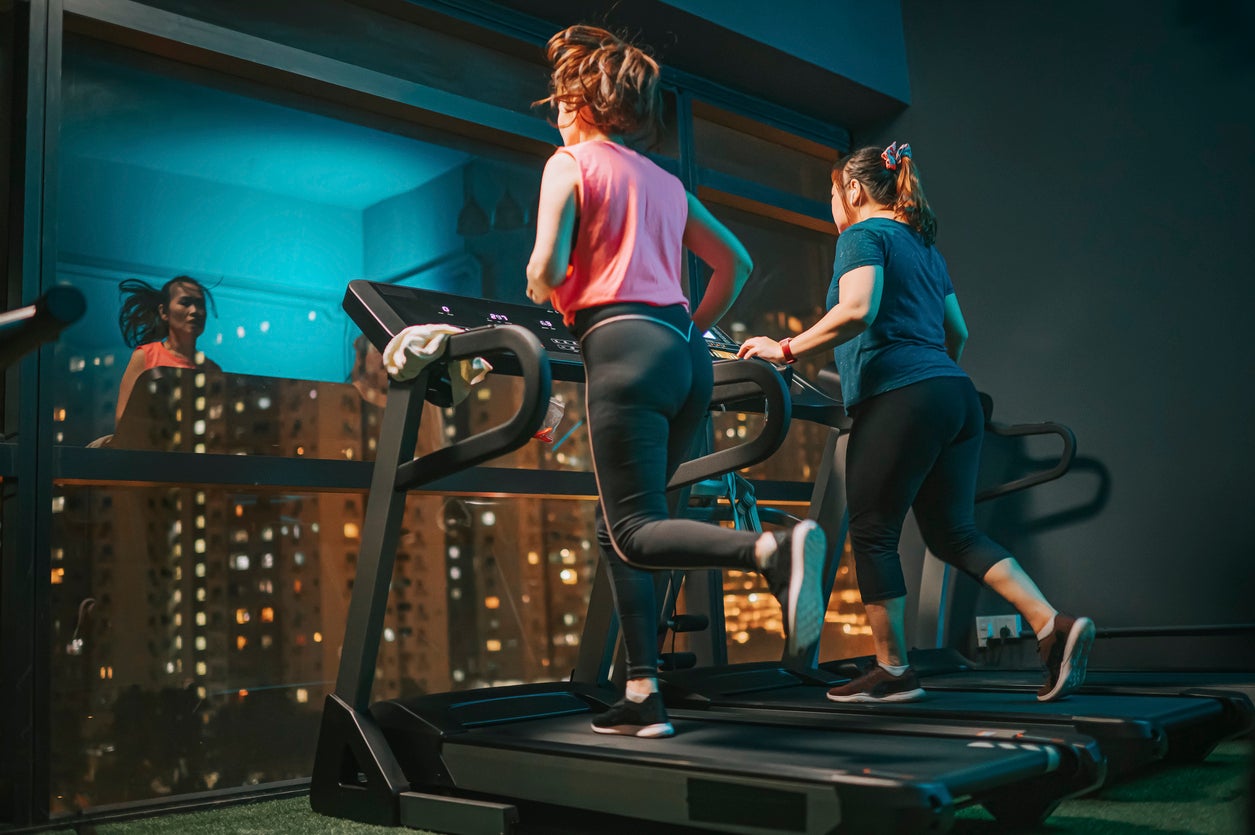 Switching out running for a lower impact aerobic activity like using an exercise bike can be a way to improve your fitness without putting as much stress on the body as you would while running (Getty/iStock)
Focus on your breath – it can tell you when you’re in trouble
People tend to rely heavily on fitness trackers to tell them about the intensity of their workouts – usually via heart rate. But there is a better way, according to Hinshaw, which doesn’t involve dropping hundreds of pounds on an expensive wearable.
“The breath is the best way to monitor your workout intensity because it’s measuring your demand for oxygen,” says Hinshaw. “What happens when you increase the intensity of your workout? Your demand for oxygen goes up, so your heart rate rises to feed oxygen-rich blood to the moving muscles. We react to intensity, and our respiration rate changes.”
A lot can be learned from paying attention to how you are breathing during a workout. Is your breath fast or slow? Is it ragged or regular?
“When running, the exhale always occurs on a foot strike,” Hinshaw explains. “The most extreme form of breathing when running is called a two-count.” Here, you breathe in on one step, out on the next, then repeat the cycle.
“When you are in that situation, you are in deep trouble,” he continues. “You are going way too fast for your body to sustain this pace; you are accumulating massive amounts of lactate and it’s only a matter of time before your muscles shut down. Soon your only options will be to stop or slow down.”
Instead, for hard but sustained efforts like a 5k, Hinshaw teaches people to settle into a four-count breathing rhythm. Here, you inhale for three strides and exhale on the fourth.
“If you are running a 5k or Hyrox and, 600m in, you’re taking just two steps per cycle of breath, it’s time to slow down,” says Hinshaw. “The breath is the tell. It’s a way to assess yourself and your fatigue at any time during a run. Elite athletes use the breath to monitor intensity and pace. That’s why they win – because they’re smart.”
It works when gauging how much other runners have left in the tank too – handy when you’re feeling competitive at your local ParkRun. If those around you are breathing in and out with each stride, their pace will soon plummet. But if you are struggling to keep step with someone whose breathing is slow and controlled, they are going to be hard to beat.
Read more: The enjoyable exercise better than walking for lifelong fitness
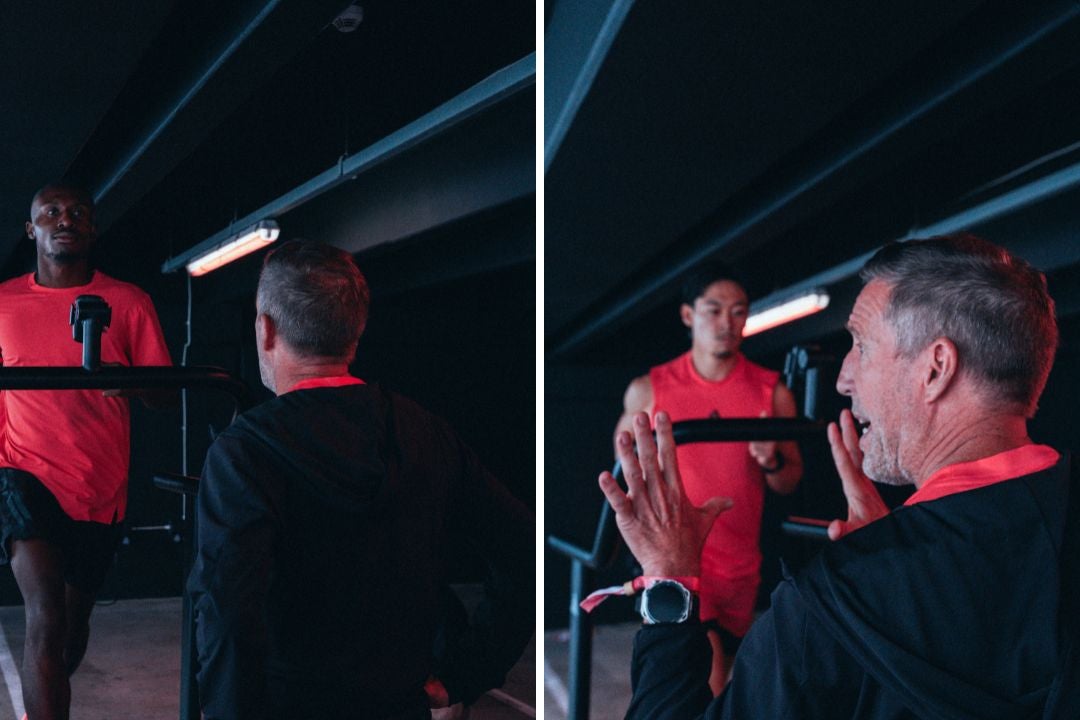 Aerobic capacity coach Chris Hinshaw teaching athletes how to learn their zone two breathing rhythm at the Adidas Go Full Hybrid event (Adidas Training)
A two-count cycle of breath is universal among those approaching their physical limits, and a four-count breath can be applied to anyone working at a hard but sustainable pace. However, people’s breathing rates vary when running at a comfortable pace, often referred to as zone two due to the heart rate zone it corresponds to.
Walking is the best tool for determining your zone two breathing rate, Hinshaw advises.
“To find what works for you, it pays to play around with how many steps you take when you inhale and how many steps you take when you exhale,” he says. “You might take four steps on the inhale and four steps on the exhale. Or you might take as many as eight on each.
“What you’re doing here is developing the awareness of how your breath dovetails with your step rate. That’s why the military, when they ruck, are aware of their breathing rate and cadence. We need to take that mainstream and teach people how to do this.
“You want to be able to slow your breathing down, calm yourself and fill your lungs completely. This is supposed to be a low-stress, easy pace you can maintain for a long time. It’s not one size fits all. Your task is to identify the unique breathing rhythm that allows you to do this.”
Read more: I walked for 15 minutes after every meal for a month – the effects were immediate