
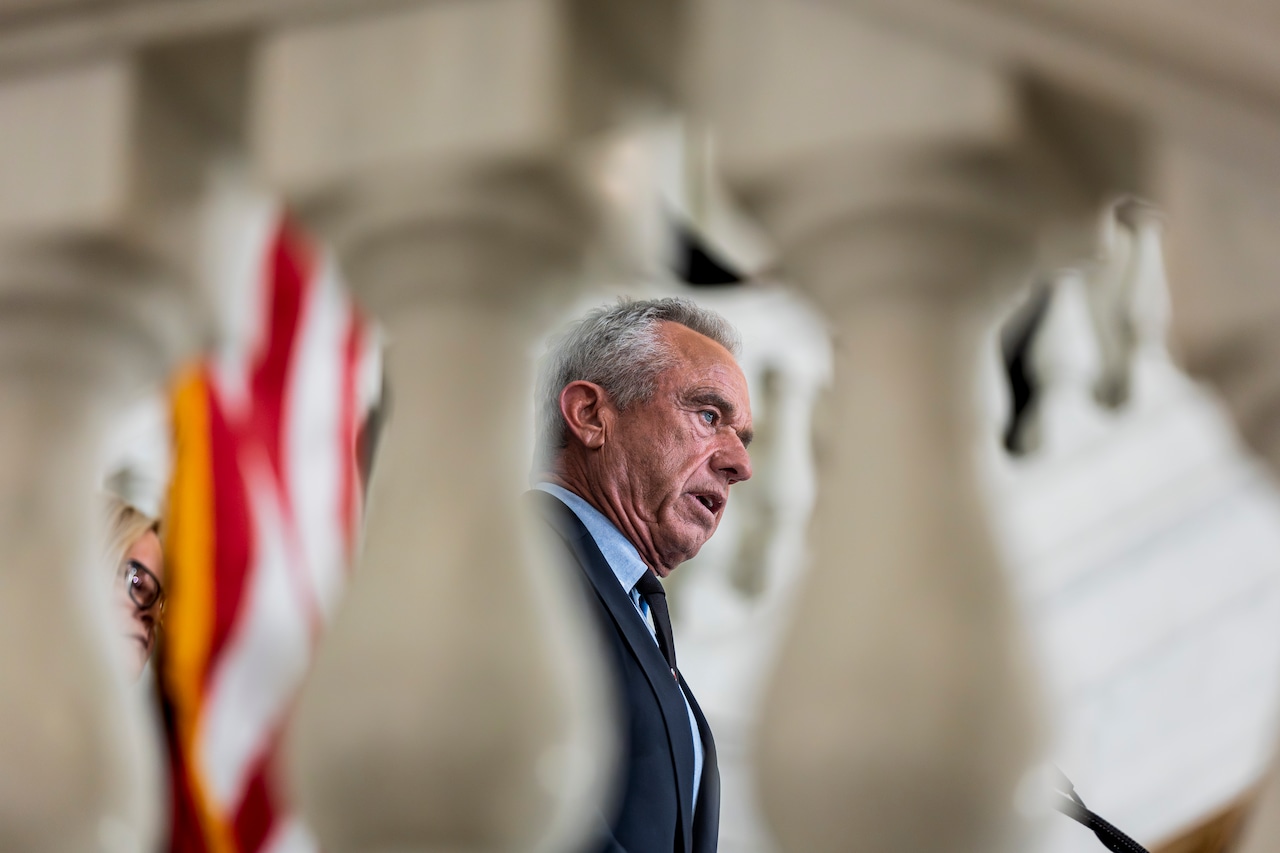
On Wednesday, when U.S. Health Secretary Robert F. Kennedy Jr. came to the state Capitol to promote his health policy agenda, he was surrounded on the steps of the Rotunda by loyal Republican lawmakers.
He was also surrounded — geographically — by the nation’s most ubiquitous purveyors of snack foods, from the potato chip, cheese puff and pretzel manufacturers of York County to the global confectionery behemoth Hershey Foods just a few miles down the road.
Kennedy, who came to Harrisburg to promote his Make America Healthy Again policies, underscored the new dietary guidelines that he announced a few weeks ago.
He is urging Americans to reduce their consumption of ultra-processed foods and snacks (a category that now explicitly includes products like white bread, flour tortillas and crackers.)
The buzz phrase of the event — used over and over by Kennedy and several Republican lawmakers who also spoke — was “eat real food.”
Kennedy criticized agri-food giants that have over decades, courted favor in Congress and transformed the American diet into one of the unhealthiest in the world, leading, he said, to rampant “obesity, diabetes, allergies, autism, autoimmune disease, especially in children.”
“That impulse, that universal impulse, is what drove Fruit Loops to the top of the food pyramid,” Kennedy said, drawing chuckles from the audience in the Rotunda.
“We’re telling Americans it’s time to start eating real food,” he said. “Honey, dairy, but also eat eggs, meat, fruit, vegetables, high fiber grains. These guidelines are going to drive a change in dietary culture.”
Kennedy said the new guidelines would not only change school lunches and meals provided to veterans, but “it’s going to drive change to the marketplace.”
The message — a clear signal from the top health official in the country — delivers a direct signal that ultra-processed foods are unhealthy, contribute to chronic illness and run counter to his national health policy agenda called MAHA, or Make America Healthy Again.
It’s a message celebrated by the commonwealth’s vast agricultural sector, which churns out an annual bounty of some of the nation’s most popular orchard fruits, as well as dairy products and billions in revenue.
“My district is heavily agrarian, run by hard-working farming families that put food on the table for millions of Americans and as an agricultural powerhouse, Pennsylvania is the perfect place to kick off the ‘Eat Real Food’ tour,” said Rep. David Rowe, a Republican whose district spans Snyder, Juniata, Mifflin and Union counties. “Eating Real Food matters because Americans, including Pennsylvanians, are facing worse health outcomes now than ever before.”
But it’s a message that seems to run up against Pennsylvania’s snack food industry, which generates over $5.1 billion in annual sales, with estimates for the specific “snack food production” market size at around $3.3 billion in 2026, according to industry advocates.
In fact, the Consumer Brands Association, a national trade group, has dubbed Pennsylvania the “Snack Food Capital of the World” due to major players like the Hershey Company and Utz Brands, which are part of an overall snacks and packaged goods sector that contributes over $111 billion to the state’s economy.
Alex Baloga, President and CEO, Pennsylvania Food Merchants Association, suggest the Commonwealth’s snack industry doesn’t have to run afoul of Kennedy’s agenda.
He said providing “healthy, affordable options” has long been part of the industry’s focus.
“Retailers are always working to meet consumer demand, and providing healthy, affordable options has long been part of that effort. Ultimately, we believe consumers are best equipped to make decisions for their families, and our members are working to provide choices for them to do so,” Baloga said in an email to PennLive.
Similarly, the Hershey Company, purveyor of some of the world’s most iconic candy brands, suggested a happy middle ground for the Trump administration and the confectionery.
“Our portfolio offers a broad range of snacking choices from individually wrapped treats and portion-controlled options to zero-sugar offerings, salty snacks, and protein bars,” Todd Scott, a company spokesman, said in an email to PennLive. “We’re focused on meeting consumers across the variety of snacking occasions they’re seeking.”
The Hershey Company, he said, aligns with the vision set forth by the National Confectioners Association to support the new MAHA policy.
“We support and value the role of the dietary guidelines in promoting balanced nutrition,” the association said in a statement earlier this month following Kennedy’s announcement on the new policy. “The dietary guidelines have consistently reinforced for consumers what they already know about chocolate and candy — that they are treats, and not meal replacements — and this latest iteration reflects that same notion.”
Speaking at the podium on Wednesday, Sen. Kristin Phillips-Hill, a Republican from York County, touted the agricultural bounty from her district, including peach growers, beef producers and dairy farms that give the county a “rich history as a national leader in agriculture…and provides some of the very best food for our nation.”
But Phillips-Hill’s district also encompasses some of the biggest manufacturers in the snack food industry, including Utz, Martins and Snyders of Hanover. She said the industry was keeping up with the times and changing attitudes about processed foods.
“Take a look at the commitment that many of our snack food manufacturers have made to make their products healthier,” she said. “Utz brands, for example, they announced a major initiative to remove all of the artificial colors and dyes from their products by the end of 2027.
“And as of the end of 2025, 80% of the products that Utz produces are now free of synthetic dye. They’re really focused on making real and simple products, using potatoes, using oils, not seed oils, using salt and they have really worked hard to make their products healthier.”
Utz, Martins and Herr’s did not immediately respond to requests for comment.
Phillips-Hill noted that some brands have rolled out healthier alternatives, citing Utz’s Boulder Canyon brand, which the company touts in a “Be for Real” campaign that urges consumers to “disconnect from digital distractions and reconnect with real moments and simple pleasures” — such as munching on the chips, which are made with avocado oil, sea salt and potatoes.
In an interview with Food Business News last year, Howard Friedman, chief executive officer for Utz Brands, boasted about Boulder Canyon’s unprecedented growth, surpassing $100 million in annual retail sales in 2024, and calling it a “very on-trend brand.”
Phillips-Hill suggested that Kennedy’s health policy message resonated not only with everyday Americans but companies such as the ones in her district.
“What the secretary of health is doing has really influenced those companies,” she said. “It’s included in making a better product for their consumers who purchase them and consume them.”
For Misty Skolnick, co-owner of Uncle Jerry’s Pretzels in Lancaster, the MAHA policy validates a trend she’s watched grow over the years.
“Consumers are avoiding highly processed packaged foods, paying more attention to labels and what they’re putting in their bodies,” she said. “They want brands that they can trust and we’re seeing that already. So it’s just kind of continuing in that trend. Ultra-processed foods. Everyone’s just paying more attention to them.”
Skolnick’s family business (the Uncle Jerry in the name is her dad) is part of Pennsylvania’s clutch on 80% of the nation’s pretzel production. Her family-owned company has been making hand-twisted pretzels for more than 35 years, and she said they use only five ingredients – water, flour, yeast, sourdough starter and salt.
“We’re a handmade product,” she said. “We’ve always done this. So we’re lucky in that we don’t have to shift too much. In a way we welcome it because it shifts the playing field between real food and reformulated ultra-processed foods. We use recognizable ingredients and traditional methods and you just can’t replace that with machine-made products.”
Increasingly, she said, big snack companies are acquiring different brands to expand their portfolios to include more natural, less processed or organic snacks.
“A lot of food companies, instead of creating from scratch their own foods that fit into these categories, they’re actually just acquiring new brands,” she said. “That’s one way that big companies are responding to this.”
Don’t expect her company to change anything in the near future.
“My dad, Jerry, is still making deliveries from Lancaster into Philly a couple times a month,” Skolnick said.