
At-home saunas are all the rage right now — so we tried one to see if they’re actually worth it
(AOL / Camryn Rabideau)
It seems like everywhere I look lately, there are at-home saunas for sale. They’re everywhere — Amazon, Costco, Sam’s Club, and pretty much every other major retailer — and some are actually quite reasonably priced, starting at just $800.
But are these at-home saunas really comparable to the real deal? What’s up with the “infrared” heat, anyway? I had a lot of questions, so I went on a mission to find out whether these home saunas are actually worth adding to your wellness routine.
I spoke to several experts, including two doctors and an exercise physiologist, to learn more about the benefits of saunas and the difference between regular and infrared options. That’s not all, either — I also tested out a popular at-home sauna myself over the course of two months to see if it lives up to the hype. Here’s what I found.
What are the benefits of using a sauna?
Many people view saunas as a place to relax after a workout or destress after a long day, but there are a number of scientifically proven health benefits to regular heat therapy, as well. “Sauna is more than relaxation, it is a controlled physiological stressor that activates adaptive repair pathways in the body,” explains Dr. Emilia Vuorisalmi, a Finnish doctor who specializes in hormones.
With consistent use, saunas can have positive impacts on your heart health, brain function, and stress levels. “The benefits of heat therapy include improved cardiovascular health, with a lower risk of sudden cardiac death, lower blood pressure, and better circulation,” explains Dr. John K. Smith, board-certified physician and surgeon at the Olympus Cosmetic Group in Oklahoma. “Additionally, the heat stress from a sauna can promote endorphin release, improving stress and anxiety, as well as promoting improved brain function with a lower risk of dementia.”
How often should you use the sauna? Research suggests there are benefits starting at just once or twice a week: “For most healthy adults, two to four sessions per week provide noticeable benefits, while four to seven sessions per week are associated with the strongest long-term health data,” says Dr. Vuorisalmi. “Typical sessions last ten to twenty minutes, with cooling breaks between rounds. Consistency is more important than duration — sauna works through repeated, moderate stress, not extremes.”
That said, saunas may not be right for everyone: “Patients with a history of unstable cardiac conditions, recent heart attack, or who are pregnant should avoid saunas due to the cardiovascular stress created by therapy sessions,” says Dr. Smith. If you have any concerns, make sure to speak with your doctor before using a sauna.
_1312.png)
Both types of saunas offer cardiovascular benefits and can help promote relaxation.
What is an infrared sauna?
Most of the at-home saunas that you’ll find are infrared saunas, which use infrared light to provide heat therapy. “Traditional and infrared saunas are both forms of passive heat therapy, but they differ in how heat is delivered,” explains Rachelle Reed, PhD, an exercise physiologist who serves as the scientific advisor for Perspire Sauna Studio.
“Traditional saunas — often called Finnish-style — heat the air to high temperatures (typically 175°F or more), and your body warms through convective heat transfer from that hot environment,” she says. “Infrared saunas operate at lower ambient air temperatures (generally 100–160°F) and use infrared wavelengths to transfer heat to the body more directly through radiant energy.” In a Finnish sauna, you often pour water on hot stones to create steam, but with infrared saunas, heat is generated by wall panels, keeping the humidity lower.
If you’ve found that traditional saunas are too hot for your liking, experts say an infrared sauna may be a more comfortable alternative: “Infrared saunas may feel more tolerable for some individuals because the surrounding air temperature is lower, while still producing increases in heart rate, core temperature, and sweating,” says Reed.
My firsthand experience with an at-home infrared sauna
To see what all the hype is about, I tested out an at-home infrared sauna from the brand Make Life Easy. It’s designed to accommodate one to two people, and I tested it for around two months with the help of my family.
.png)
Make Life Easy
We tested the EZ Life Infrared Sauna for several weeks, and it proved itself to be a surprisingly convenient tool for at-home heat therapy.
PROSReaches up to 140°FSurprisingly spaciousUses 120v outletEasy to set up with two people
CONSFreight deliveryNo backrestsNot true “red light therapy”
Specs
Exterior dimensions: 39”L x 36”W x 73”H
Interior dimensions: 36”L x 32”W x 67”H
Voltage / Frequency: 110V/15amp
Temperature range: 118-140°F
What we like about itIt’s surprisingly easy to set up
It might seem like a complex item to assemble, but the EZ Life Sauna was surprisingly simple to put together. My husband and father did the bulk of the assembly — I was just there for morale support.
Basically, you put down the base of the sauna, then each of the four walls slots down into it. You need two people to maneuver the walls into place, so make sure to enlist a friend to help out. There are latches that hold the walls together, and then the roof just slides down and locks everything in place. I think there are a total of six screws that you have to install, as well as a few electrical connections on the top.
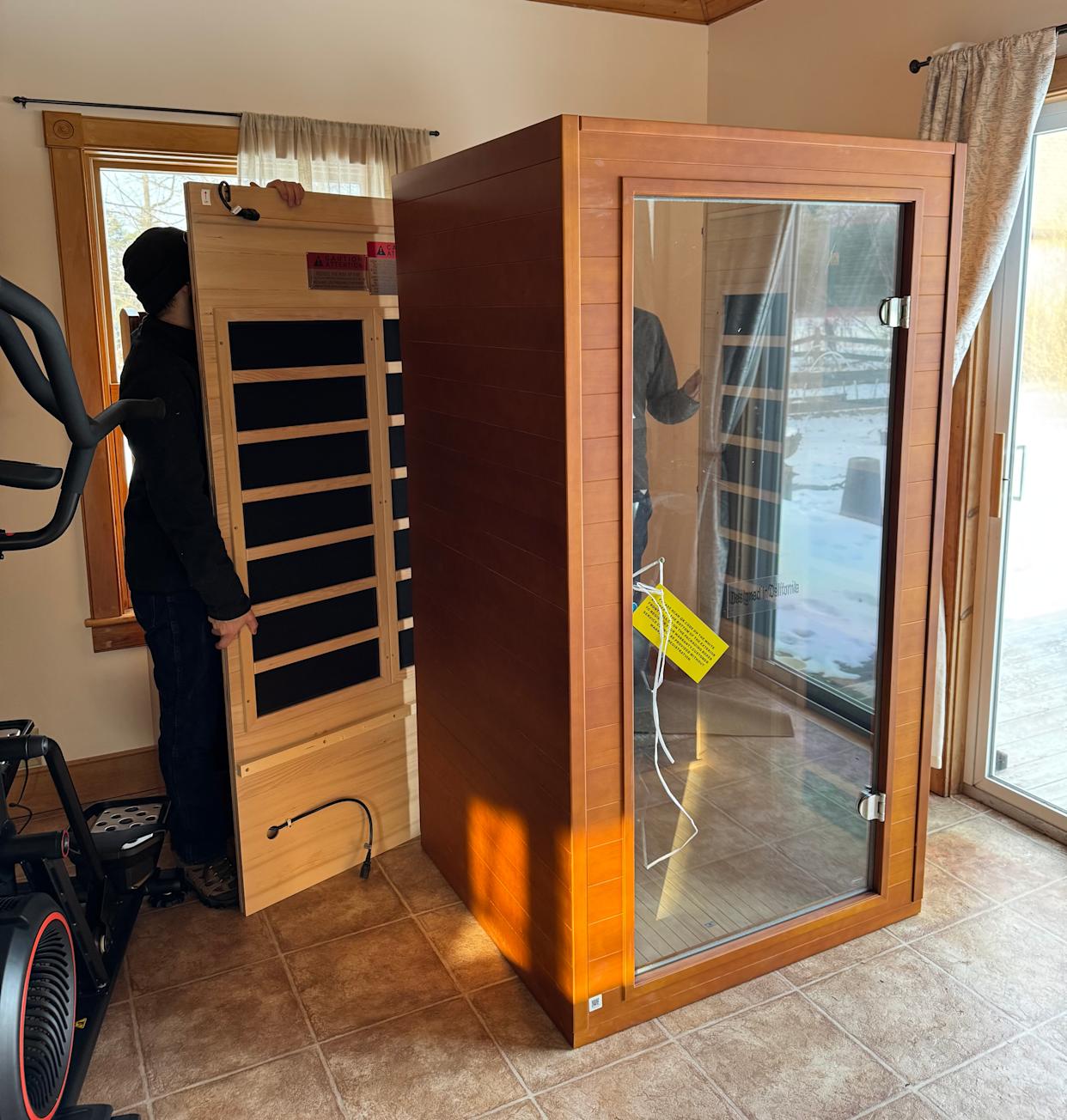
The home sauna is surprisingly simple to assemble, but you will need two adults for the task.
(AOL / Camryn Rabideau)
In total, it took us about 20 minutes to set up the sauna. Once assembly is complete, it plugs into a standard 120-volt outlet, and you’re ready to go!
It’s attractive, well-made, and spacious
Once the sauna was set up in our exercise room, I was pleasantly surprised at how attractive it is. The exterior is made from a richly colored Canadian hemlock, and the sleek glass door gives it a contemporary appearance. The whole thing looks very high-end, making the space feel like a luxe spa!
This sauna is marketed for just one or two people, and one of my biggest concerns was that it would feel claustrophobic inside. Thankfully, that’s not the case at all. The interior is actually big enough for two people to sit side-by-side — my husband and I fit very comfortably — and the glass door makes it feel more open.

The infrared sauna is a stylish addition to our exercise space.
(AOL / Camryn Rabideau)
You do have to sit upright on the bench — there’s not enough space to lie down or lounge, but it’s still spacious and comfortable to be inside. We typically put a towel down to help soak up any sweat and provide some cushioning while sitting.
It heats up to 140°F and really gets you sweating
The EZ Life Sauna has a temperature range of 118-140°F, but before you can get your sweat on, the infrared sauna needs time to heat up — similar to preheating the oven before cooking.
In general, you’ll have to give the sauna at least 30 minutes to warm up before hopping inside. It can generally reach around 120-130°F in that time, as long as you don’t open the door and let the heat out. If you want it even warmer, I’d recommend turning the sauna on at least 45-60 minutes before you plan to use it.
Once the sauna has reached your desired temperature, you can hop in and start reaping the benefits of heat therapy. I generally start sweating within five minutes of being in the sauna, and I’ve found that 10 minutes is more than enough for me. My husband, on the other hand, loves being hot, so he’ll happily sit inside for up to 20 minutes. Sometimes it’s nice to just sit in silence and practice some meditative breathing, but you can also hook up your phone to play music or a podcast over the sauna’s built-in speakers.
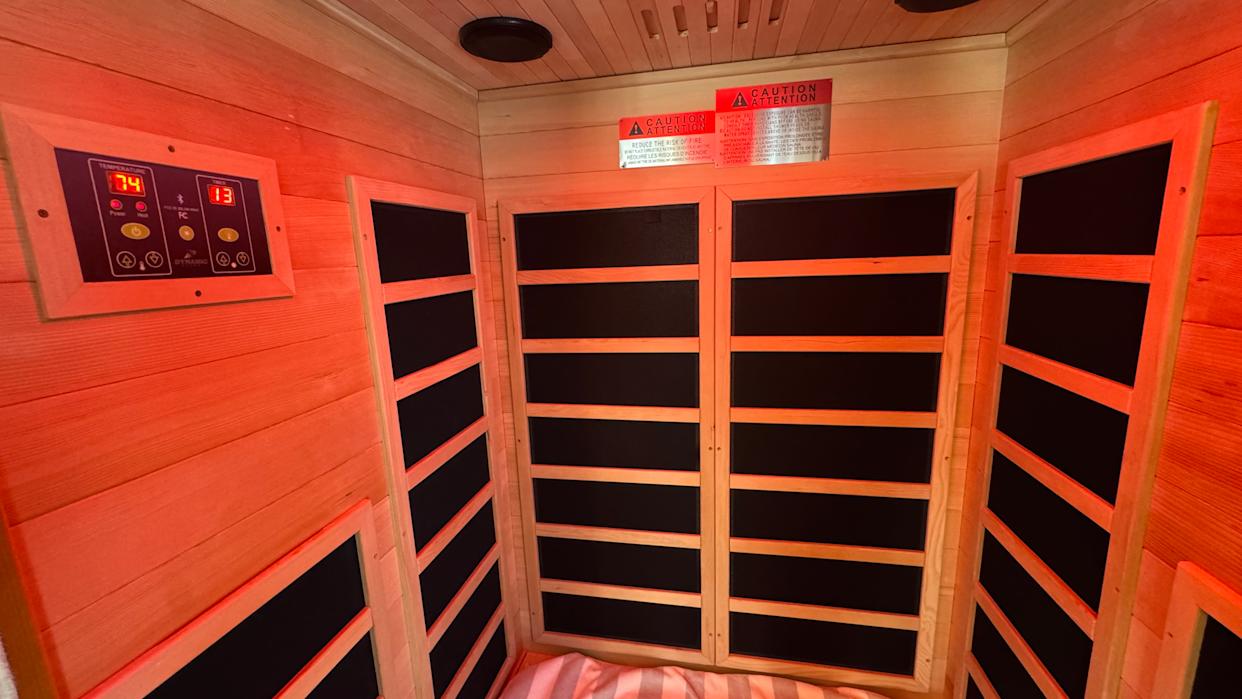
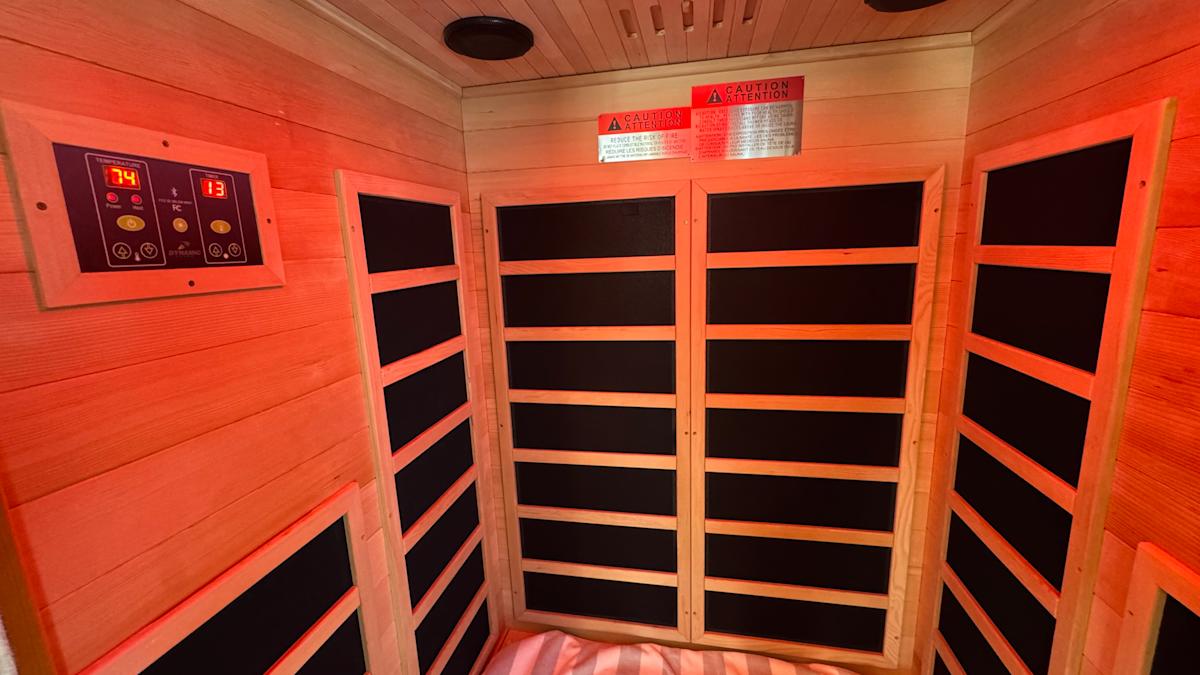
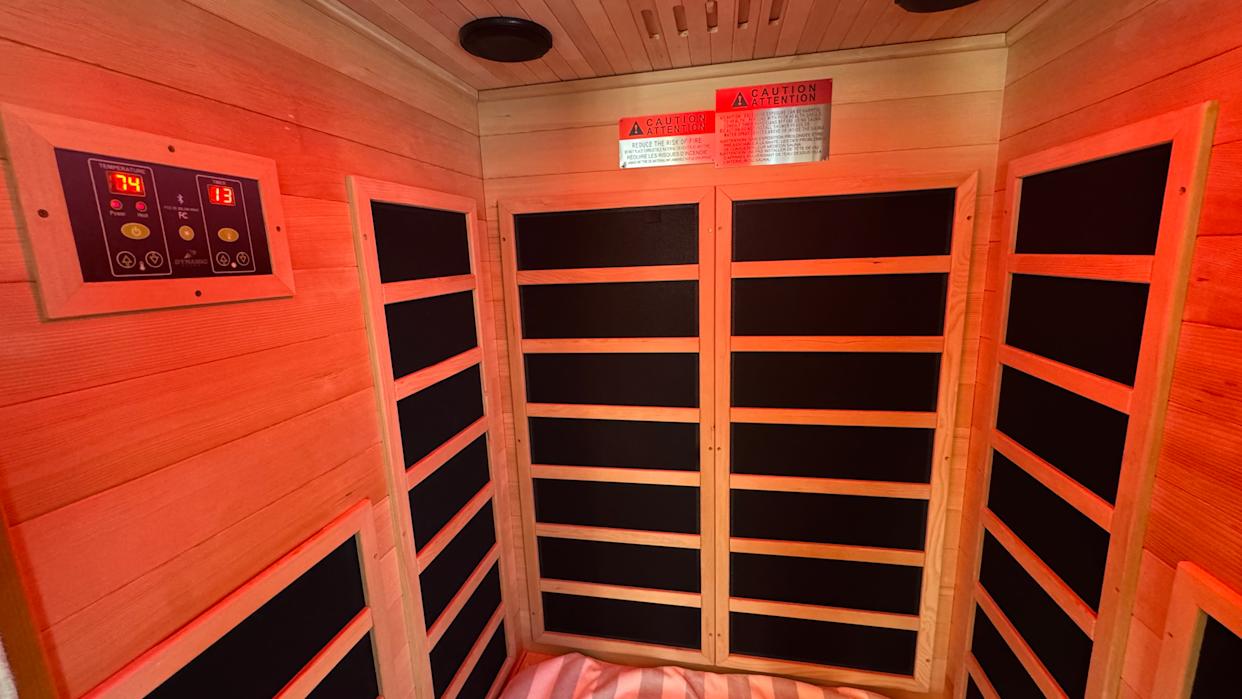
The interior of the sauna features carbon heat panels, a control board, and a bench.
(AOL / Camryn Rabideau)
My husband and I use the sauna once a week or so, but my 65-year-old father — who lives next door and shares our exercise space — is by far its biggest fan: “I really enjoy the sauna, especially after exercising,” my dad said. “I can get it up to 130 degrees in around 30 minutes. I do my exercises while it is warming up, and after my workout, I spend 15 minutes in the sauna, which really helps these old muscles. “
What we don’t likeIt gets dropped off in your driveway
While setup was easy enough, the delivery of the sauna wasn’t ideal. At the high price point, I would have expected in-home delivery, if not white glove setup! However, the sauna ships via standard freight, so the pallet and packaging were dropped off in my driveway. Unfortunately, it was raining on the day it was delivered, making unboxing even more inconvenient.
The box was too heavy to move (it’s over 250 pounds total), so my husband and I had to throw a tarp over it and bring each panel inside one at a time. All the while, I was worried that something would get wet and break. Thankfully, nothing went wrong, but just keep in mind that the heavy box won’t be brought inside your house upon delivery.
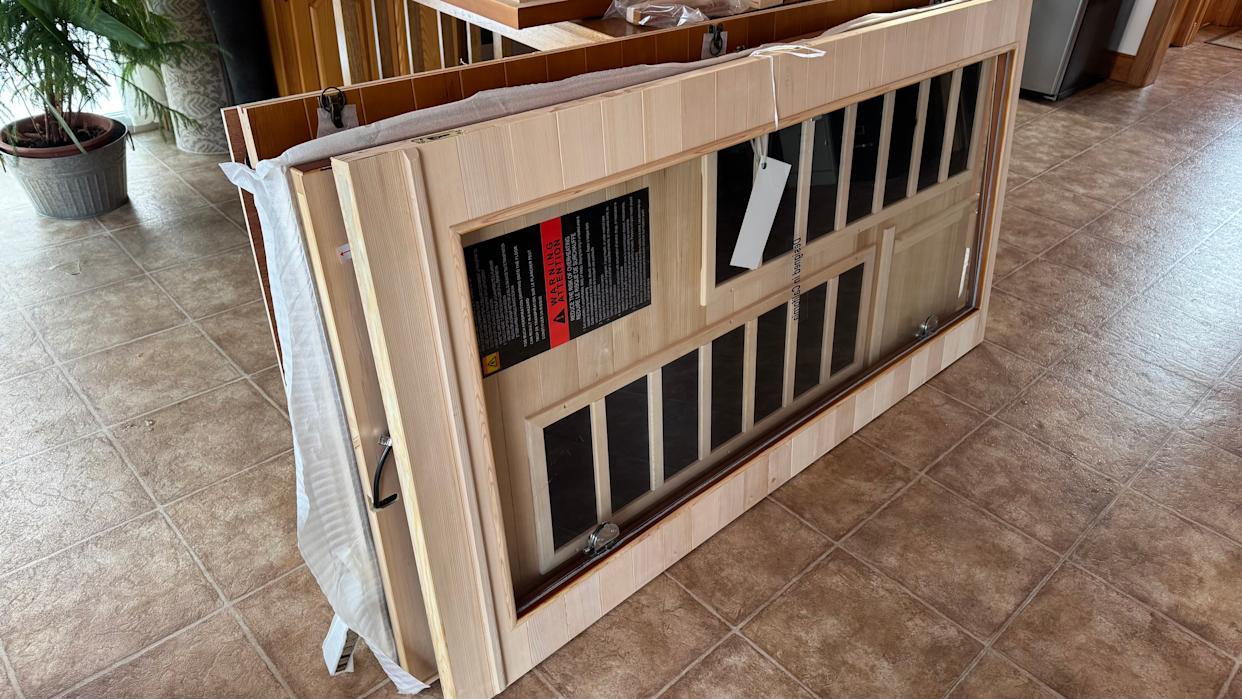
The package was too heavy to move, so we carried each panel inside one at a time.
(AOL / Camryn Rabideau)
Given the package’s size and weight, it’s probably not surprising that returns aren’t particularly easy. If you choose to send the product back, you’ll be responsible for a 30% restocking fee to cover shipping and processing.
There’s no backrest
My father’s only real complaint about the sauna is that there’s nowhere you can comfortably lean back while inside: “As for what I don’t like, there is no way to lean back against the wall,” he told me. “The heating units are all around, and I don’t think you are supposed to block them. So, you have to sit up straight or lean over your knees.”
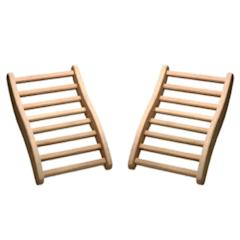
To remedy this issue, we’ve ordered one of these sauna backrests, which allows you to lean back without touching the infrared panels. However, it would have been nice if they were included with the sauna itself.
 I’m skeptical of its ‘red light therapy’ claims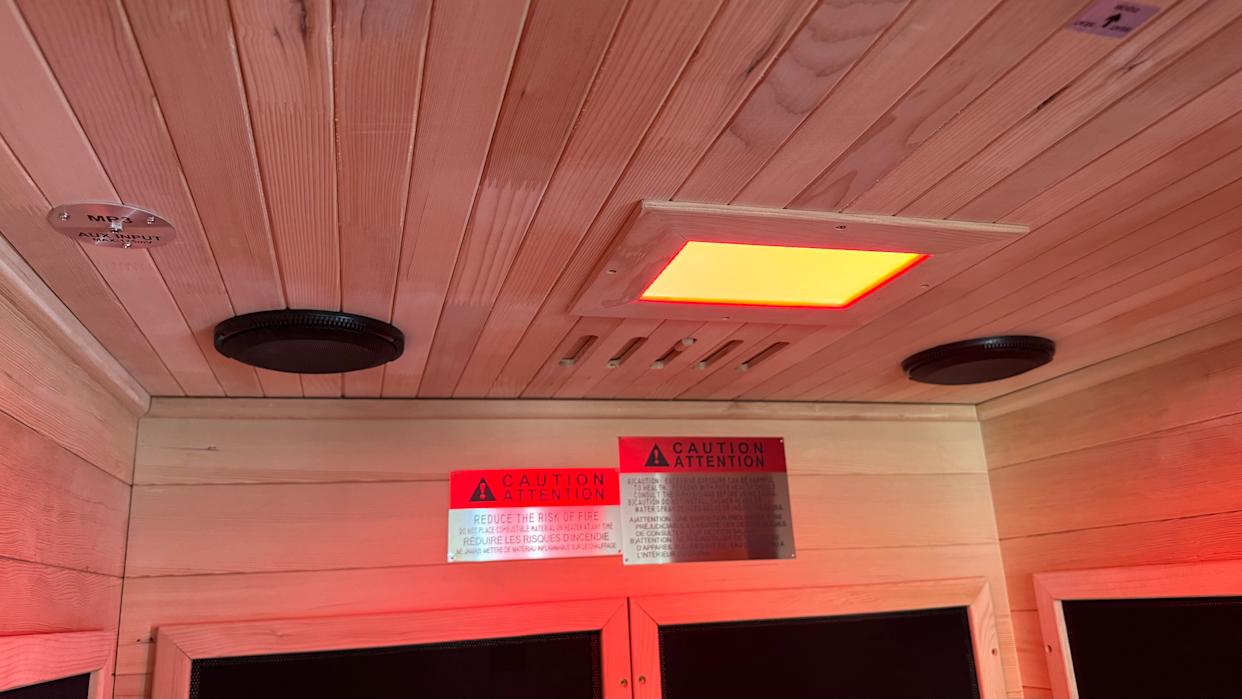
The red light in the sauna doesn’t seem like it’s a true medical-grade light.
(AOL / Camryn Rabideau)
This sauna advertises a “9-color chromotherapy lighting” system that the brand says offers red light therapy. However, I’m fairly skeptical of these claims, as there just seems to be a basic multi-color LED bulb in the ceiling of the sauna.
To be effective, red light therapy requires specific wavelengths and irradiance. “When combined thoughtfully, [saunas and red light therapy] may complement each other, though device quality and wavelength specificity are important,” says Dr. Vuorisalmi.
I own a red light therapy mask, and its bulbs look and feel very different from the light in the sauna. So while it can be fun to change the color of the light while you sweat — I personally find the blue very calming and serene — I wouldn’t buy this sauna expecting it to serve as a red light therapy device.
Should you buy an at-home infrared sauna?
If you love relaxing in a sauna and want to reap the benefits of heat therapy, I think an at-home infrared sauna is worth the investment. They range in price from $800 to $3,000, but you’ll definitely get your money’s worth if you use the sauna several times a week. Plus, having a sauna right in the comfort of your home makes it easy and convenient to stick with the habit, and research has proven that there are long-lasting benefits for your heart, brain, and overall wellbeing.
This infrared sauna offers the benefits of heat therapy in the comfort of your own home.
PROSReaches up to 150°FSurprisingly spaciousUses 120v outletEasy to set up with two people
CONSFreight deliveryNo backrestsNot true “red light therapy”
Other infrared saunas to consider
.png)
_8056.png)
Prices were accurate at the time of publication. Curious about how we test and choose products at AOL? Here’s a quick explanation, from our editors.