

Many people associate Jewish delis with New York City, but according to authors Neal Samors and Eric Bronsky, Chicago has a rich deli tradition of its own that they aim to preserve in their new book “Corned Beef on Rye: Remembering Chicago’s Jewish Delis.”
The pair celebrated the release of the book with a “meet the authors” event Wednesday at Mensch’s Deli in Evanston. The book is currently available for purchase exclusively through Amazon.
Samors and Bronsky first met 22 years ago and have co-authored four books, all focused on Chicago history. Their latest project documents the memories and cultural significance of Jewish delis in the Chicagoland area.
Typically, Jewish delis offer items such as corned beef, pastrami, beef brisket, lox, matzo ball soup, gefilte fish, latkes, kugel, and knishes — but the authors say that what makes Jewish delis unique extends beyond the food itself.
“Part of it is the food, part of it is the atmosphere, the camaraderie there,” Bronsky said.
The book includes a chapter exploring what sets Chicago’s Jewish delis apart from those in other cities. While New York may be more closely associated with deli culture, Chicago developed its own traditions and iconic establishments.
Among the best-known Jewish delis in the Chicagoland area are Manny’s Cafeteria & Delicatessen, Max and Benny’s and Mensch’s Deli in Evanston.
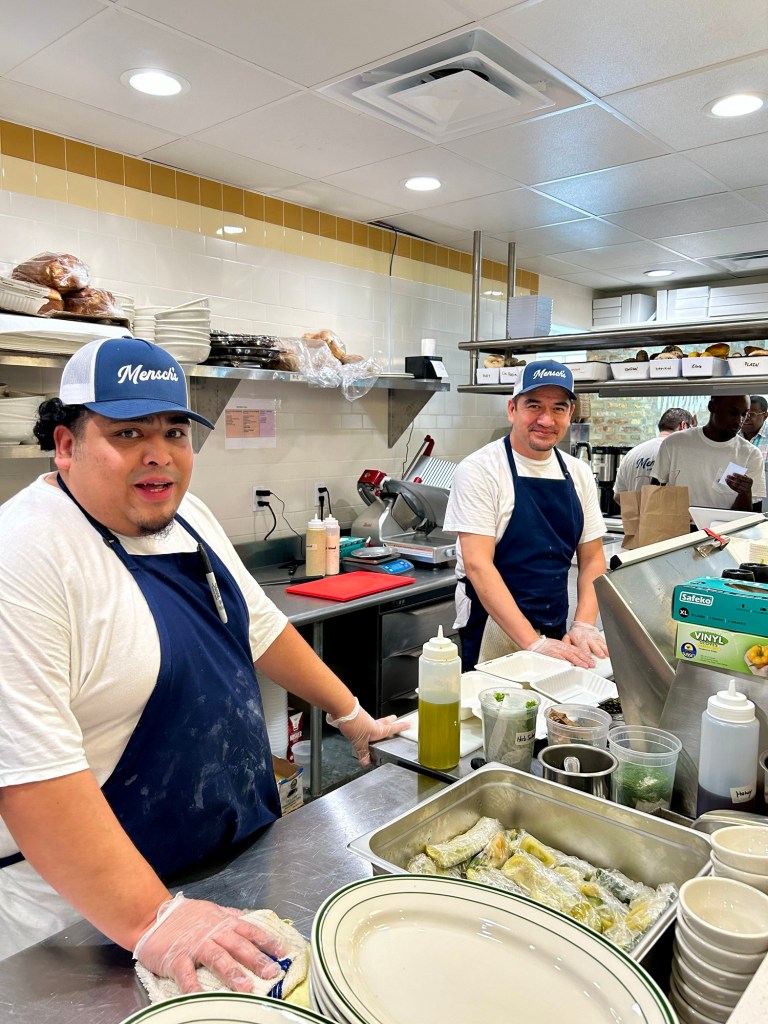 Employees wait for sandwich orders at Mensch’s Deli, 1608 Chicago Ave. in Evanston. Credit: Julie Chernoff
Traditional Jewish delis often featured a counter at the front, offered both dine-in and carry-out service and served as gathering places for families and neighbors. According to the authors, they played an especially important role during an era when fewer people owned cars and many relied on walking or public transportation.
Samors recalled growing up in Rogers Park and visiting Ashkenaz Restaurant and Delicatessen, one of many neighborhood institutions that helped shape Chicago’s Jewish community.
“It was part of a whole multigenerational experience,” he said.
Today, many surviving delis operate in a much more car-oriented culture. Over the years, Jewish delis have also expanded their menus beyond the traditional options to attract new customers.
The authors say that shift has changed some aspects of the deli experience, though many establishments still serve as important community gathering places.
“Lots of people think of lox and bagels with cream cheese, but it’s so much more than that,” Samors said.
Related Stories