
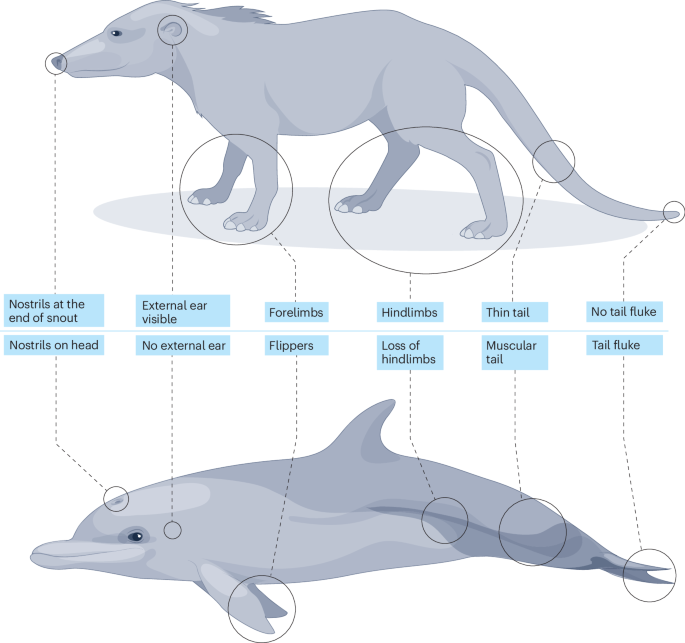
Thewissen, J. & Bajpai, S. Whale origins as a poster child for macroevolution. BioScience 51, 1037–1049 (2001).
Gatesy, J. et al. A phylogenetic blueprint for a modern whale. Mol. Phylogenet. Evol. 66, 479–506 (2013).
Simpson, G. G. The Principles of Classification and a Classification of Mammals Vol. 85 (American Museum of Natural History, 1945).
Spaulding, M., O’Leary, M. A. & Gatesy, J. Relationships of Cetacea (Artiodactyla) among mammals: increased taxon sampling alters interpretations of key fossils and character evolution. PLoS ONE 4, e7062 (2009).
Geisler, J. H. & Uhen, M. D. Morphological support for a close relationship between hippos and whales. J. Vertebr. Paleontol. 23, 991–996 (2003).
Irwin, D. M. & Árnason, Ú. Cytochrome b gene of marine mammals: phylogeny and evolution. J. Mamm. Evol. 2, 37–55 (1994).
Gatesy, J. in The Emergence of Whales: Evolutionary Patterns in the Origin of Cetacea (ed Thewissen J. G. M.) 63–111 (Springer, 1998).
Montgelard, C., Catzeflis, F. M. & Douzery, E. Phylogenetic relationships of artiodactyls and cetaceans as deduced from the comparison of cytochrome b and 12S rRNA mitochondrial sequences. Mol. Biol. Evol. 14, 550–559 (1997).
Flower, W. H. On whales, past and present, and their probable origin. Nature 28, 199–202 (1883).
Boyden, A. & Gemeroy, D. The relative position of the Cetacea among the orders of Mammalia as indicated by precipitin tests. Zoologica 35, 145–151 (1950).
Gingerich, P. D., Haq, M. U., Zalmout, I. S., Khan, I. H. & Malkani, M. S. Origin of whales from early artiodactyls: hands and feet of Eocene Protocetidae from Pakistan. Science 293, 2239–2242 (2001).
Thewissen, J. G., Williams, E., Roe, L. & Hussain, S. Skeletons of terrestrial cetaceans and the relationship of whales to artiodactyls. Nature 413, 277–281 (2001).
Committee on Taxonomy. List of marine mammal species and subspecies. Society for Marine Mammalogy https://marinemammalscience.org/science-and-publications/list-marine-mammal-species-subspecies/ (2026).
Croll, D., Kudela, R. & Tershy, B. in Whales, Whaling, and Ocean Ecosystems (eds DeMaster D. P. et al.) 202–214 (Univ. California Press, 2006).
Nerini, M. & Oliver, J. Gray whales and the structure of the Bering Sea benthos. Oecologia 59, 224–225 (1983).
Nicol, S. et al. Southern Ocean iron fertilization by baleen whales and Antarctic krill. Fish. Fish. 11, 203–209 (2010).
Fordyce, R. E. in Encyclopedia of Life Sciences(ed. John Wiley & Sons) 1–9 (John Wiley & Sons, 2013).
Gatesy, J. & O’Leary, M. A. Deciphering whale origins with molecules and fossils. Trends Ecol. Evol. 16, 562–570 (2001).
Thewissen, J. G. & Williams, E. M. The early radiations of Cetacea (Mammalia): evolutionary pattern and developmental correlations. Annu. Rev. Ecol. Syst. 33, 73–90 (2002).
Fordyce, R. & de Muizon, C. in Secondary Adaptation of Tetrapods to Life in Water (eds Mazin, J. M. & de Buffrenil, V.) 169–233 (Dr. Friedrich Pfeil, 2001).
Uhen, M. D. The origin(s) of whales. Annu. Rev. Earth Planet. Sci. 38, 189–219 (2010).
Marx, F. G., Lambert, O. & Uhen, M. D. Cetacean Paleobiology (Wiley, 2016).
Kelley, N. P. & Pyenson, N. D. Evolutionary innovation and ecology in marine tetrapods from the Triassic to the Anthropocene. Science 348, aaa3716 (2015).
Pimiento, C., Cortés, D. & Valenzuela-Toro, A. M. Ocean giants through time: evolution and ecology intertwined. Annu. Rev. Ecol. Evol. Syst. 56, 491–519 (2025).
Bajpai, S. & Gingerich, P. D. A new Eocene archaeocete (Mammalia, Cetacea) from India and the time of origin of whales. Proc. Natl Acad. Sci. USA 95, 15464–15468 (1998).
Waqas, M. et al. A basal representative of Cetacea from the Eocene of India. Nat. Ecol. Evol. 10, 1195–1203 (2026).
Coombs, E. J. et al. The tempo of cetacean cranial evolution. Curr. Biol. 32, 2233–2247 (2022).
Coombs, E. J. et al. Drivers of morphological evolution in the toothed whale jaw. Curr. Biol. 34, 273–285 (2024).
Gingerich, P. D. Land-to-sea transition in early whales: evolution of Eocene Archaeoceti (Cetacea) in relation to skeletal proportions and locomotion of living semiaquatic mammals. Paleobiology 29, 429–454 (2003).
Madar, S. I. The postcranial skeleton of early Eocene pakicetid cetaceans. J. Paleontol. 81, 176–200 (2007).
Clementz, M. T., Goswami, A., Gingerich, P. D. & Koch, P. L. Isotopic records from early whales and sea cows: contrasting patterns of ecological transition. J. Vertebr. Paleontol. 26, 355–370 (2006).
Thewissen, J. G., Cooper, L. N., Clementz, M. T., Bajpai, S. & Tiwari, B. N. Whales originated from aquatic artiodactyls in the Eocene epoch of India. Nature 450, 1190–1194 (2007).
Cooper, L. N., Thewissen, J., Bajpai, S. & Tiwari, B. Postcranial morphology and locomotion of the Eocene raoellid Indohyus (Artiodactyla: Mammalia). Historical Biol. 24, 279–310 (2012).
Patel, S., Nanda, A. C., Orliac, M. & Thewissen, J. G. Cranial anatomy of Indohyus indirae (Raoellidae), an artiodactyl from the Eocene of India, and its implications for raoellid biology. Palaeontol. Electron. 27, 1–14 (2024).
Waqas, M., Smith, T., Rana, R. S. & Orliac, M. J. The cranium and dentition of Khirtharia(Artiodactyla, Raoellidae): new data on a stem taxon to Cetacea. J. Mamm. Evol. 31, 24 (2024).
Bouaziz, H. et al. Morphological study of the anterior dentition in Raoellidae (Mammalia, Artiodactyla), new insight on their dietary habits. J. Anat. 248, 269–283 (2025).
Waqas, M., Smith, T., Rana, R. & Orliac, M. J. The endocranial cast of Khirtharia (Artiodactyla, Raoellidae) provides new insights into the earliest evolution of the cetacean brain. Brain Behav. Evol. 100, 80–92 (2025).
Madar, S. I., Thewissen, J. & Hussain, S. Additional holotype remains of Ambulocetus natans (Cetacea, Ambulocetidae), and their implications for locomotion in early whales. J. Vertebr. Paleontol. 22, 405–422 (2002).
Thewissen, J., Madar, S. I. & Hussain, S. T. Ambulocetus natans, an Eocene cetacean (Mammalia) from Pakistan. Cour. Forsch. Senckenberg. 191, 1–86 (1996).
Thewissen, J. G., Hussain, S. T. & Arif, M. Fossil evidence for the origin of aquatic locomotion in archaeocete whales. Science 263, 210–212 (1994).
Burin, G., Park, T., James, T. D., Slater, G. J. & Cooper, N. The dynamic adaptive landscape of cetacean body size. Curr. Biol. 33, 1787–1794 (2023).
Nummela, S., Thewissen, J. G., Bajpai, S., Hussain, S. T. & Kumar, K. Eocene evolution of whale hearing. Nature 430, 776–778 (2004).
Nummela, S., Thewissen, J., Bajpai, S., Hussain, T. & Kumar, K. Sound transmission in archaic and modern whales: anatomical adaptations for underwater hearing. Anat. Rec. 290, 716–733 (2007).
Thewissen, J. G. & Fish, F. Locomotor evolution in the earliest cetaceans: functional model, modern analogues, and paleontological evidence. Paleobiology 23, 482–490 (1997).
Roe, L. J. et al. in The Emergence of Whales: Evolutionary Patterns in the Origin of Cetacea (ed. Thewissen J. G. M.) 399–422 (Springer, 1998).
Bebej, R. M., ul-Haq, M., Zalmout, I. S. & Gingerich, P. D. Morphology and function of the vertebral column in Remingtonocetus domandaensis (Mammalia, Cetacea) from the middle Eocene Domanda Formation of Pakistan. J. Mamm. Evol. 19, 77–104 (2012).
Bebej, R. M., Zalmout, I. S., El-Aziz, A. A. A., Antar, M. S. M. & Gingerich, P. D. First remingtonocetid archaeocete (Mammalia, Cetacea) from the middle Eocene of Egypt with implications for biogeography and locomotion in early cetacean evolution. J. Paleontol. 89, 882–893 (2015).
Uhen, M. D. & Peredo, C. M. The first possible remingtonocetid stem whale from North America. Acta Palaeontol. Pol. 66, 77–83 (2021).
Andrews, C. W. A descripion of new species of zeuglodont and of leathery turtle from the Eocene of southern Nigeria. Proc. Zool. Soc. Lond. 89, 309–319 (1919).
Gohar, A. S. et al. A new protocetid whale offers clues to biogeography and feeding ecology in early cetacean evolution. Proc. R. Soc. B 288, 20211368 (2021).
Gingerich, P. D., Antar, M. S. M. & Zalmout, I. S. Aegicetus gehennae, a new late Eocene protocetid (Cetacea, Archaeoceti) from Wadi Al Hitan, Egypt, and the transition to tail-powered swimming in whales. PLoS ONE 14, e0225391 (2019).
Fraas, E. Neue Zeuglodonten aus dem unteren Mitteleocän vom Mokattam bei Cairo. Geol. und Palaeontol. Abh. 6, 199–220 (1904).
Lambert, O. et al. An amphibious whale from the middle Eocene of Peru reveals early South Pacific dispersal of quadrupedal cetaceans. Curr. Biol. 29, 1352–1359 (2019).
Gingerich, P. D. Makaracetus bidens, a new protocetid archaeocete (Mammalia, Cetacea) from the early middle Eocene of Balochistan (Pakistan). Contr. Mus. Paleontol. Univ. Mich. 31, 197 (2005).
Fahlke, J. M., Bastl, K. A., Semprebon, G. M. & Gingerich, P. D. Paleoecology of archaeocete whales throughout the Eocene: dietary adaptations revealed by microwear analysis. Palaeogeogr. Palaeoclimatol. Palaeoecol. 386, 690–701 (2013).
Hulbert, R. C. Jr, Petkewich, R. M., Bishop, G. A., Bukry, D. & Aleshire, D. P. A new middle Eocene protocetid whale (Mammalia: Cetacea: Archaeoceti) and associated biota from Georgia. J. Paleontol. 72, 907–927 (1998).
Gingerich, P. D. et al. New protocetid whale from the middle Eocene of Pakistan: birth on land, precocial development, and sexual dimorphism. PLoS ONE 4, e4366 (2009).
Thewissen, J. & McLellan, W. A. Maiacetus: displaced fetus or last meal. Comment. on: Gingerich, PD, ul-Haq, M., W. von. Koenigswald, WJ Sanders, BH Smith, IS. Zalmout. N. protocetid whale middle Eocene Pakistan: birth land, precocial development, Sex. dimorphism. PLoS ONE 4, e4366 (2009).
Buono, M. R. et al. Eocene basilosaurid whales from the la Meseta formation, Marambio (Seymour) Island, Antarctica. Ameghiniana 53, 296–315 (2016).
Antar, M. S. et al. A diminutive new basilosaurid whale reveals the trajectory of the cetacean life histories during the Eocene. Commun. Biol. 6, 707 (2023).
Gingerich, P. D. & Zouhri, S. New fauna of archaeocete whales (Mammalia, Cetacea) from the Bartonian middle Eocene of southern Morocco. J. Afr. Earth Sci. 111, 273–286 (2015).
Gingerich, P. D., Smith, B. H. & Simons, E. L. Hind limbs of Eocene Basilosaurus: evidence of feet in whales. Science 249, 154–157 (1990).
Stromer, E. Die Archaeoceti des agyptischen Eozans. Beitrage zur Paleotologie und Geologie Osterreich-Ungarns und des Orients 21, 108–177 (1908).
Malkani, M., Dhanotr, M., Latif, A. & Saeed, H. New remains of Basilosauridae—the giant basal whale, and Baluchithere—the giant rhinoceros discovered from Balochistan Province (Pakistan). Sindh Univ. Res. J. 45, 177–188 (2013).
Gol’din, P. & Zvonok, E. Basilotritus uheni, a new cetacean (Cetacea, Basilosauridae) from the late Middle Eocene of Eastern Europe. J. Paleontol. 87, 254–268 (2013).
van Vliet, H. J., Bosselaers, M., Schouten, S. & Post, K. Eocene cetaceans from the Belgian–Dutch coastal waters. Deinsea 20, 1–34 (2022).
Seeley, H. G. Notice of the occurrence of remains of a British fossil zeuglodon (Z. wanklyni, Seeley) in the Barton Clay of the Hampshire coast. Q. J. Geol. Soc. 32, 428–432 (1876).
Köhler, R. & Fordyce, R. E. An archaeocete whale (Cetacea: Archaeoceti) from the Eocene Waihao Greensand, New Zealand. J. Vertebr. Paleontol. 17, 574–583 (1997).
Fordyce, R. Oligocene archaeocetes and toothed mysticetes: Cetacea from times of transition. Geol. Soc. N. Z. Misc. Publ. A 114, 16–17 (2002).
Uhen, M. D. & Gingerich, P. D. New genus of dorudontine archaeocete (Cetacea) from the middle-to-late Eocene of South Carolina. Mar. Mammal. Sci. 17, 1–34 (2001).
Harlan, R. Notice of fossil bones found in the Tertiary formation of the state of Louisiana. Trans. Am. Philos. Soc. 4, 397–403 (1834).
Uhen, M. D., Pyenson, N. D., Devries, T. J., Urbina, M. & Renne, P. R. New middle Eocene whales from the Pisco Basin of Peru. J. Paleontol. 85, 955–969 (2011).
Uhen, M. D. & Taylor, D. A basilosaurid archaeocete (Cetacea, Pelagiceti) from the Late Eocene of Oregon, USA. PeerJ 8, e9809 (2020).
Bianucci, G. et al. A heavyweight early whale pushes the boundaries of vertebrate morphology. Nature 620, 824–829 (2023).
Martínez-Cáceres, M., Lambert, O. & De Muizon, C. The anatomy and phylogenetic affinities of Cynthiacetus peruvianus, a large Dorudon-like basilosaurid (Cetacea, Mammalia) from the late Eocene of Peru. Geodiversitas 39, 7–163 (2017).
Uhen, M. D. A review of North American Basilosauridae. Bull. Alabama Mus. Nat. Hist. 31, 1–45 (2013).
Buchholtz, E. A. in The Emergence of Whales: Evolutionary Patterns in the Origin of Cetacea (ed. Thewissen J. G. M.) 325–351 (Springer, 1998).
Uhen, M. D. Form, function, and anatomy of Dorudon atrox (Mammalia, Cetacea): an archaeocete from the middle to late Eocene of Egypt. Univ. Michigan Paper Paleontol. 34, 1–222 (2004).
Ekdale, E. G. & Racicot, R. A. Anatomical evidence for low frequency sensitivity in an archaeocete whale: comparison of the inner ear of Zygorhiza kochii with that of crown Mysticeti. J. Anat. 226, 22–39 (2015).
Mourlam, M. J. & Orliac, M. J. Infrasonic and ultrasonic hearing evolved after the emergence of modern whales. Curr. Biol. 27, 1776–1781 (2017).
Kellogg, R. A review of the Archaeoceti. Carnegie Inst. Wash. Publ. 482, 1–366 (1936).
Voss, M., Antar, M. S. M., Zalmout, I. S. & Gingerich, P. D. Stomach contents of the archaeocete Basilosaurus isis: apex predator in oceans of the late Eocene. PLoS ONE 14, e0209021 (2019).
Buchholtz, E. A. Vertebral osteology and swimming style in living and fossil whales (Order: Cetacea). J. Zool. 253, 175–190 (2001).
Snively, E., Fahlke, J. M. & Welsh, R. C. Bone-breaking bite force of Basilosaurus isis (Mammalia, Cetacea) from the Late Eocene of Egypt estimated by finite element analysis. PLoS ONE 10, e0118380 (2015).
Gingerich, P. D., Amane, A. & Zouhri, S. Skull and partial skeleton of a new pachycetine genus (Cetacea, Basilosauridae) from the Aridal Formation, Bartonian middle Eocene, of southwestern Morocco. PLoS ONE 17, e0276110 (2022).
Motani, R. & Pyenson, N. D. Downsizing a heavyweight: factors and methods that revise weight estimates of the giant fossil whale Perucetus colossus. PeerJ 12, e16978 (2024).
Paul, G. S. & Larramendi, A. Further trimming down the marine heavyweights: Perucetus colossus did not come close to, much less exceed, the tonnage of blue whales, and the latter are not ultra-sized either. Palaeontol. Electron. 28, 1–24 (2025).
De Muizon, C., Bianucci, G., Martínez-Cáceres, M. & Lambert, O. Mystacodon selenensis, the earliest known toothed mysticete (Cetacea, Mammalia) from the late Eocene of Peru: anatomy, phylogeny, and feeding adaptations. Geodiversitas 41, 401–499 (2019).
Fordyce, R. E. & Marx, F. G. Gigantism precedes filter feeding in baleen whale evolution. Curr. Biol. 28, 1670–1676 (2018).
Marx, F. G. et al. Gigantic mysticete predators roamed the Eocene Southern Ocean. Antarctic Sci. 31, 98–104 (2019).
Marx, F. G. & Campbell, H. J. First record of the Eocene baleen whale Llanocetus outside Antarctica. Acta Palaeontol. Pol. 70, 705–708 (2025).
Mitchell, E. D. A new cetacean from the late Eocene La Meseta formation Seymour Island, Antarctic peninsula. Can. J. Fish. Aquat. Sci. 46, 2219–2235 (1989).
Tsai, C.-H. & Kohno, N. Multiple origins of gigantism in stem baleen whales. Sci. Nat. 103, 89 (2016).
Davydenko, S., Mörs, T. & Gol’din, P. A small whale reveals diversity of the Eocene cetacean fauna of Antarctica. Antarctic Sci. 33, 81–88 (2021).
Tsai, C.-H., Goedert, J. L. & Boessenecker, R. W. The oldest mysticete in the northern hemisphere. Curr. Biol. 34, 1794–1800 (2024).
Barnes, L. The earliest known echolocating toothed whales (Mammalia; Odontoceti): preliminary observations of fossils from Washington State. Mesa Southwest. Mus. Bull. 8, 91 (2001).
Velez-Juarbe, J. New heterodont odontocetes from the Oligocene Pysht Formation in Washington State, USA, and a reevaluation of Simocetidae (Cetacea, Odontoceti). PeerJ 11, e15576 (2023).
Westerhold, T. et al. An astronomically dated record of Earth’s climate and its predictability over the last 66 million years. Science 369, 1383–1387 (2020).
Smith, K. M., Hastings, A. K., Bebej, R. M. & Uhen, M. D. Biogeographic, stratigraphic, and environmental distribution of Basilosaurus (Mammalia, Cetacea) in North America with a review of the late Eocene shoreline in the southeastern coastal plain. J. Paleontol. 96, 439–451 (2022).
Corrie, J. E. & Fordyce, R. E. A new genus and species of kekenodontid from the late Oligocene of New Zealand with comments on the evolution of tooth displacement in Cetacea. J. R. Soc. N. Z. 54, 722–737 (2024).
Corrie, J. E. & Fordyce, R. E. A redescription and re-evaluation of Kekenodon onamata (Mammalia: Cetacea), a late-surviving archaeocete from the Late Oligocene of New Zealand. Zool. J. Linn. Soc. 196, 1637–1670 (2022).
Hernández-Cisneros, A. E. & Tsai, C.-H. A possible enigmatic kekenodontid (Cetacea, Kekenodontidae) from the Oligocene of Mexico. Paleontol. Mex. 5, 147–155 (2016).
Katz, M. E. et al. Impact of Antarctic Circumpolar Current development on late Paleogene ocean structure. Science 332, 1076–1079 (2011).
Scher, H. D. et al. Onset of Antarctic Circumpolar Current 30 million years ago as Tasmanian Gateway aligned with westerlies. Nature 523, 580–583 (2015).
Fordyce, R. E. The development of the Circum-Antarctic Current and the evolution of the Mysticeti (Mammalia: Cetacea). Palaeogeogr. Palaeoclimatol. Palaeoecol. 21, 265–271 (1977).
Fordyce, R. E. Whale evolution and Oligocene southern ocean environments. Palaeogeogr. Palaeoclimatol. Palaeoecol. 31, 319–336 (1980).
Evangelinos, D. et al. Late Miocene onset of the modern Antarctic Circumpolar Current. Nat. Geosci. 17, 165–170 (2024).
Hill, D. J. et al. Paleogeographic controls on the onset of the Antarctic Circumpolar Current. Geophys. Res. Lett. 40, 5199–5204 (2013).
Fitzgerald, E. M. A bizarre new toothed mysticete (Cetacea) from Australia and the early evolution of baleen whales. Proc. R. Soc. B Biol. Sci. 273, 2955–2963 (2006).
Fitzgerald, E. M. The morphology and systematics of Mammalodon colliveri (Cetacea: Mysticeti), a toothed mysticete from the Oligocene of Australia. Zool. J. Linn. Soc. 158, 367–476 (2010).
Duncan, R. J. et al. An immature toothed mysticete from the Oligocene of Australia and insights into mammalodontid (Cetacea: Mysticeti) morphology, systematics, and ontogeny. Zool. J. Linn. Soc. 204, zlaf090 (2025).
Fordyce, R. E. & Marx, F. G. Mysticetes baring their teeth: a new fossil whale, ‘Mammalodon hakataramea’, from the Southwest Pacific. Mem. Mus. Vic. 74, 107–116 (2016).
Geisler, J. H., Boessenecker, R. W., Brown, M. & Beatty, B. L. The origin of filter feeding in whales. Curr. Biol. 27, 2036–2042 (2017).
Boessenecker, R. W., Beatty, B. L. & Geisler, J. H. New specimens and species of the Oligocene toothed baleen whale Coronodonfrom South Carolina and the origin of Neoceti. PeerJ 11, e14795 (2023).
Demere, T. A. & Berta, A. Skull anatomy of the Oligocene toothed mysticete Aetioceus weltoni (Mammalia; Cetacea): implications for mysticete evolution and functional anatomy. Zool. J. Linn. Soc. 154, 308–352 (2008).
Hernandez Cisneros, A. E. & Velez-Juarbe, J. Palaeobiogeography of the North Pacific toothed mysticetes (Cetacea, Aetiocetidae): a key to Oligocene cetacean distributional patterns. Palaeontology 64, 51–61 (2021).
Hernández Cisneros, A. E. & Velez-Juarbe, J. Morphology of the toothed mysticete Fucaia goedertorum and a reassessment of Aetiocetidae (Cetacea, Mysticeti). J. Vertebr. Paleontol. 44, e2436924 (2024).
Vélez-Juarbe, J. A new stem odontocete from the late Oligocene Pysht Formation in Washington State, USA. J. Vertebr. Paleontol. 37, e1366916 (2017).
Uhen, M. D. A new Xenorophus-like odontocete cetacean from the Oligocene of North Carolina and a discussion of the basal odontocete radiation. J. Syst. Palaeontol. 6, 433–452 (2008).
Boessenecker, R. W., Fraser, D., Churchill, M. & Geisler, J. H. A toothless dwarf dolphin (Odontoceti: Xenorophidae) points to explosive feeding diversification of modern whales (Neoceti). Proc. R. Soc. B Biol. Sci. 284, 20170531 (2017).
Geisler, J. H., Colbert, M. W. & Carew, J. L. A new fossil species supports an early origin for toothed whale echolocation. Nature 508, 383–386 (2014).
Sanders, A. E. & Geisler, J. H. A new basal odontocete from the upper Rupelian of South Carolina, USA, with contributions to the systematics of Xenorophus and Mirocetus (Mammalia, Cetacea). J. Vertebr. Paleontol. 35, e890107 (2015).
Boessenecker, R. W. & Geisler, J. H. New skeletons of the ancient dolphin Xenorophus sloanii and Xenorophus simplicidens sp. nov. (Mammalia, Cetacea) from the Oligocene of South Carolina and the ontogeny, functional anatomy, asymmetry, pathology, and evolution of the earliest Odontoceti. Diversity 15, 1154 (2023).
Mchedlidze, G. A. Nekotorye Obshchie Cherty Istorii Kitoobraznykh [in Russian] (Metsniereba, 1970).
Boessenecker, R. W. & Geisler, J. H. New records of the archaic dolphin Agorophius (Mammalia: Cetacea) from the upper Oligocene Chandler Bridge Formation of South Carolina, USA. PeerJ 6, e5290 (2018).
Dubrovo, I. A. & Sanders, A. E. A new species of Patriocetus (Mammalia, Cetacea) from the late Oligocene of Kazakhstan. J. Vertebr. Paleontol. 20, 577–590 (2000).
Fordyce, R. E. Systematics of the odontocete whale Agorophius pygmaeus and the Family Agorophidae (Mammalia: Cetacea). J. Paleontol. 55, 1028–1045 (1981).
Godfrey, S. J., Uhen, M. D., Osborne, J. E. & Edwards, L. E. A new specimen of Agorophius pygmaeus (Agorophiidae, Odontoceti, Cetacea) from the early Oligocene Ashley formation of South Carolina, USA. J. Paleontol. 90, 154–169 (2016).
Goedert, J. L., Squires, R. L. & Barnes, L. G. Paleoecology of whale-fall habitats from deep-water Oligocene rocks, Olympic Peninsula, Washington State. Palaeogeogr. Palaeoclimatol. Palaeoecol. 118, 151–158 (1995).
Sawamura, H., Kimura, M., Barnes, L. G. & Furusawa, H. Late Oligocene Cetacea from Ashoro-Cho, Hokkaido, Japan; the fauna and its ecologic implications. Paleontol. Soc. Spec. Publ. 8, 342–342 (1996).
Tsai, C.-H. In search of the origin of crown Mysticeti. J. R. Soc. N. Zealand 54, 682–695 (2024).
Berta, A., Lanzetti, A., Ekdale, E. G. & Deméré, T. A. From teeth to baleen and raptorial to bulk filter feeding in mysticete cetaceans: the role of paleontological, genetic, and geochemical data in feeding evolution and ecology. Integr. Comp. Biol. 56, 1271–1284 (2016).
Gatesy, J. et al. Anatomical, ontogenetic, and genomic homologies guide reconstructions of the teeth-to-baleen transition in mysticete whales. J. Mamm. Evol. 29, 891–930 (2022).
Geisler, J. H., Beatty, B. L. & Boessenecker, R. W. New evidence of the feeding behaviors of Coronodonand the origin of filter feeding in mysticetes (Mammalia: Cetacea) revisited. Diversity 16, 549 (2024).
Deméré, T. A., McGowen, M. R., Berta, A. & Gatesy, J. Morphological and molecular evidence for a stepwise evolutionary transition from teeth to baleen in mysticete whales. Syst. Biol. 57, 15–37 (2008).
Ekdale, E. G. & Deméré, T. A. Neurovascular evidence for a co-occurrence of teeth and baleen in an Oligocene mysticete and the transition to filter-feeding in baleen whales. Zool. J. Linn. Soc. 194, 395–415 (2022).
Ekdale, E. G. et al. Lateral palatal foramina are not widespread in Artiodactyla and imply baleen in extinct mysticetes. Sci. Rep. 14, 10174 (2024).
Hocking, D. P., Marx, F. G., Park, T., Fitzgerald, E. M. & Evans, A. R. A behavioural framework for the evolution of feeding in predatory aquatic mammals. Proc. Biol. Sci. 284, 20162750 (2017).
Hocking, D. P., Marx, F. G., Park, T., Fitzgerald, E. M. G. & Evans, A. R. Reply to comment by Kienle et al. 2017. Proc. Biol. Sci. 284, 20171836 (2017).
Marx, F. G. et al. Suction causes novel tooth wear in marine mammals, with implications for feeding evolution in baleen whales. J. Mamm. Evol. 30, 493–505 (2023).
Marx, F. G. et al. Suction feeding preceded filtering in baleen whale evolution. Mem. Mus. Vic. 75, 71–82 (2016).
Peredo, C. M., Pyenson, N. D., Marshall, C. D. & Uhen, M. D. Tooth loss precedes the origin of baleen in whales. Curr. Biol. 28, 3992–4000 (2018).
Peredo, C. M., Pyenson, N. D. & Boersma, A. T. Decoupling tooth loss from the evolution of baleen in whales. Front. Mar. Sci. 4, 67 (2017).
Hocking, D. P., Marx, F. G., Fitzgerald, E. M. & Evans, A. R. Ancient whales did not filter feed with their teeth. Biol. Lett. 13, 20170348 (2017).
Boessenecker, R. W. & Fordyce, R. E. A new eomysticetid (Mammalia: Cetacea) from the Late Oligocene of New Zealand and a re-evaluation of ‘Mauicetus’ waitakiensis. Pap. Palaeontol. 1, 107–140 (2015).
Boessenecker, R. W. & Fordyce, R. E. Anatomy, feeding ecology, and ontogeny of a transitional baleen whale: a new genus and species of Eomysticetidae (Mammalia: Cetacea) from the Oligocene of New Zealand. PeerJ 3, e1129 (2015).
Lindberg, D. R. & Pyenson, N. D. Things that go bump in the night: evolutionary interactions between cephalopods and cetaceans in the tertiary. Lethaia 40, 335–343 (2007).
Park, T., Fitzgerald, E. M. & Evans, A. R. Ultrasonic hearing and echolocation in the earliest toothed whales. Biol. Lett. 12, 20160060 (2016).
Churchill, M., Martinez-Caceres, M., de Muizon, C., Mnieckowski, J. & Geisler, J. H. The origin of high-frequency hearing in whales. Curr. Biol. 26, 2144–2149 (2016).
Racicot, R. A., Boessenecker, R. W., Darroch, S. A. & Geisler, J. H. Evidence for convergent evolution of ultrasonic hearing in toothed whales (Cetacea: Odontoceti). Biol. Lett. 15, 20190083 (2019).
Park, T., Evans, A. R., Gallagher, S. J. & Fitzgerald, E. M. Low-frequency hearing preceded the evolution of giant body size and filter feeding in baleen whales. Proc. R. Soc. B Biol. Sci. 284, 20162528 (2017).
Ritsche, I. S. et al. Relationships of cochlear coiling shape and hearing frequencies in cetaceans, and the occurrence of infrasonic hearing in Miocene Mysticeti. Foss. Rec. 21, 33–45 (2018).
Serio, C. et al. Macroevolution of toothed whales exceptional relative brain size. Evolut. Biol. 46, 332–342 (2019).
Waugh, D. A. & Thewissen, J. G. M. The pattern of brain-size change in the early evolution of cetaceans. PLoS ONE 16, e0257803 (2021).
Mccurry, M. R. et al. Brain size evolution in whales and dolphins: new data from fossil mysticetes. Biol. J. Linn. Soc. 133, 990–998 (2021).
Greenop, R. et al. Orbital forcing, ice volume, and CO2 across the Oligocene–Miocene transition. Paleoceanogr. Paleoclimatol. 34, 316–328 (2019).
Hyeong, K. et al. Southward shift of the Intertropical Convergence Zone due to northern hemisphere cooling at the Oligocene–Miocene boundary. Geology 42, 667–670 (2014).
Marx, F. G., Fitzgerald, E. M. & Fordyce, R. E. Like phoenix from the ashes: how modern baleen whales arose from a fossil “dark age”. Acta Palaeontol. Pol. 64, 231–238 (2019).
Marx, F. G., Coste, A., Richards, M. D., Palin, J. M. & Fordyce, R. E. Strontium isotopes reveal a globally unique assemblage of Early Miocene baleen whales. J. R. Soc. N. Z. 54, 711–721 (2024).
Bisconti, M. et al. A new fossil from the Late Miocene of Piedmont (north-western Italy) sheds light on the evolution of the Cetotheriidae (Mammalia: Cetacea: Mysticeti). J. Syst. Palaeontol. 23, 2540310 (2025).
Marx, F. G. & Fordyce, R. E. Baleen boom and bust: a synthesis of mysticete phylogeny, diversity and disparity. R. Soc. Open. Sci. 2, 140434 (2015).
Tanaka, Y. & Fordyce, R. Papahu-like fossil dolphin from Kaikoura, New Zealand, helps to fill the Early Miocene gap in the history of Odontoceti. N. Z. J. Geol. Geophysics 59, 551–567 (2016).
Bianucci, G., de Muizon, C., Urbina, M. & Lambert, O. Extensive diversity and disparity of the Early Miocene platanistoids (Cetacea, Odontoceti) in the southeastern Pacific (Chilcatay Formation, Peru). Life 10, 27 (2020).
Gaetán, C. M., Buono, M. R. & Gaetano, L. C. Prosqualodon australis (Cetacea: Odontoceti) from the early Miocene of Patagonia, Argentina: redescription and phylogenetic analysis. Ameghiniana 56, 1–27 (2018).
Gaetán, C. M., Buono, M. R., Tanaka, Y., Farroni, N. D. & Milano, V. N. Echoes from the Miocene: tracing the anatomy and phylogeny of Prosqualodon australis (Cetacea: Odontoceti). J. Syst. Palaeontol. 23, 2455753 (2025).
Gaetán, C. M., Paolucci, F. & Buono, M. R. A new squaloziphiid-like odontocete from the Early Miocene of Patagonia expands the cetacean diversity in the southwestern Atlantic Ocean. J. Vertebrate Paleontol. 42, e2232425 (2022).
Lambert, O., de Muizon, C., Bennion, R. F., Urbina, M. & Bianucci, G. New data on archaic homodont odontocetes from the Early Miocene of Peru reveal a second species of Chilcacetus Lambert, Muizon & Bianucci, 2015 and a southern hemisphere record for a northeastern Pacific species. Geodiversitas 47, 369–408 (2025).
Viglino, M., Buono, M. R., Fordyce, R. E., Cuitiño, J. I. & Fitzgerald, E. M. Anatomy and phylogeny of the large shark-toothed dolphin Phoberodon arctirostris Cabrera, 1926 (Cetacea: Odontoceti) from the early Miocene of Patagonia (Argentina). Zool. J. Linn. Soc. 185, 511–542 (2019).
Viglino, M., Buono, M. R., Gutstein, C., Cozzuol, M. A. & Cuitiño, J. I. A new dolphin from the early Miocene of Patagonia, Argentina: insights into the evolution of Platanistoidea in the southern hemisphere. Acta Palaeontol. Pol. 63, 261–277 (2018).
Viglino, M., Gaetán, C. M., Cuitiño, J. I. & Buono, M. R. First toothless platanistoid from the early Miocene of Patagonia: the golden age of diversification of the Odontoceti. J. Mamm. Evol. 28, 337–358 (2021).
Bianucci, G. & Landini, W. Change in diversity, ecological significance and biogeographical relationships of the Mediterranean Miocene toothed whale fauna. Geobios 35, 19–28 (2002).
Lambert, O., Bianucci, G. & Beatty, B. L. Bony outgrowths on the jaws of an extinct sperm whale support macroraptorial feeding in several stem physeteroids. Naturwissenschaften 101, 517–521 (2014).
Lambert, O. et al. No deep diving: evidence of predation on epipelagic fish for a stem beaked whale from the Late Miocene of Peru. Proc. R. Soc. B Biol. Sci. 282, 20151530 (2015).
McGowen, M. R. et al. Phylogenomic resolution of the cetacean tree of life using target sequence capture. Syst. Biol. 69, 479–501 (2020).
Lambert, O., Bianucci, G. & De Muizon, C. Macroraptorial sperm whales (Cetacea, Odontoceti, Physeteroidea) from the Miocene of Peru. Zool. J. Linn. Soc. 179, 404–474 (2017).
McCurry, M. R. & Pyenson, N. D. Hyper-longirostry and kinematic disparity in extinct toothed whales. Paleobiology 45, 21–29 (2019).
Lambert, O. & Goolaerts, S. Late Miocene survival of a hyper-longirostrine dolphin and the Neogene to recent evolution of rostrum proportions among odontocetes. J. Mamm. Evol. 29, 99–111 (2022).
Benites-Palomino, A. et al. The largest freshwater odontocete: a South Asian river dolphin relative from the proto-Amazonia. Sci. Adv. 10, eadk6320 (2024).
Zachos, J., Pagani, M., Sloan, L., Thomas, E. & Billups, K. Trends, rhythms, and aberrations in global climate 65 Ma to present. science 292, 686–693 (2001).
Lambert, O. et al. The giant bite of a new raptorial sperm whale from the Miocene epoch of Peru. Nature 466, 105–108 (2010).
Watmore, K. I., Prothero, D. R. & Madan Richards, M. Gigantic macroraptorial sperm whale tooth from the Miocene of Orange County, California. Mar. Mammal. Sci. 41, e70036 (2025).
Lloyd, G. T. & Slater, G. J. A total-group phylogenetic metatree for Cetacea and the importance of fossil data in diversification analyses. Syst. Biol. 70, 922–939 (2021).
Flower, B. P. & Kennett, J. P. The middle Miocene climatic transition: East Antarctic ice sheet development, deep ocean circulation and global carbon cycling. Palaeogeogr. Palaeoclimatol. Palaeoecol. 108, 537–555 (1994).
Steeman, M. E. et al. Radiation of extant cetaceans driven by restructuring of the oceans. Syst. Biol. 58, 573–585 (2009).
McGowen, M. R., Spaulding, M. & Gatesy, J. Divergence date estimation and a comprehensive molecular tree of extant cetaceans. Mol. Phyl. Evol. 53, 891–906 (2009).
Gillet, A., Frédérich, B. & Parmentier, E. Divergent evolutionary morphology of the axial skeleton as a potential key innovation in modern cetaceans. Proc. R. Soc. B 286, 20191771 (2019).
Berger, W. H. Cenozoic cooling, Antarctic nutrient pump, and the evolution of whales. Deep. Sea Res. Part. II: Topical Stud. Oceanogr. 54, 2399–2421 (2007).
Marx, F. G. & Uhen, M. D. Climate, critters, and cetaceans: Cenozoic drivers of the evolution of modern whales. Science 327, 993–996 (2010).
Bianucci, G. et al. A new Late Miocene beaked whale (Cetacea, Odontoceti) from the Pisco Formation, and a revised age for the fossil Ziphiidae of Peru. Bolletino della Societa Paleontol. Ital. 63, 21–43 (2024).
Lambert, O., De Muizon, C., Duhamel, G. & van Der Plicht, J. Neogene and Quaternary fossil remains of beaked whales (Cetacea, Odontoceti, Ziphiidae) from deep-sea deposits off Crozet and Kerguelen islands, Southern Ocean. Geodiversitas 40, 135–140 (2018).
Ichishima, H., Augustin, A. H., Toyofuku, T. & Kitazato, H. A new species of Africanacetus (Odontoceti: Ziphiidae) found on the deep ocean floor off the coast of Brazil. Deep. Sea Res. Part. II: Top. Stud. Oceanogr. 146, 68–81 (2017).
Bianucci, G., Sielfeld, W., Olguin, N. A. & Guzmán, G. A new diminutive fossil ziphiid from the deep-sea floor off northern Chile and some remarks on the body size evolution and palaeobiogeography of the beaked whales. Acta Palaeontol. Pol. 68, 477–491 (2023).
Lambert, O., Bosselaers, M. & Louwye, S. Past beaked whale diversity in the North Sea: reappraisal through a new Miocene record and biostratigraphic analyses. Geologica Belgica 26, 117–126 (2023).
Rabosky, D. L. Automatic detection of key innovations, rate shifts, and diversity-dependence on phylogenetic trees. PLoS ONE 9, e89543 (2014).
Ochoa, D. et al. Late Neogene evolution of the Peruvian margin and its ecosystems: a synthesis from the Sacaco record. Int. J. Earth Sci. 110, 995–1025 (2021).
De Muizon, C. & Domning, D. P. The anatomy of Odobenocetops(Delphinoidea, Mammalia), the walrus-like dolphin from the Pliocene of Peru and its palaeobiological implications. Zool. J. Linn. Soc. 134, 423–452 (2002).
de Muizon, C., Domning, D. P. & Ketten, D. R. Odobenocetops peruvianus, the walrus-convergent delphinoid (Mammalia: Cetacea) from the Early Pliocene of Peru. Smithson. Contrib. Paleobiol. 93, 223–261 (2002).
de Muizon, C. Walrus-like feeding adaptation in a new cetacean from the Pliocene of Peru. Nature 365, 745–748 (1993).
Bianucci, G., Geisler, J. H., Citron, S. & Collareta, A. The origins of the killer whale ecomorph. Curr. Biol. 32, 1843–1851 (2022).
Colpaert, W., Bosselaers, M. & Lambert, O. Out of the Pacific: a second fossil porpoise from the pliocene of the North Sea basin. Acta Palaeontol. Pol. 60, 1–10 (2014).
Barnes, L. G. Fossil Odontocetes (Mammalia: Cetacea) from the Almejas Formation, Isla Cedros, Mexico (Univ. California, Museum of Paleontology, 1984).
Vélez-Juarbe, J. & Pyenson, N. D. Bohaskaia monodontoides, a new monodontid (Cetacea, Odontoceti, Delphinoidea) from the Pliocene of the western North Atlantic Ocean. J. Vertebr. Paleontol. 32, 476–484 (2012).
Bianucci, G., Pesci, F., Collareta, A. & Tinelli, C. A new Monodontidae (Cetacea, Delphinoidea) from the lower Pliocene of Italy supports a warm-water origin for narwhals and white whales. J. Vertebr. Paleontol. 39, e1645148 (2019).
Ichishima, H., Furusawa, H., Tachibana, M. & Kimura, M. First monodontid cetacean (Odontoceti, Delphinoidea) from the early Pliocene of the north-western Pacific Ocean. Pap. Palaeontol. 5, 323–342 (2019).
El Adli, J. J., Deméré, T. A. & Boessenecker, R. W. Herpetocetus morrowi (Cetacea: Mysticeti), a new species of diminutive baleen whale from the Upper Pliocene (Piacenzian) of California, USA, with observations on the evolution and relationships of the Cetotheriidae. Zool. J. Linn. Soc. 170, 400–466 (2014).
Bisconti, M., Pellegrino, L. & Carnevale, G. The chronology of mysticete diversification (Mammalia, Cetacea, Mysticeti): body size, morphological evolution and global change. Earth Sci. Rev. 239, 104373 (2023).
de Lavigerie, G. D. et al. New Pliocene right whale from Belgium informs balaenid phylogeny and function. J. Syst. Palaeontol. 18, 1141–1166 (2020).
Pimiento, C. et al. The Pliocene marine megafauna extinction and its impact on functional diversity. Nat. Ecol. Evol. 1, 1100–1106 (2017).
Boessenecker, R. W. Pleistocene survival of an archaic dwarf baleen whale (Mysticeti: Cetotheriidae). Naturwissenschaften 100, 365–371 (2013).
Galatius, A. Paedomorphosis in two small species of toothed whales (Odontoceti): how and why? Biol. J. Linn. Soc. 99, 278–295 (2010).
Slater, G. J., Goldbogen, J. A. & Pyenson, N. D. Independent evolution of baleen whale gigantism linked to Plio-Pleistocene ocean dynamics. Proc. R. Soc. B Biol. Sci. 284, 20170546 (2017).
Bianucci, G. et al. Rise of the titans: baleen whales became giants earlier than thought. Biol. Lett. 15, 20190175 (2019).
Rule, J. P. et al. Giant baleen whales emerged from a cold southern cradle. Proc. R. Soc. B Biol. Sci. 290, 20232177 (2023).
Viglino, M., Gaetán, M., Buono, M. R., Fordyce, R. E. & Park, T. Hearing from the ocean and into the river: the evolution of the inner ear of Platanistoidea (Cetacea: Odontoceti). Paleobiology 47, 591–611 (2021).
Braulik, G. T. et al. Taxonomic revision of the South Asian River dolphins (Platanista): Indus and Ganges River dolphins are separate species. Mar. Mammal. Sci. 37, 1022–1059 (2021).
Dutoit, L. et al. Convergent evolution of skim feeding in baleen whales. Mar. Mammal. Sci. 39, 1337–1343 (2023).
Fordyce, R. E. & Marx, F. G. The pygmy right whale Caperea marginata: the last of the cetotheres. Proc. R. Soc. B Biol. Sci. 280, 20122645 (2013).
Marx, F. G., Buono, M. R., Fordyce, R. E. & Boessenecker, R. W. Juvenile morphology: a clue to the origins of the most mysterious of mysticetes? Naturwissenschaften 100, 257–261 (2013).
Marx, F. G. & Fordyce, R. E. A link no longer missing: new evidence for the cetotheriid affinities of Caperea. PLoS ONE 11, e0164059 (2016).
Wolf, M. et al. The genome of the pygmy right whale illuminates the evolution of rorquals. BMC Biol. 21, 79 (2023).
Park, T., Marx, F. G., Fitzgerald, E. M. & Evans, A. R. The cochlea of the enigmatic pygmy right whale Caperea marginata informs mysticete phylogeny. J. Morphol. 278, 801–809 (2017).
Bisconti, M. Comparative osteology and phylogenetic relationships of Miocaperea pulchra, the first fossil pygmy right whale genus and species (Cetacea, Mysticeti, Neobalaenidae). Zool. J. Linn. Soc. 166, 876–911 (2012).
Bisconti, M. & Carnevale, G. Skeletal transformations and the origin of baleen whales (Mammalia, Cetacea, Mysticeti): a study on evolutionary patterns. Diversity 14, 221 (2022).
Árnason, Ú, Lammers, F., Kumar, V., Nilsson, M. A. & Janke, A. Whole-genome sequencing of the blue whale and other rorquals finds signatures for introgressive gene flow. Sci. Adv. 4, eaap9873 (2018).
Lo, B.-W. et al. Genome-wide demographic analyses of balaenid whales revealed complex history of gene flow associated with past climate oscillation. Genome Biol. Evolution 17, evaf081 (2025).
Moura, A. E. et al. Phylogenomics of the genus Tursiops and closely related Delphininae reveals extensive reticulation among lineages and provides inference about eco-evolutionary drivers. Mol. Phylogen. Evol. 146, 106756 (2020).
Tsai, C.-H. et al. Northern pygmy right whales highlight Quaternary marine mammal interchange. Curr. Biol. 27, R1058–R1059 (2017).
Davies, J. L. The antitropical factor in Cetacean speciation. Evolution 17, 107–116 (1963).
Lindberg, D. R. Marine biotic interchange between the northern and southern hemispheres. Paleobiology 17, 308–324 (1991).
Barnes, L. G. Evolution, taxonomy and antitropical distributions of the porpoises (Phocoenidae, Mammalia). Mar. Mammal. Sci. 1, 149–165 (1985).
Dalebout, M. L., Steel, D. & Baker, C. S. Phylogeny of the beaked whale genus Mesoplodon (Ziphiidae: Cetacea) revealed by nuclear introns: implications for the evolution of male tusks. Syst. Biol. 57, 857–875 (2008).
do Amaral, K. B., Amaral, A. R., Ewan Fordyce, R. & Moreno, I. B. Historical biogeography of Delphininae dolphins and related taxa (Artiodactyla: Delphinidae). J. Mamm. Evol. 25, 241–259 (2018).
Rosenbaum, H. C. et al. World-wide genetic differentiation of Eubalaena: questioning the number of right whale species. Mol. Ecol. 9, 1793–1802 (2000).
Tsai, C.-H. & Chang, C.-H. A right whale (Mysticeti, Balaenidae) from the Pleistocene of Taiwan. Zool. Lett. 5, 37 (2019).
Lambert, O. et al. Earliest mysticete from the Late Eocene of Peru sheds new light on the origin of baleen whales. Curr. Biol. 27, 1535–1541 (2017).
Hauffe, T., Cantalapiedra, J. L. & Silvestro, D. Trait-mediated speciation and human-driven extinctions in proboscideans revealed by unsupervised Bayesian neural networks. Sci. Adv. 10, eadl2643 (2024).
Bennion, R. F. et al. Convergence and constraint in the cranial evolution of mosasaurid reptiles and early cetaceans. Paleobiology 49, 215–231 (2023).
Coombs, E. J., Clavel, J., Park, T., Churchill, M. & Goswami, A. Wonky whales: the evolution of cranial asymmetry in cetaceans. BMC Biol. 18, 86 (2020).
Park, T. et al. Functional trade-offs and innovation shape the adaptive landscape of aquatic mammal feeding. iScience 29, 114338 (2026).
Martin, J. E. et al. Calcium isotopes correlate with baleen whale feeding ecology. Mar. Mammal. Sci. 42, e70079 (2026).
Thomas, D. B. et al. Constructing a multiple-part morphospace using a multiblock method. Methods Ecol. Evol. 14, 65–76 (2023).
Buono, M. R. & Vlachos, E. Breaking the mold: telescoping drives the evolution of more integrated and heterogeneous skulls in cetaceans. PeerJ 10, e13392 (2022).
Andréoletti, J. et al. The occurrence birth–death process for combined-evidence analysis in macroevolution and epidemiology. Syst. Biol. 71, 1440–1452 (2022).
van der Meer, D. G. et al. Long-term Phanerozoic global mean sea level: insights from strontium isotope variations and estimates of continental glaciation. Gondwana Res. 111, 103–121 (2022).
Rabosky, D. L. et al. BAMMtools: an R package for the analysis of evolutionary dynamics on phylogenetic trees. Methods Ecol. Evol. 5, 701–707 (2014).
Morlon, H., Parsons, T. L. & Plotkin, J. B. Reconciling molecular phylogenies with the fossil record. Proc. Natl Acad. Sci. USA 108, 16327–16332 (2011).
Galatius, A., Racicot, R., McGowen, M. & Olsen, M. T. Evolution and diversification of delphinid skull shapes. iScience 23, 101543 (2020).
Lanzetti, A., Portela-Miguez, R., Fernandez, V. & Goswami, A. Testing heterochrony: connecting skull shape ontogeny and evolution of feeding adaptations in baleen whales. Evolution Dev. 25, 257–273 (2023).
Racicot, R. A. et al. Variation in whale (Cetacea) inner ear anatomy reveals the early evolution of “specialized” high-frequency hearing sensitivity. J. Anat. 246, 363–375 (2025).
Galatius, A. et al. Raising your voice: evolution of narrow-band high-frequency signals in toothed whales (Odontoceti). Biol. J. Linn. Soc. 126, 213–224 (2018).
Lanzetti, A., Crouch, N., Portela Miguez, R., Fernandez, V. & Goswami, A. Developing echolocation: distinctive patterns in the ontogeny of the tympanoperiotic complex in baleen and toothed whales (Cetacea). Biol. J. Linn. Soc. 135, 394–406 (2021).
Lambert, O. et al. First eurhinodelphinid dolphin from the Paratethys reveals a new family of specialised echolocators. Hist. Biol. 35, 1074–1091 (2023).
Park, T., Mennecart, B., Costeur, L., Grohé, C. & Cooper, N. Convergent evolution in toothed whale cochleae. BMC Evolut. Biol. 19, 195 (2019).
Costeur, L. et al. The bony labyrinth of toothed whales reflects both phylogeny and habitat preferences. Sci. Rep. 8, 7841 (2018).
Sanks, J. & Racicot, R. Predicting ecology and hearing sensitivities in Parapontoporia—an extinct long-snouted dolphin. Anat. Rec. https://doi.org/10.1002/ar.25538 (2026).
Martins, M. C. I., Park, T., Racicot, R. & Cooper, N. Intraspecific variation in the cochleae of harbour porpoises (Phocoena phocoena) and its implications for comparative studies across odontocetes. PeerJ 8, e8916 (2020).
Racicot, R. A., Gearty, W., Kohno, N. & Flynn, J. J. Comparative anatomy of the bony labyrinth of extant and extinct porpoises (Cetacea: Phocoenidae). Biol. J. Linn. Soc. 119, 831–846 (2016).
Racicot, R. A., Darroch, S. A. F. & Kohno, N. Neuroanatomy and inner ear labyrinths of the narwhal, Monodon monoceros, and beluga, Delphinapterus leucas (Cetacea: Monodontidae). J. Anat. 233, 421–439 (2018).
Park, T., Ekdale, E. G., Racicot, R. A. & Marx, F. G. in Convergent Evolution: Animal Form and Function (eds Bels, V. L. & Russell, A. P.) 65–78 (Springer International, 2023).
Viglino, M. & Park, T. River dolphin cochlea has not evolved convergently. Biol. Lett. 21, 20250035 (2025).
Uhen, M. D. et al. Paleobiology database user guide version 1.0. PaleoBios 40, 1–56 (2023).
Fish, F. E. in Convergent Evolution: Animal Form and Function (eds Bels, V. L. & Russell, A. P.) 477–522 (Springer International, 2023).
Motani, R. & Shimada, K. Skeletal convergence in thunniform sharks, ichthyosaurs, whales, and tunas, and its possible ecological links through the marine ecosystem evolution. Sci. Rep. 13, 16664 (2023).
Sander, P. M. et al. Early giant reveals faster evolution of large body size in ichthyosaurs than in cetaceans. Science 374, eabf5787 (2021).
Pimiento, C. et al. The extinct marine megafauna of the Phanerozoic. Camb. Prisms: Extinction 2, e7 (2024).
Page, C. E. & Cooper, N. Morphological convergence in ‘river dolphin’ skulls. PeerJ 5, e4090 (2017).
Hamilton, H., Caballero, S., Collins, A. G. & Brownell, R. L. Jr. Evolution of river dolphins. Proc. R. Soc. London. Ser. B Biol. Sci. 268, 549–556 (2001).
Fordyce, R. E., Quilty, P. G. & Daniels, J. Australodelphis mirus, a bizarre new toothless ziphiid-like fossil dolphin (Cetacea: Delphinidae) from the Pliocene of Vestfold Hills, East Antarctica. Antarctic Sci. 14, 37–54 (2002).