
Ap Chanel/Getty Images
We may receive a commission on purchases made from links.
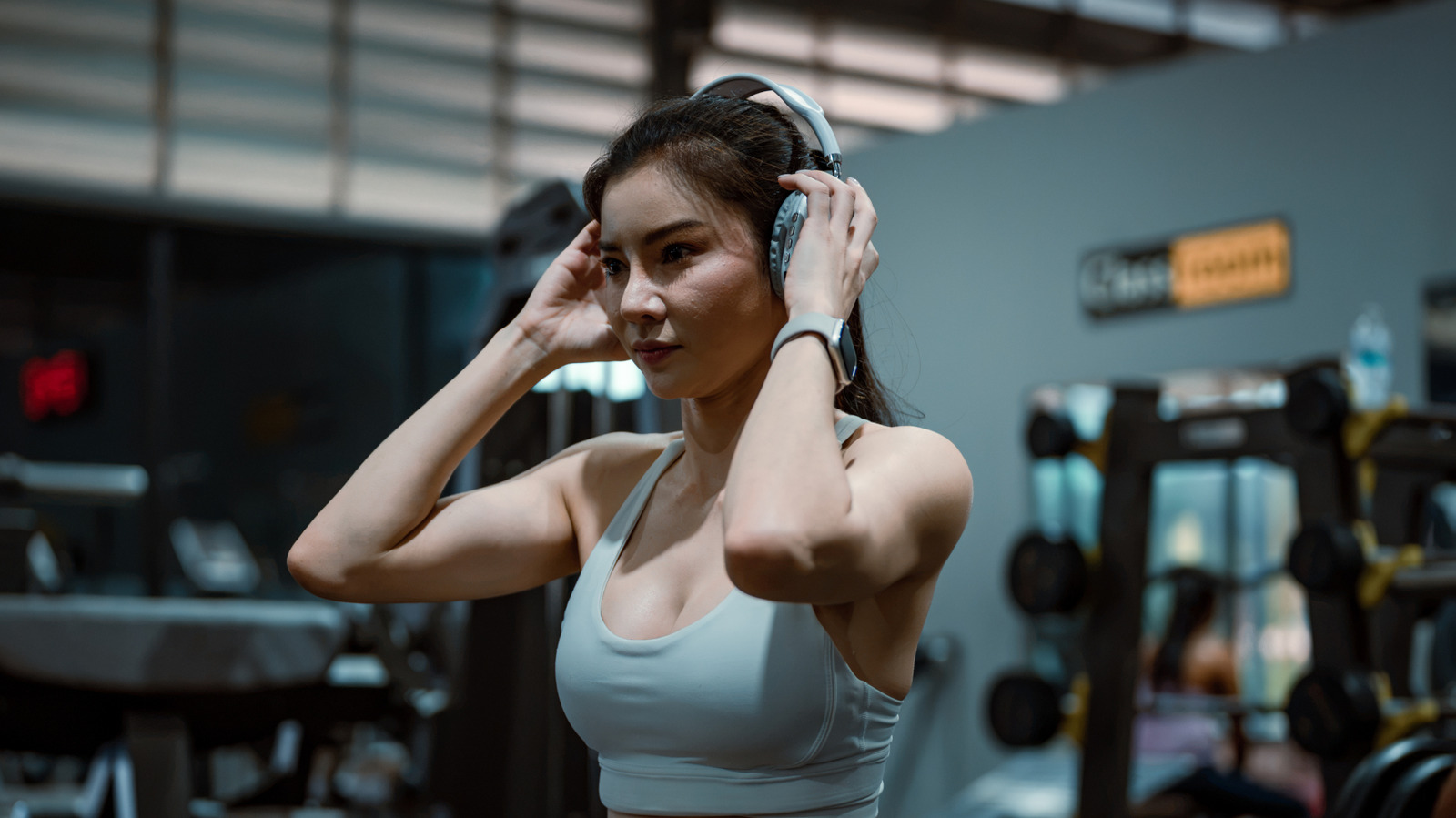
If you don’t own a pair of exercise headphones, you might be content working out with whatever kit you already own instead of paying for an extra gadget. Whether you’ve finally picked up some over-ear headphones worth buying, or have found wireless earbuds that are worth the money, you may just be happy using the device you already own.
But take it from me, as someone who’s been reviewing fitness and audio kit for years: you’re doing yourself a disservice. If you really want to work out to the best of your abilities, exercise headphones can give you advantages standard options can’t. Moreover, if you use normal headphones or earbuds that weren’t designed for fitness, you may end up damaging them in a few ways. There’s a reason this massive audio market segment exists.
Let’s run down a few of the key advantages exercise headphones and earbuds have over “standard” models, highlighting some options worth considering and guiding you toward smart purchases. All of the suggestions are either pairs I’ve tested myself, or well-received models from brands with whom I have personal experience.
They’re often designed to be sweatproof

PeopleImages/Shutterstock
Sweating when you exercise is totally normal, as it’s your body’s way of cooling down. But do you know where sweat shouldn’t be? Your headphones — specifically, the cushions or ear tips. Many of the common materials used to make them can be damaged by your perspiration. For example, it can damage leather by removing protective coatings and creating salt deposits that break down the material. Devices without an ingress protection (IP) rating can also be damaged by the moisture.
This can be a big problem for your beloved headphones, causing them to get damaged and stop working far faster than they otherwise would, even if you take steps to protect your headphones from sweat. However, exercise headphones neatly sidestep the issue.
Any option worth its salt will have an IP rating of at least IPX4 to cover sweat, though options like the IP55-toting Sennheiser Sport offer more protected. Another benefit I’ve encountered frequently is that these buds seem designed so that sweat won’t impede their usual activity; if your earbuds get sweaty from a run, it won’t be on or near the magnetic charging pins, so when you put them in a case their charging isn’t affected. If you’re buying exercise headphones, the label “sweat-proof” should be the bare minimum you look for.
You can replace and clean the cushions
YouraPechkin/Shutterstock
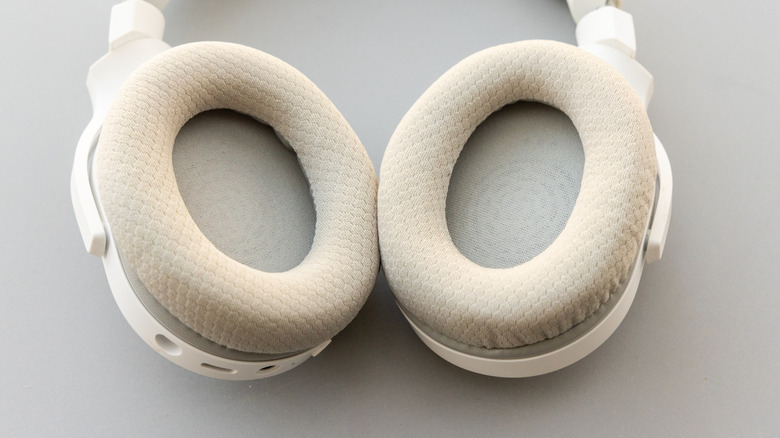
When it comes to exercise headphones, one specific sweat-proof feature isn’t offered nearly frequently enough on non-workout cans. Many of the best sports headphones I’ve tested let you remove the cushions, the parts that press onto your head, and few “standard” models let you take this part off easily.
Headphone cushions can get sweaty when you exercise, and even materials which aren’t damaged by perspiration, can still get slick or smelly if you don’t take care of them. Removing them makes them much easier to clean, and avoids you from accidentally damaging the rest of the device, so options like this can be much more hygienic, and safe.
So if you’re interested in over-ears, look for picks like the Raycon Fitness Headphones which tout pad replaceability as a key selling point. There’s an added benefit to replaceable ear cups, beyond avoiding the stink. Online, it’s easy to find cups with different materials or designs, so you can swap out cushions for ones that look better or feel more comfortable, the latter of which is naturally pretty important if you’re going to be wearing these while active.
They’re designed to emphasize low-end sound

muse studio/Shutterstock
Your sonic preference, for emphasis on treble or bass or a neutral sound, is completely your own. However, studies have indicated that bassy music is particularly good at motivating you when you work out (as are high-tempo tunes), in addition to it being conventional wisdom. This is something sports audio companies know, and in my experience, this kind of gadget is often the best at offering powerful low-end sound.
Every time I connect a new pair of exercise headphones, I know I’m going to get something with more bass heft than the average gadget, which makes them better than your average device for working out (some earbuds are good for rumbly low-end, but it’s not always the case). In fact, some companies have taken this to extremes. Shokz has its Bassphere tech in devices like the OpenDots 2 to emphasize low-end, and the Crusher 540 Active from Skullcandy has a physical bass slider which you can use to choose just how much bass your tunes have.
Some models have open designs to hear your surroundings

tinhkhuong/Shutterstock
When you’re running or cycling on a busy road, lifting weights at a packed gym or doing yoga in a public space, it’s important to be able to hear your surroundings. You might think wearing headphones in the first place would be counterintuitive, but the best open-ear headphones will keep the driver in your ear without blocking the ear canal, so you can hear your music and your environment at the same time. This form factor isn’t exclusively for active users, but many early options like the Bose Sport Open Earbuds were designed for workouts.
There are two common types of open earbuds: hook-style like the Shokz OpenFit Pro which go around your ear, and clip-style models like the Soundcore AeroClip which clip onto the bottom of your ear. In my experience, clip buds sound and fit better, but hook buds have longer-lasting batteries and more advanced features. Ultimately, buying the model that feels most natural in your ear is most important.
Audiophiles won’t love these kinds of earbuds. The fact that the driver is far from your ear means that audio isn’t on par with other earbuds or headphones, but the safety and comfort are the real selling points. Other Slashgear writers have written about the appeal of switching to clip-on earbuds, so there’s more to read if you’re intrigued.
They’re designed to sit well while you exercise

Vinodkumar Amberkhane/Getty Images
There’s a reason your AirPods fly out of your ears when you start working out. When you’re exercising, you’re moving a lot more than you otherwise would be. Everyday earbuds or headphones aren’t all designed to stay in place during this kind of activity. They’ll drop out of your ears or off of your head at the slightest provocation. One of the key selling points of exercise headphones is that they’re designed to stay in place when you’re active.
Over-ear headphones for exercising are often designed to sit tight on your head, with options like the H20 Audio RIPT Ultra having a really firm clasping band. In-ear buds have a few solutions; some have ear hooks that go around the ear to keep them in place, like the Beats Powerbeats Pro 2. Others use small silicon hooks or fins to ensure they’re wedged in place in your ear, like the JBL Endurance Race 2 .
All of the top-rated wireless earbuds that promise to never fall out are exercise buds that feature some sort of design element to ensure they stay in place. And a reliable fit isn’t just about avoiding the buds falling out; if they wiggle about in your ear, it can affect audio quality, even if they’re not falling to the floor.
Better IP ratings let you swim with them
Anna Zaro/Shutterstock
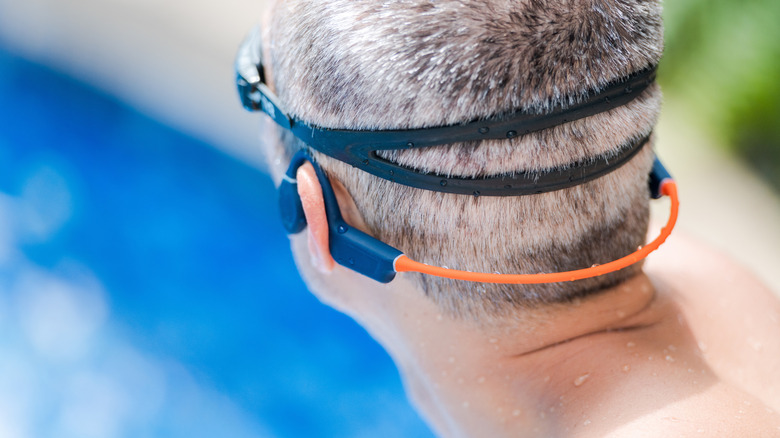
If swimming is your sport of choice, then you’ll already know that most headphones and earbuds are off the table. Not only do mainstream options like the Sony WH-1000XM6 have no water resistance whatsoever, but they’re also often bulky and lacking the hydrodynamic considerations that you’d want when gliding through the water. But if you still want to enjoy music while you’re doing laps (and don’t want to see if your waterproof speaker can really go underwater), you’ll be glad to know that there a few swimming headphones you can buy.
Options like the Shokz OpenSwim Pro and H20 Audio Tri 2 Pro are waterproof enough to work in swimming pools — even if you’re going for underwater lengths — and they’re streamlined to not affect your stroke or fall off while you’re splashing about. They also offer some extra bonuses that’ll be useful for swimming, like the ability to store music so you can leave your phone out of the water (and because Bluetooth won’t work if you’re in water), and designs that don’t interfere with swim googles or caps.
Some headphones let you store music and ditch your phone
Zamrznuti tonovi/Shutterstock
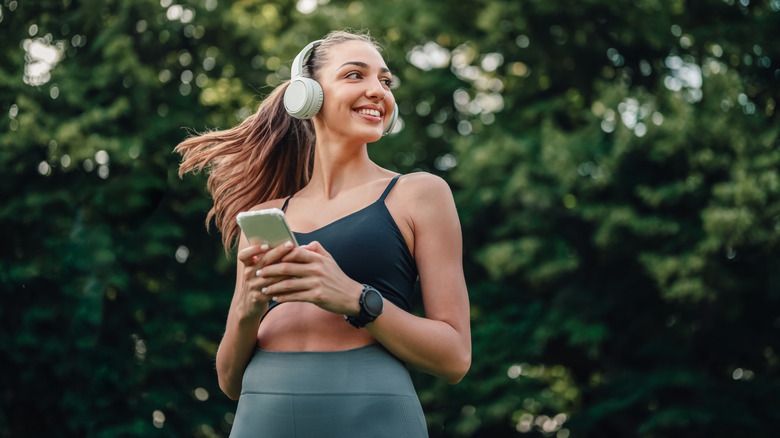
If you’re exercising with headphones or earbuds — including most pairs of fitness-designed ones — you’ll be bringing your smartphone along for the ride. These gadgets require a source device to play the music from, and unless you’ve opted for an audiophile-focused MP3 player, said device is probably your smartphone. But using a smartphone isn’t always ideal.
As we brought up just a couple paragraphs ago, swimming can present lots of complications, and if you’re running, you’ll have to hold your phone in your hand, or hope it fits in your pocket or shoulder holster. At the gym, you’ll need to remember to pick it up and carry it between stations. If you treat your workout as a digital detox away from your tech, this is all extra problematic.
However, a small group of fitness headphones have internal memory for music, allowing you to ditch the smartphone and keep all your tracks. The swimming earbuds we looked at before are prime examples, as is the Audio-Technica ATH-Sport90BT, which comes with 4GB internal memory. Sure, this solution can be a little fiddly: you will need your own music, instead of relying on a music streaming service, and it’ll take some set-up as you upload your tunes to the earbuds. But if you want to stay light while working out, this will let you keep another device at home or safely stowed in a locker.
They have touch controls designed for mid-workout

Andreswd/Getty Images
One of the reasons I personally find non-exercise headphones unsuitable for running is their touch controls. Almost all buds nowadays have some form of gesture control, haptic patch, or physical trigger, for playing or pausing your music, skipping a track, or changing the volume. Quite a few headphones do too. These don’t always work when you’re mid workout.
For starters, many such touch controls use haptic sensors, which sense your finger or gesture in order to enact a control. I’ve found these quite poor at recognizing sweaty fingers, and we’ve already discussed how that’s unavoidable during exercises. Many other options also need accurate touches, which can be nearly impossible when you’re bouncing up and down on a run, or mid-cycle and at risk of wobbling about with one hand off the handlebars.
Quite a few exercise headphones solve this problem by using smartly designed buttons. They’re often mechanical, which means you have to physically press or squeeze them like with the Baseus Bowie MC2 (resulting in a satisfying click), or they have large sensors that are hard to miss like the Soundcore Aerofit 2 Pro. This isn’t a major factor for every buyer, because for some tasks it’s simply easier to use your smartphone to control your music, but certain workouts require dexterity, and easy-to-use touch controls make a difference.
Some of them can track your heart rate
photoschmidt/Shutterstock
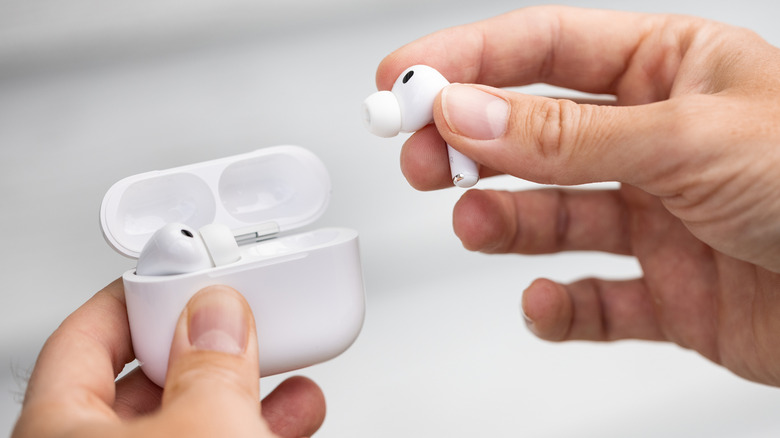
If you’ve bought a fitness tracker to help you meet your goals, then you already have a way to track your heart rate. Some people even own a heart rate monitor chest strap for the most accurate information possible. But if you’re trying to keep the tech to a minimum, you may want a way to track your heart rate without an extra gadget, and some earbuds offer that functionality. Naturally, you shouldn’t expect as accurate results as you’d get from a bespoke kit, but it can still be useful.
Models like the AirPods Pro 3 and Soundcore Liberty 4 have in-ear heart rate sensors that measure your metrics, at least once you enable the function. While neither of these pairs would be considered conventional exercise headphones, and they miss out on design considerations that make many alternatives so worthy, this feature could make them useful for buyers who don’t need anything especially hardy. Both also offer IP ratings for sweat protection (and more, the case of the AirPods).
For some races, they’re the only legal pair
ShamAn77/Shutterstock
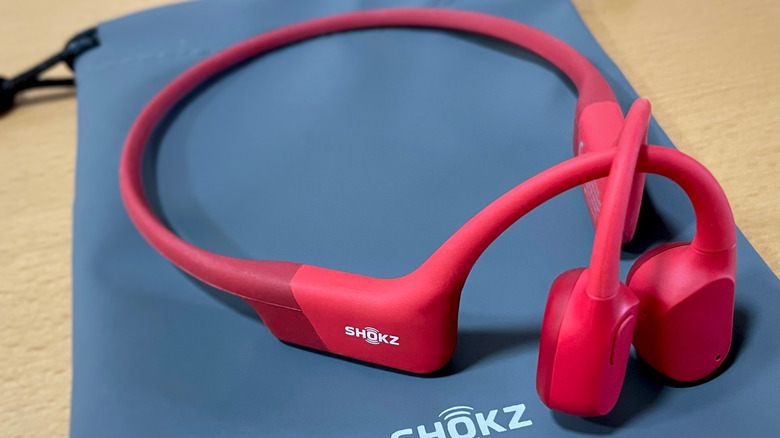
You don’t want to spend months and months training for a marathon, only to discover that the buds you’d been running with since day one aren’t allowed in your ears during the event. Many major race organizers have bans on certain types of headphone: the Boston Marathon rules discourage the use of any kind of headphones, and United Kingdom Athletics rules actively prohibit most kinds as well. This is because buds which block your hearing, meaning you might not be safe on roads, and you can miss instructions from race marshals.
However, while your standard earbuds and headphones may not be allowed on the run, some exceptions exist, and they’re generally for exercise headphones that don’t block up your ear canal. We’ve already explored open earbuds, which keep your ear canal partially clear, but bone conduction headphones are another option. To paraphrase our bone conduction headphone explainer guide, these don’t go in your ear, and instead let you “hear” sound by transmitting vibrations through the bones in your skull. Therefore, something like the Shokz OpenRun Pro 2 could be one of your only choices, if you plan to undertake a marathon.