
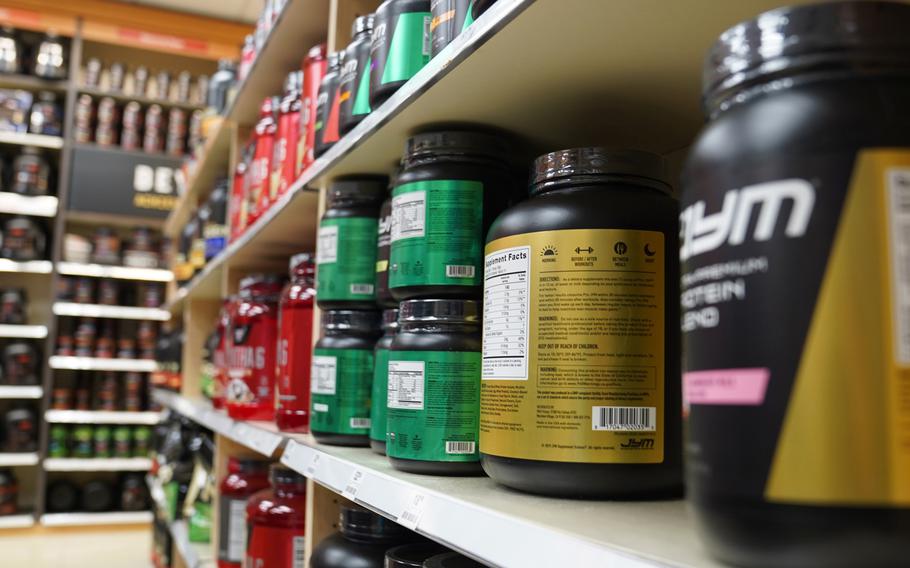
Supplements are displayed for sale in the exchange at Keesler Air Force Base, Miss., in August 2022. (Elizabeth Davis/U.S. Air Force)
Only 10% of dietary supplements sold at a pair of Army installations carried third-party certification as recommended by the Pentagon, according to a study published in October by Military Medicine.
Researchers examined 1,209 products sold at Fort Drum, N.Y., and at Camp Buehring in Kuwait during six months in 2024.
Only 120 were certified by a DOD-approved third-party agency.
Products included vitamins, minerals, herbs, botanicals, probiotics, fish oils, protein powders and supplements marketed to enhance physical performance.
The study is part of an initiative aimed at increasing the percentage of supplements sold on military installations that carry third-party certification by entities approved by the Defense Department’s Operation Supplement Safety, said Kyala Clegg, a registered dietician who coauthored the study, during a phone interview Wednesday.
“My goal is to make sure that our service members have products that are going to keep them healthy and safe,” said Clegg, director of the human performance program for Army Special Operations Command.
A 2021 study found that about 75% of U.S. service members consumed at least one supplement weekly. Between a quarter and a third of military users consume three or more products weekly.
Although the study of two Army installations cannot be generalized for the entire service, it provides a baseline for a second phase of research that is examining product certification more broadly, Clegg said.
The idea for the initial study came a few years ago when Clegg was working as a performance dietician at Fort Drum.
“I picked up that there was a general assumption that if a product was sold on a military installation, it was surely vetted in some way,” she said.
The researchers were surprised to learn that a mere 10% of supplements on the two installations had been certified by any of the four independent organizations recognized by the Defense Department, Clegg said.
The supplements market is largely unregulated; the Food and Drug Administration does not require safety or efficacy testing for new supplements being brought to market.
Products sometimes contain ingredients that are mislabeled or hidden. In some cases, supplements contain ingredients banned by the Defense Department. Service members at times discover during routine urine testing that they have been unknowingly consuming prohibited ingredients.
Some ingredients have proven dangerous.
In 2011, the Defense Department pulled 18 products being sold on military bases around the world that contained DMAA, an amphetamine-like stimulant linked to the deaths of several soldiers.
As a result, the Pentagon launched a safety awareness program that morphed into Operation Supplement Safety, which maintains the Defense Department’s official list of prohibited dietary supplement ingredients and provides education about supplements.
It maintains an interactive “scorecard” at www.opss.org/opss-scorecard to assist service members in judging risks in using particular supplements.
The study recommends that Operation Supplement Safety coordinate with installation retail outlets operated by AAFES, Defense Commissary Agency and Morale, Welfare and Recreation to reevaluate the vetting process for dietary supplements.
Ultimately, the study recommends, only supplements vetted by approved third-party certifiers should be sold on military installations.