
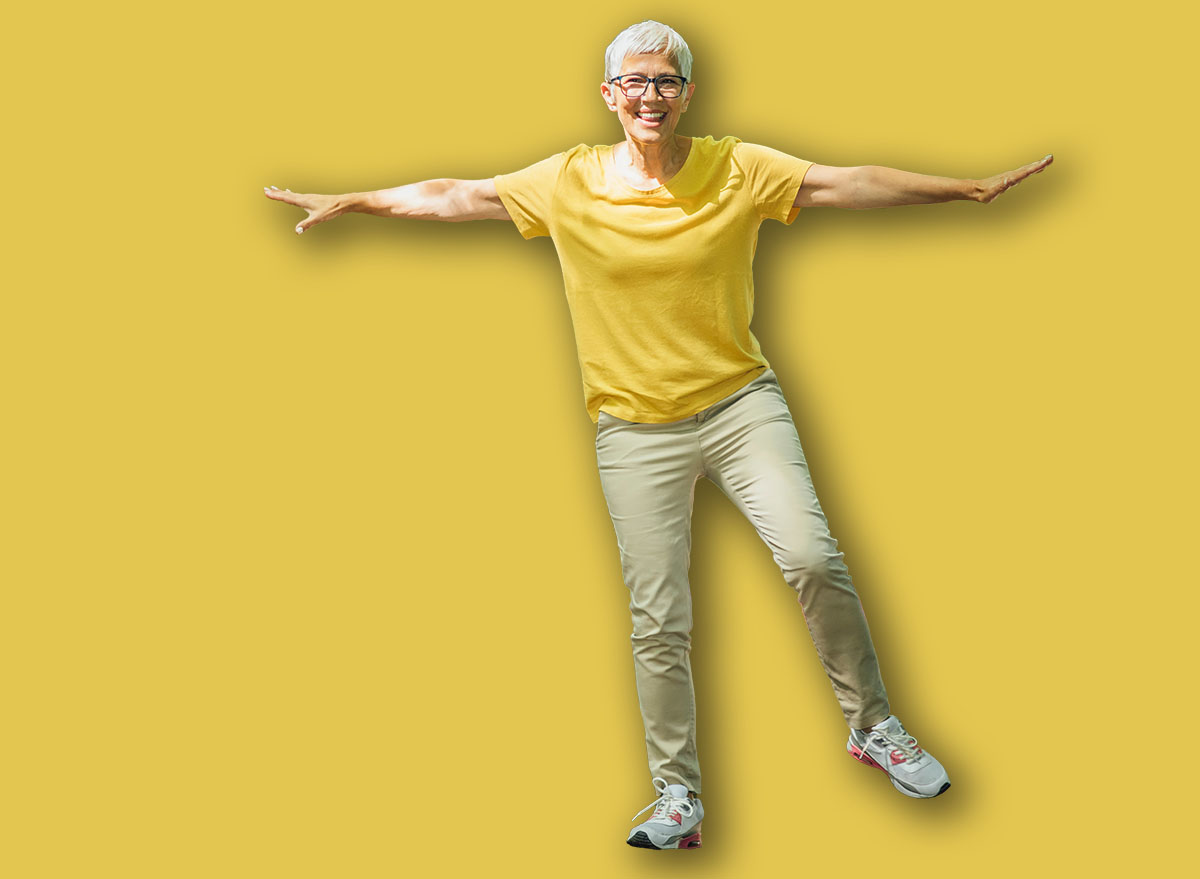
Standing exercises become more important than ever after turning 60.
If you’re 60 and don’t have standing moves in your workout rotation, you should consider adding them. Standing workouts activate many muscles, helping to improve core strength, balance, and posture. They’re also more neck and back-friendly than floor work. We spoke with an expert who shares four standing moves that indicate you’re fitter than most 40-year-olds.
Standing exercises are more important than ever after you hit 60, because they challenge the muscles that keep you steady and upright in daily life.
“When you’re on your feet, you’re training your legs, hips, core, and back to support your body the way they do when you walk, climb stairs, or get up from a chair,” says Dr. Gbolahan Okubadejo, NYC area orthopaedic and spinal surgeon. “From my perspective as a spine and orthopedic surgeon, that kind of functional strength is what protects people from falls, back strain, and the gradual loss of balance that often sneaks up with age.”
Standing workouts also fire up the small stabilizing muscles around the joints and spine, which don’t receive much use when performing seated movements.
“Over time, these exercises help maintain posture, preserve bone density through weight-bearing stress, and keep the body moving fluidly instead of stiffening up,” Dr. Okubadejo tells us. “It’s one of the simplest ways to hold on to independence and confidence as you get older.”
These standing moves are key markers of strong functional fitness at 60.
Single-Leg Balance
“Being able to stand on one leg for 20 to 30 seconds without wobbling is a big sign of solid hip strength and good neuromuscular control,” Dr. Okubadejo explains. “Balance is one of the first things to decline with age, and strong stabilizers around the hips and spine are what keep someone safe from falls.”
Balance on one leg, barefoot, on a flat, solid surface without using additional support.
Keep your gaze forward and your arms crossed. The lifted leg should not touch your grounded leg.
The time begins once your leg comes off the floor and stops when your foot touches the ground.
Balance for at least 20 to 30 seconds.
Switch sides.
RELATED: If You Can Do These 3 Balance Tests at 60, Your Body Age Is 20 Years Younger6254a4d1642c605c54bf1cab17d50f1e
Sit-to-Stand
“The sit-to-stand test is a simple move that shows powerful leg strength—especially in the quadriceps and glutes, along with a stable core,” Dr. Okubadejo tells us. “If a 60-year-old can stand up smoothly from a chair and sit back down under control, it tells me their joints, muscles, and balance systems are working together the way they should in daily life.”
Begin seated on a firm chair with your arms crossed and feet flat on the floor.
Stand up completely without using your hands for support.
Return back to a seated position.
Continue to stand up and sit back down with control.
Standing Hip Hinge
“A clean hip hinge shows good hamstring flexibility, strong glutes, and a back that is staying supported rather than overworked,” Dr. Okubadejo says. “This pattern protects the spine during bending, lifting, and reaching. When someone can hinge without rounding their back, it shows a healthy understanding of how to move in a spine safe way.”
Stand tall with your feet hip-width apart, core engaged, and knees bent slightly.
Place your hands on your hips.
Press your hips straight back, maintaining a tall chest and neutral spine.
Lower your torso until you feel a solid stretch in your hamstrings.
Drive your hips forward to return to a standing position.
Standing Heel Raises
“Rising up onto the toes and lowering slowly builds calf strength and ankle stability,” Dr. Okubadejo explains. “Strong heel raises reflect the kind of lower leg strength needed for a steady gait, climbing stairs, and catching themselves if they trip.”
Stand tall with your feet hip-width apart.
Lift your heels off the ground to rise onto the balls of your feet.
Hold for a moment at the top, feeling a solid stretch in your calves.
Gradually lower to the start position.
Continue to rise and lower.
“When someone can perform all four movements with control, it usually means their legs, hips, core, and balance systems are aging in a healthy way and they’re better equipped to stay active, independent, and injury-free,” Dr. Okubadejo notes.
Alexa Mellardo
Alexa is a content strategist, editor, and writer based in Greenwich, Connecticut. She has 11+ years of experience creating content for travel, lifestyle, fitness, wellness, F&B, home, and celeb news publications. Read more about Alexa