

A popular health supplement sold at chemists around Australia is facing increased scrutiny. Krill oil, taken for its Omega-3 benefits, is now facing questions about its sustainability credentials.
Most recently, WWF has lodged an objection with the Marine Stewardship Council (MSC), calling for the certification of the Antarctic fishery from which krill is harvested to be immediately reviewed.
Over 500,000 tonnes of krill are taken from the environment each year, which the industry says it can do “sustainably”. But conservationists argue the rules have changed since the fishery was certified and the process is now being “mismanaged”.
WWF-Australia’s ocean conservation manager Emily Grilly told Yahoo News that there could be “terrible impacts” on species that depend on krill. They can include whales, seals and penguins.
“In Antarctica, the ecosystem is very fragile,” she said.
“What’s happening now with the fishery is they can take very high catches from small regions that overlap with key foraging grounds for wildlife.”
What’s changed about krill harvesting?
Under an international agreement, ships worked a wide catchment area to ensure that waters with the highest abundance were not depleted. But in 2024, this conservation measure lapsed, meaning they could target areas, and the catch limit was reached in record time.
WWF-UK’s Rhona Kent said she believes “the mismanagement of the krill fishery is having a negative impact”.
“WWF is calling for an immediate moratorium on krill fishing and a review of the sustainability certification issued by the MSC until more precautionary fisheries management measures are agreed,” she said.
MSC recognises ‘need to protect’ Antarctica
MSC said it recognises “the unique nature of the Antarctic ecosystem” and the “need to protect it”, but said it cannot comment on ongoing assessments.
“The independent assessors published their final draft report earlier this month,” it told Yahoo News.
“Stakeholders have 15 working days in which to submit objections to the independent auditor’s findings.”
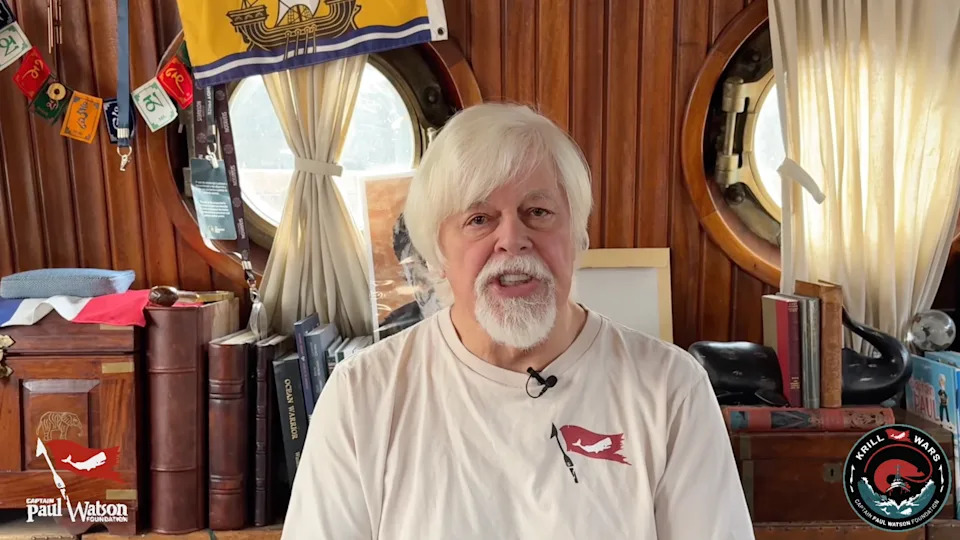
Captain Paul Watson has launched a mission to challenge krill harvesters. Source: Captain Paul Watson Foundation
Industry criticised from multiple fronts
Sea Shepherd founder and Greenpeace co-founder, Captain Paul Watson, has taken direct action against the ships launched by China and Norway.
In the early 2000s, his crews targeted Japanese whalers illegally operating in the Southern Ocean.
In 2026, through his latest conservation venture — the Captain Paul Watson Foundation — he launched a convoy of ships from Eden, NSW, to “defend Antarctica” against the harvesters.
“If the oceans die, we die,” says Captain Paul Watson. “Krill are the blood of the sea. Without them, the whales, penguins, fish and birds will starve, and the ocean will fall silent.”
In 2025, Bob Brown Foundation began a campaign urging a consumer boycott of krill products and targeting international companies that profit from the harvest.
They included one of the biggest suppliers of krill supplements, Chinese-owned Swisse, and its supplier, the world’s largest harvester, Norway’s Aker BioMarine.
At the time, Aker BioMarine CEO Matts Johansen told Yahoo News the major problem facing the industry was a “perception issue”.
“It is actually one of the most sustainable fisheries in the world,” he told Yahoo News in November.
Do you have a story tip? Email: newsroomau@yahoonews.com.
You can also follow us on Facebook, Instagram, TikTok, Twitter and YouTube.