
Breadcrumb Trail Links
Consumers are not necessarily making ethical declarations. They are managing budgets.
Published May 08, 2026 • Last updated 6 days ago • 3 minute read
You can save this article by registering for free here. Or sign-in if you have an account.
 Raw meat slice for grill with seasoning. Photo by Getty ImagesArticle content
For years, the food industry assumed Canada’s protein future would be shaped by a dramatic shift toward veganism and strict plant-based eating. That future never arrived. Instead, Canadians have chosen something far more pragmatic and far more disruptive to the market: Flexibility.
Advertisement 2
This advertisement has not loaded yet, but your article continues below.

THIS CONTENT IS RESERVED FOR SUBSCRIBERS ONLY
Subscribe now to read the latest news in your city and across Canada.
Unlimited online access to articles from across Canada with one account.Get exclusive access to the Toronto Sun ePaper, an electronic replica of the print edition that you can share, download and comment on.Enjoy insights and behind-the-scenes analysis from our award-winning journalists.Support local journalists and the next generation of journalists.Daily puzzles including the New York Times Crossword.
SUBSCRIBE TO UNLOCK MORE ARTICLES
Subscribe now to read the latest news in your city and across Canada.
Unlimited online access to articles from across Canada with one account.Get exclusive access to the Toronto Sun ePaper, an electronic replica of the print edition that you can share, download and comment on.Enjoy insights and behind-the-scenes analysis from our award-winning journalists.Support local journalists and the next generation of journalists.Daily puzzles including the New York Times Crossword.
REGISTER / SIGN IN TO UNLOCK MORE ARTICLES
Create an account or sign in to continue with your reading experience.
Access articles from across Canada with one account.Share your thoughts and join the conversation in the comments.Enjoy additional articles per month.Get email updates from your favourite authors.
THIS ARTICLE IS FREE TO READ REGISTER TO UNLOCK.
Create an account or sign in to continue with your reading experience.
Access articles from across Canada with one accountShare your thoughts and join the conversation in the commentsEnjoy additional articles per monthGet email updates from your favourite authors
Article content
The latest Canadian Food Sentiment Index from Dalhousie University’s Agri-Food Analytics Lab, supported by Caddle, shows a remarkable transformation in dietary behaviour among Canadian adults. Omnivorous diets, meaning consumers with no specific dietary restrictions, fell from 67.6% in fall 2024 to 55% in spring 2026.
Article content
Article content
Based on Canada’s adult population, that represents approximately 2 to 3.5 million fewer adult Canadians identifying as omnivores in less than two years. Meanwhile, flexitarian diets climbed steadily from 4.6% to 9.4%, paleo also expanded significantly.
Vegetarian and vegan diets, despite years of headlines suggesting explosive growth, remained relatively small and mostly stagnant. In fact, at 2.6% of respondents in spring 2026, the data suggests that roughly 600,000 adult Canadians identify as vegan today. That figure has barely moved over the last several survey waves despite enormous media attention and billions invested globally into plant-based alternatives.

Your Midday Sun
Thanks for signing up!
Article content
Advertisement 3
This advertisement has not loaded yet, but your article continues below.
Article content
Reshaping Canada’s agri-food economy
This is not a vegan revolution. It is a protein recalibration, and it is already reshaping Canada’s agri-food economy. Canadians are no longer defining themselves by strict labels like “vegetarian” or “vegan.” Instead, they are becoming opportunistic eaters, adapting their diets based on price, convenience, health goals, protein density, satiety, and increasingly, metabolic concerns tied to GLP-1 medications like Ozempic.
The old assumption was binary: Consumers would either eat meat or reject it. But today’s consumer wants flexibility and optionality. Someone may eat steak on Friday, Greek yogurt on Saturday, plant-based protein on Monday, and skip lunch entirely Tuesday because of appetite suppression drugs. This creates a far more volatile and fragmented protein economy.
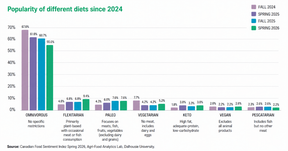 Charlebois graphic on meat
The graph tells us something profound: Canada is not abandoning animal protein. Canadians are becoming more selective about when, how, and why they consume it. That shift is already sending shockwaves through food manufacturing and retail. Traditional meat categories are under pressure, especially premium red meat consumed at home. But value-added proteins are thriving. High-protein snacks, fortified beverages, dairy-based protein products, egg innovations, and hybrid foods are outperforming expectations.
Advertisement 4
This advertisement has not loaded yet, but your article continues below.
Article content
The success of protein-enhanced foods, from yogurt to beer, reflects a market obsessed not with ideology, but functionality. Consumers increasingly ask one question before buying food: “What does this do for me?” That is why cottage cheese suddenly became fashionable again. It is why protein bars now occupy entire aisles. It is why dairy is quietly winning the protein wars despite years of criticism from anti-animal-product activists.
A miss by plant-based food companies
Ironically, many plant-based food companies misunderstood consumer psychology. Canadians never truly wanted ultra-processed meat replicas as much as investors believed. They wanted moderation, affordability, and nutritional efficiency. Flexitarianism offers all three. The data also reveals the immense economic pressure Canadians remain under. Meat inflation has consistently outpaced many other food categories in recent years, while household budgets remain stretched. For many households, especially larger families, dietary adaptation is no longer philosophical. It is financial. That is why flexitarianism is growing faster than veganism. Consumers are not necessarily making ethical declarations. They are managing budgets.
Advertisement 5
This advertisement has not loaded yet, but your article continues below.
Article content
The implications for agriculture are enormous. Canada’s livestock sector is unlikely to disappear despite years of predictions suggesting otherwise. But producers will face a more segmented marketplace. Premiumization, traceability, sustainability claims, animal welfare standards, and protein functionality will matter more than sheer volume growth. Meanwhile, pulse producers and ingredient manufacturers may benefit enormously from hybrid consumption patterns. Lentils, chickpeas, pea proteins, and beans are increasingly integrated into mainstream diets without consumers fully abandoning meat. Canada, one of the world’s largest pulse exporters, is uniquely positioned to capitalize on this middle ground.
For over a decade, the food conversation was dominated by activists predicting the collapse of animal agriculture and the inevitable rise of fully plant-based diets. But Canadians have chosen moderation instead of absolutism. That may frustrate ideological purists on both sides, but it reflects how real consumers actually behave during periods of economic uncertainty. People rarely eat according to political theory. They eat according to affordability, biology, convenience, and habit. The future of protein in Canada will not belong exclusively to meat, nor to plants. It will belong to flexibility.
– Sylvain Charlebois is director of the Agri-Food Analytics Lab at Dalhousie University, co-host of The Food Professor Podcast and visiting scholar at McGill University
Article content
Share this article in your social network