
Published June 30, 2026 09:04AM
Hydration often feels intuitive during the summer months. As temperatures rise, your body’s natural thirst mechanism alerts you to fluid loss from sweating. Maintaining a well-hydrated state is fundamental for optimal physical function, whether you are running for general fitness, preparing for a summer trail event, or beginning a fall marathon training cycle.
Recognizing how much to drink when exercising can be confusing as hydration needs vary from person to person. Moreover, your fluid needs depend on a variety of factors, such as your sweat rate, exercise intensity and volume, and outside temperature.
Thankfully, by following a few simple guidelines, you can dial in your hydration needs, and ensure your body stays hydrated in the summer heat.
Water Recommendations
Although water has no caloric value, it’s the most essential nutrient required in your diet on a daily basis. You may be surprised to learn that the average adult is made of 50-65% water. For example, a person weighing 130 pounds has around 30 liters (or 1,014 ounces) of fluid inside the body. Not only is water the fundamental component of your blood, but it’s also found in your brain, heart, lungs, and bones. Water has many important roles within your body:
Water in the blood transports glucose, oxygen, and fatty acids to working muscles and removes metabolic by-products like carbon dioxide and lactic acid.
Water in the urine eliminates metabolic waste products.
During exercise, water absorbs heat from your muscles, dissipates it through sweat via the skin, and regulates body temperature.
Water in saliva and gastric secretions helps digest food.
Water lubricates joints and cushions organs and tissues.
Water nourishes the brain and spinal cord.
All biochemical reactions occur in water.
Drinking recommendations vary, but guidelines suggest consuming a minimum of 92 and 124 ounces of fluids for women and men, respectively. And for those who don’t love drinking plain water, you should try to have 80% of your fluid intake come from water. Liquids such as coffee, tea, milk, and juice, as well as water-dense fruits and veggies (e.g., watermelon, strawberries, lettuce, and cucumbers), are suitable options to make up the remaining 20%.
Now you may be wondering: If you are made of water, why do you still need to drink so much water?
Every day, you lose 2-3 liters (about 77 ounces) of water from sweating, urination, breathing, and bowel movements. Ensuring you are adequately hydrated to maintain the proper fluid balance daily is essential to your health.
Why Daily Hydration Matters More in the Summer
In hot weather, your body’s priority is preventing overheating, primarily through sweating. During exercise, muscle contractions generate significant heat. To dissipate this, your internal thermostat redirects warm blood from your muscles and organs toward the skin’s surface. As your core temperature rises, water in your body acts as an internal cooling system, producing sweat that evaporates, drawing heat away.
Consequently, higher sweat rates require increased fluid intake to prevent overheating. Starting a workout when dehydrated places additional stress on your body, forcing your cardiovascular system to work harder. This causes blood pressure to drop, blood to thicken, and your heart rate to increase to maintain oxygen delivery to your muscles.
Furthermore, because muscles are roughly 75% water, inadequate hydration impairs their ability to contract properly, recover, and flush waste products. This explains why runners are more prone to aches and injuries in summer. As temperatures rise, muscles work harder, and dehydration prevents them from functioning effectively.
Benefits of starting your workout hydrated
Lower heart rate
Higher skin blood flow
Lower core body temperature
Lower perceived exertion
Improved skills and concentration
Reduced incidence of GI issues
Higher cardiac output
Higher stroke volume
Improve muscle and joint functioning
Improved digestion and gastric emptying
Improved performance
While many runners seem to focus exclusively on hydration during workouts, your true hydration status is determined by your drinking habits between training sessions. Beginning a run in a dehydrated state significantly increases the risk of heat exhaustion. Considering that your body naturally loses 0.5 to 1 liter of fluid overnight through “insensible water loss” (e.g., breathing and light sweating), when you factor in additional variables like alcohol consumption, travel, yardwork, a demanding workday, or illness, ensuring you are well-hydrated before you start your run is critical.
Here’s a simple timeline to help you arrive to your workout in a hydrated state:
Drink 16 to 24 ounces of fluid for every pound of body weight lost during your workout (continue reading to learn how to determine how much weight you lose during a workout)
2 hours before a workout: Consume ~16 to 20 ounces of water.
10 to 20 minutes before a workout: Consume 8 to 12 ounces of water.
What Impacts Your Hydration Status During a Workout
Many runners wonder at what point they should start drinking water during a workout. Although research suggests that fluid consumption isn’t necessary for runs under 60 minutes, that it may be beneficial for runs 60–90 minutes long, and that it is recommended for anything over 90 minutes, this distance-based framework overlooks crucial factors like intensity and weather. A more practical approach prioritizes the dew point, the temperature at which air must be cooled to become fully saturated with moisture.
While temperature measures heat, the dew point indicates your body’s cooling efficiency (how effectively sweat can evaporate). As exercise intensity increases, your body generates more heat. While sweating is your primary cooling mechanism, it is the evaporation of that sweat that actually lowers your skin temperature. When relative humidity is high, the air is saturated, preventing evaporation and disabling your body’s natural air-conditioning system.
Determining Your Fluid Intake Based on Dew Point
Dew PointWorkout ImpactHydration Needs<55°FGenerally tolerableConsume 0-8 ounces of fluid per hour55-60°FLow risk for dehydrationConsume 8-16 ounces of fluid per hour60-65°FPerformance may be impactedConsume 16-24 ounces of fluid per hour65-70°FHydration needs become increasingly significantConsume 24-28 ounces of fluid per hour (consider adding additional sodium)70°FGreater risk for excessive thermal strainConsume 26-32 ounces of fluid per hour (consume with additional sodium)
As a general guideline, try to consume 2-6 ounces every 10-15 minutes.
Fine-Tuning Your Hydration Strategy
While mastering pre-workout hydration and adjusting your fluid intake based on the dew point are essential first steps, they are only the beginning. To truly optimize your performance and to keep yourself healthy in the heat, consider these additional strategies to further refine and personalize your hydration plan.
Monitor Your Urine Status
Your urine color says a lot about your hydration status. When you are dehydrated, the kidneys filter waste to retain water, which causes urine to become darker and more concentrated. If you are going more than three hours without the urge to urinate, that may be a sign of dehydration. Consistently clear urine (and frequent urination) means you are drinking too much water. Overhydration can flush out essential electrolytes (like sodium). Healthy urine should be a light yellow color, which shows your body is filtering waste while maintaining proper electrolyte balance. Some supplements may alter urine color, like B vitamins and beet juice.
Urine Color and Hydration Status
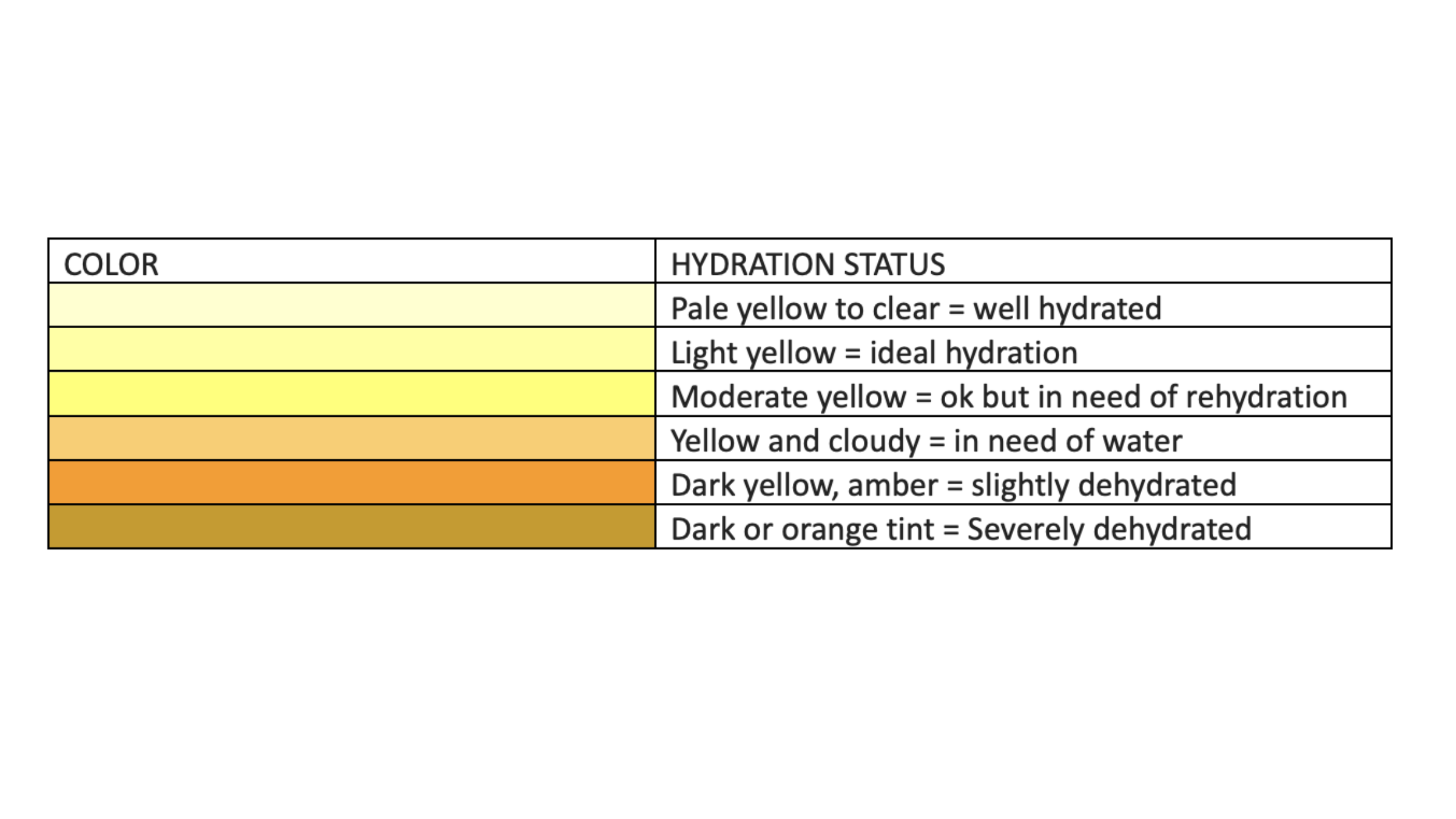 Healthy urine should be a light yellow color, which shows your body is filtering waste while maintaining proper electrolyte balance. (Photo: Courtesy Marni Sumbal)
Signs and Symptoms of Dehydration
Maintaining adequate hydration during exercise does more than just quench your thirst; it optimizes your body’s cooling systems, protects your heart, helps your muscles work properly, and keeps your digestion on track. While you might feel like you can power through, even a minor fluid loss can gradually slow your speed, diminish your endurance, cloud your focus, and zap your motivation. Pay attention to the following warning signs that you are not meeting your hydration needs:
Mild dehydration
Reduced performance
Headache
Fatigue
Impaired cognition
Less elastic skin
Sunken eyes
Dry mouth
Dizziness
Loss of appetite
Increased thirst
Extreme dehydration
Hypotension
Tachycardia
Weak pulse
Cold hands/chills
Overhydration
Nausea
Vomiting
Headache
Puffy face, hands, ankles
Changes in mental state
Muscles weakness, cramps, spasms
Pre- and Post-workout Weight
Understanding your unique sweat rate and fluid needs helps you avoid both dehydration and overhydration during exercise. Comparing your body weight before and after a workout is a practical way to assess your hydration status. A significant weight loss (1-5%) typically indicates dehydration, while a weight gain suggests overhydration. Keep in mind that daily weight fluctuations, caused by factors like food intake, inflammation, bowel movements, and glycogen depletion, are normal.
How to estimate your sweat rate
Note that weight loss does not always mean dehydration because glycogen (stored carbohydrates) holds water. This is why many people experience rapid weight loss on a low-carb diet. Thus, weight loss after a hot, prolonged workout may be a combination of glycogen depletion and fluid loss.
Pre-exercise weight – post-exercise weight (in pounds) + fluid intake during the activity (in ounces) = individual hourly sweat rate
Body weight pre- and post- is taken in the nude.
Every 1 pound lost is equal to 16 ounces of fluid.
Urinating (or having a bowel movement) during the workout will throw off the calculation.
Example: Pre-workout weight: 140 pounds
Post-workout weight: 139 pounds
Volume water consumed during 1-hour workout: 12 ounces
1. Fluid deficient: 140—139 = 1 pound (or 16 ounces)
2. Total sweat loss: 16 ounces + 12 ounces = 28 ounces per hour
3. Sweat rate (ounces per hour) = 28 ounces per hour
To fully replenish fluid and electrolytes post-workout, aim to consume 16-24 ounces of fluid for every pound lost. Since 1 pound of body weight roughly equals 16 ounces of fluid, the additional amount accounts for obligatory urine losses.
Instead of guzzling large volumes immediately, sip fluids slowly over 60 minutes. To encourage consumption, choose cool, lightly flavored beverages. If you anticipate high sodium losses, consider adding a pinch of salt (approximately 1/4 teaspoon or ~500 mg sodium) to your pre- and post-workout drinks. Because precise sweat and sodium loss can vary significantly, professional sweat testing may be needed for more personalized guidance.
Your Best Hydration Strategy Is Personal
Instead of asking, “When should I start hydrating on my run?” a better question is, “What are the conditions today, and what does my body need to perform well?”
There is no single hydration rule that works for every athlete, every run, or every environment. Dew point, intensity, sweat rate, daily hydration status, and body weight changes all provide valuable feedback that can help you build a hydration strategy tailored to your individual needs.
Instead of avoiding drinking because your run is “only 45 minutes” or guzzling fluids because you feel hot, the goal is to replace enough fluid to support performance, health, and recovery without over- or under-hydrating.
The runners who thrive in the summer heat are the ones paying attention to the signals their bodies provide. When you learn how your body responds to different training and environmental conditions, hydration becomes less of a guessing game and more of a performance tool.