
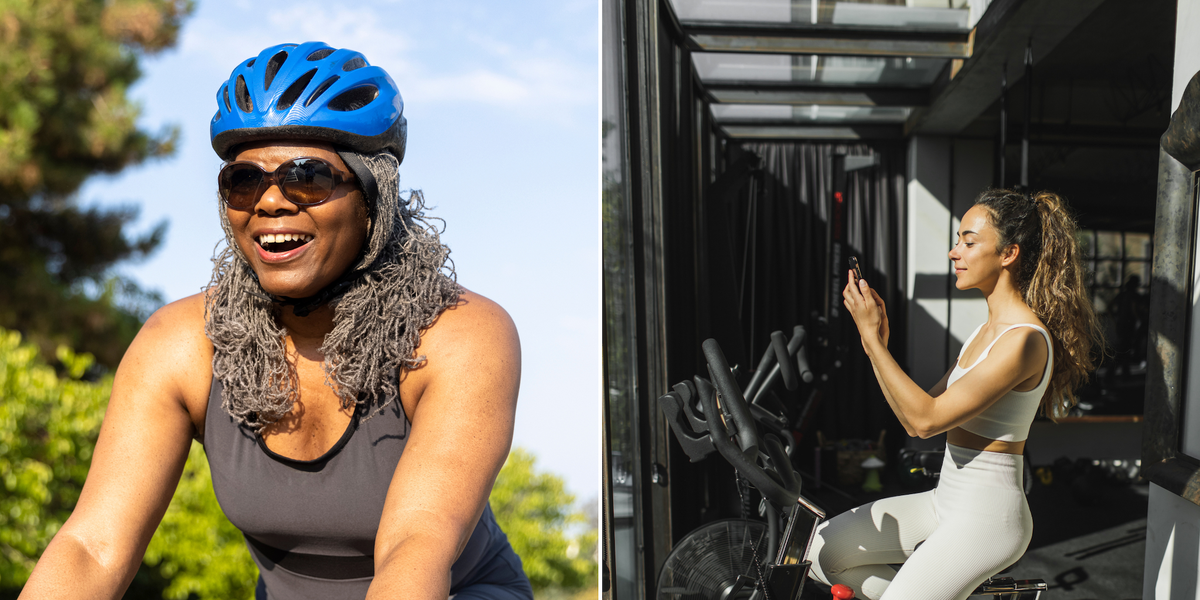
Cycling is having a huge moment right now, with more people than ever taking to the saddle to improve their health and fitness.
According to a Transport for London report published last year, cycling journeys in the capital alone increased by 43% over six years, reaching 1.5 million a day. Meanwhile, spin has long been one of the world’s most popular gym classes.
But when it comes to the specific health benefits, how do indoor and outdoor cycling actually compare?
We asked a sport and exercise medicine doctor to explain the differences.
Indoor vs outdoor cycling: which is better for fitness?
‘Neither is objectively better because they train slightly different things,’ says Dr David Porter of Opus Biological.
Ultimately, the better option depends on your goal.
‘Both build cardiovascular fitness, but outdoor cycling recruits more of the stabilising muscles around the hips, core and shoulders because you’re constantly correcting balance, reading the road and adjusting to the terrain,’ he explains.
That aligns with the research. A systematic review published in the Scandinavian Journal of Medicine & Science in Sports found clear links between outdoor cycling and improved cardiorespiratory fitness, particularly among younger people. Commuter cycling was also associated with lower all-cause and cancer mortality in middle-aged and older adults.
Indoor cycling performs well too. A separate systematic review published in Medicina highlighted its potential to improve aerobic capacity – one of the key markers of cardiovascular fitness.
The two differ slightly when it comes to strength.
Outdoor riding recruits more stabilising muscles, making it a better option if your goal is broader functional fitness.
Indoor cycling, meanwhile, ‘isolates the leg muscles more cleanly, which is genuinely useful if the goal is a structured power or interval session,’ says Dr Porter.
Indoor vs outdoor cycling: which is better for recovery and bone health?
‘Indoor cycling on a stationary bike or in a studio class is a controlled, low-impact movement pattern: no potholes, no sudden braking, no camber in the road,’ says Dr Porter.
‘That makes it a good option for anyone building back up after a knee, hip or lower-back injury, or managing early-stage joint issues because the resistance and cadence are fixed and predictable.’
Outdoor cycling, by comparison, exposes you to constantly changing terrain.
‘Outdoor riding adds unpredictable terrain and constant small stabilising adjustments, which is harder on the joints in the short term but does more for functional strength and proprioception over time,’ he explains.
When it comes to bone health, neither is a complete solution.
‘Weight-bearing, impact-loaded activity is what stimulates bone density, and outdoor cycling – particularly on rougher surfaces – provides more of that mechanical loading than a stationary bike,’ says Dr Porter.
‘It’s not a reason to avoid indoor cycling, but anyone using it as their only form of exercise should pair it with some impact or resistance training.’
Supporting that, one study published in the Journal of Strength and Conditioning Research found that combining indoor cycling with resistance training for nine weeks increased sedentary women’s leg strength by almost 30%. Core, back and arm strength also improved, while estimated VO2 max increased by 8.5%.
Should you cycle indoors or outdoors?
‘Indoor is the better choice during injury rehab, in poor weather, or for anyone who wants a precise, time-efficient workout with no traffic or navigation to think about,’ says Dr Porter.
‘Outdoor is better for building genuine bike-handling skills, enjoying the mental health benefits of being outside and preparing for an event that will actually take place on the road.’
That mental health element shouldn’t be overlooked.
According to research from the Eden Project, more than half of UK adults (52%) spend less than two hours a week in nature, despite 86% saying it benefits their wellbeing.
So, if it’s practical and safe for you to do so, outdoor cycling offers the dual benefit of improving your fitness while spending more time outside.
‘Indoor gives you control and consistency, outdoor gives you resilience and skill. Most people would benefit from doing both rather than treating it as a choice between the two,’ concludes Dr Porter.
As with any form of exercise, though, the best option is the one you’ll actually keep doing.
One of our most frequently asked questions here at Women’s Health? How to build muscle and burn fat at the same time. So, we asked superstar trainer Oyinda Okunowo exactly how to do it. In this 4-week plan – created exclusively for Women’s Health COLLECTIVE members – you’ll get the workouts and nutrition guidance needed to help you on your way to better body composition. Tap the link below to unlock 14 days of free access to Oyinda’s plan and start training today.

Hannah Bradfield is a Senior Health and Fitness Writer for Women’s Health UK. An NCTJ-accredited journalist, Hannah graduated from Loughborough University with a BA in English and Sport Science and an MA in Media and Cultural Analysis. She has been covering sports, health and fitness for the last five years and has created content for outlets including BBC Sport, BBC Sounds, Runner’s World and Stylist. She especially enjoys interviewing those working within the community to improve access to sport, exercise and wellness. Hannah is a 2024 John Schofield Trust Fellow and was also named a 2022 Rising Star in Journalism by The Printing Charity. A keen runner, Hannah was firmly a sprinter growing up (also dabbling in long jump) but has since transitioned to longer-distance running. While 10K is her favoured race distance, she loves running or volunteering at parkrun every Saturday, followed, of course, by pastries. She’s always looking for fun new runs and races to do and brunch spots to try.