
The new program complements SuppCo’s TrustScore supplement quality rating system and builds on earlier testing initiatives, which revealed that roughly half of the top-selling supplements that the company bought off the shelf failed to meet basic label accuracy standards.
“SuppCo was born out of my own frustration trying to make informed decisions about supplements, and I quickly realized this wasn’t a personal challenge but a systemic failure of the industry,” Steve Martocci, co-founder and CEO of SuppCo, shared in a press release. “With TESTED by SuppCo, we’re setting a clear, independent standard for transparency and accountability so people can finally trust what they’re buying, and responsible brands can prove it.”
TESTED by SuppCo debuts in partnership with brands including Momentous, Thorne, Metagenics, Gaia Herbs, Designs for Health, Fatty15, Solaray, Niagen, Integrative Therapeutics and Pendulum.
Certifying what’s on the shelf and surfacing failures
Jordan Glenn, head of science at SuppCo, said that the certification is a logical extension of the company’s testing of some 44 popular supplements sold on Amazon last year, which found that roughly half of the products tested failed to meet basic label accuracy standards.
It also adds another layer to the TrustScore feature, which shines a light on formulation decisions, manufacturing standards and transparency practices that signal quality before a product reaches a lab.
“TESTED tells you what’s actually in the bottle you buy off the shelf,” Glenn said. “Together they create a closed loop where TrustScore helps users identify products that should be trustworthy, and TESTED confirms whether that trust holds up in the real world.”
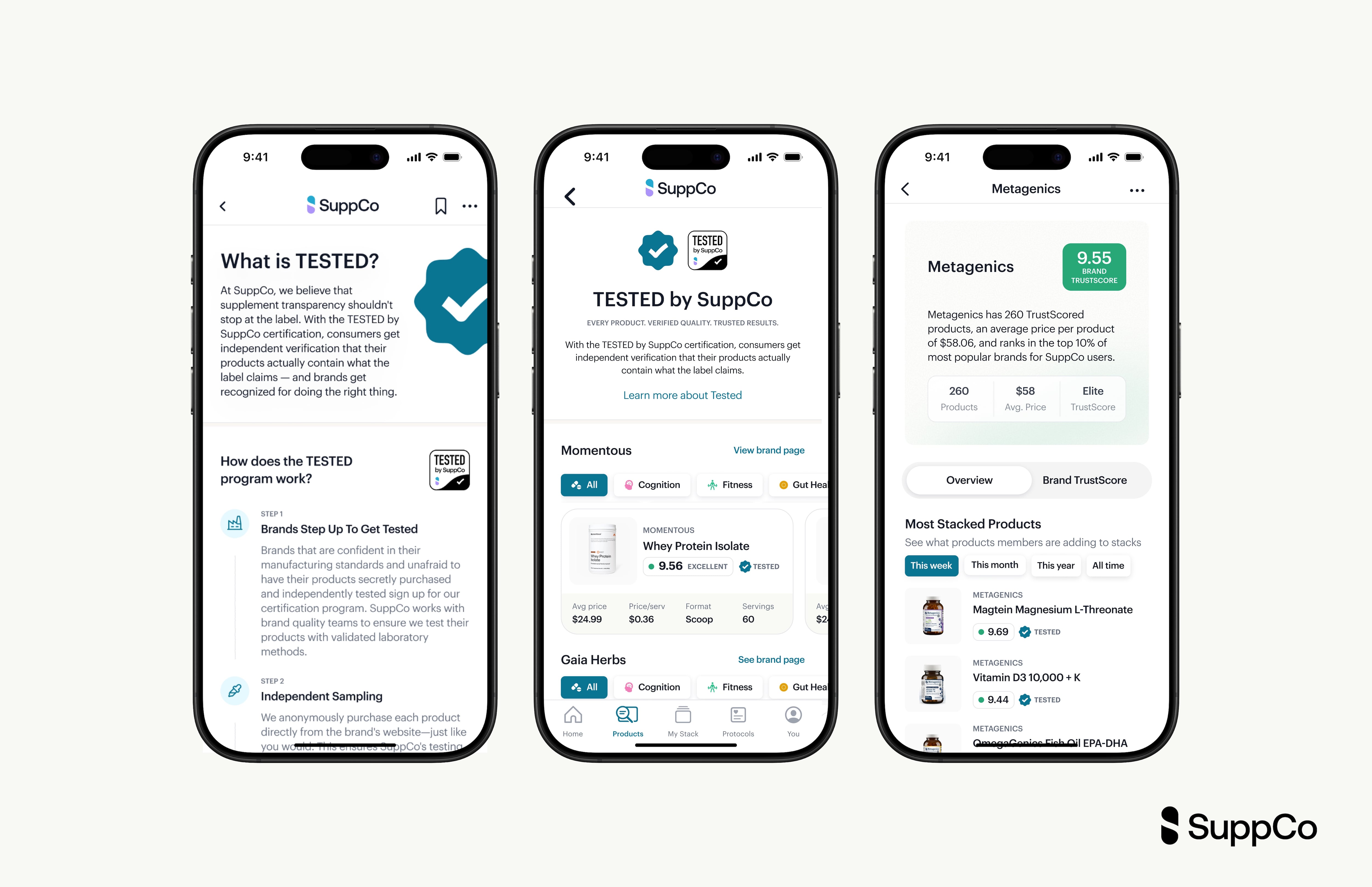 SuppCo purchases the product anonymously from the brand’s website just like a consumer would and submits it to independent testing. (SuppCo)
SuppCo’s initial testing rounds targeted creatine, NAD+, urolithin A and berberine supplements, with results showing that 22 of the products contained 0% to 3% of their listed active ingredients. Failings were particularly prominent in brands claiming the highest serving size, which SuppCo reported often concealed weak or absent active ingredients.
“These aren’t borderline misses of ‘close enough’ results, they’re evidence of breakdowns at nearly every level of quality control, from raw ingredient sourcing to final formulation verification,” SuppCo stated in its 2025 testing retrospective.
“Whether the cause was manufacturing shortcuts, supplier variability, lack of internal testing or intentional deception somewhere in the supply chain, the end result was the same: products that made confident claims yet delivered almost none of what they promised.”
TESTED by SuppCo submits all products for testing through an independent ISO 17025–accredited laboratory, and those that meet or exceed 95% of their labeled active ingredient claims earn certification. All results, regardless of certification status, are posted on SuppCo’s product pages so that consumers can make informed decisions.
“With over 650,000 users actively tracking their supplement routines on SuppCo, certification results, including failures, are surfaced directly to the people making purchase decisions,” Glenn said. “That visibility is an important complement to existing certifications, which are valuable but were not designed with a direct consumer audience in mind.”
Testing is then repeated annually to ensure compliance, and products that do not meet the standard are guided through remediation before being retested. Brands pay a certification fee to cover the cost of independent testing, program operations and licensing.
Overcoming the structural issues, closing a ‘meaningful loophole’
SuppCo is not the first company to monitor the marketplace for supplements that fall short of labeling and identity standards, particularly as the focus on self-regulation and adherence to good manufacturing practices intensifies in the supplement space.
“The supplement industry is at an inflection point,” Glenn said. “Consumer expectations are rising, regulatory scrutiny is increasing and independent verification is becoming a baseline expectation rather than a differentiator.”
He added that brands partnering with TESTED at launch understand that transparency is the only durable competitive advantage in a category that is only getting noisier. Here, verification, accountability and transparency are baseline, and brands that build quality into their operations and prove it independently define the category at scale.
“It’s easy for brands to talk about quality and boast big claims about their products, but it’s much harder to prove it,” said Jeff Byers, CEO of Momentous. “We chose to participate in TESTED by SuppCo because trust and accountability are how this industry moves forward. Transparency should not be optional and the brands that stand behind their products, like we do, should be willing to step up to the plate and prove it.”
Like ConsumerLab, NSF International and the United States Pharmacopeia before it, SuppCo is on a mission to ensure and seal supplement label accuracy, identity, purity and quality but presents its certification as resolving a fundamental structural issue in how testing is done.
“Most existing certifications rely on manufacturer-submitted samples or tests from production lots,” Glenn said. “TESTED purchases products anonymously, off the shelf, after normal retail aging, the same way a consumer would. That distinction closes a meaningful loophole where a product can pass a certification test using a carefully selected lot and still underdeliver in the bottle a consumer actually opens.”
Companies in the space—and none more prominently than natural product manufacturer NOW Foods—have also conducted their own testing of supplements largely purchased on Amazon and identified wide-ranging supplement labeling and potency problems.
Through its industry self-policing program, NOW has conducted 19 rounds of testing of “no name brands” purchased on Amazon since 2017. Ingredients monitored include St. John’s Wort, methyl B-12, SAM-e, resveratrol, berberine, astaxanthin, bromelain, magnesium glycinate, quercetin, CoQ10, glutathione, curcumin, phosphatidyl serine, acetyl-l-carnitine, alpha lipoic acid and creatine.
In most cases, NOW described the results as “alarming”, “abysmal” or “persistent”, raising multiple red flags and warnings of buyer beware.