
Kinesio tape, sometimes called KT tape or sports tape, has been used since the 1970s to treat muscle and joint problems and to help improve movement – but a new study has questioned how useful it actually is.
The thin, stretchy, cotton-based tape is designed to support muscles and joints without stopping them from moving. It is supposed to lift the skin, stimulate sensory nerves, increase blood flow, and help the body heal faster.
Top athletes, including footballer Cristiano Ronaldo and golfer Tiger Woods have been seen wearing colourful Kinesio tape to ease injuries, and some Olympic skiers even apply to their faces to prevent frostbite.
Despite its popularity, evidence for its effectiveness is limited.
Researchers say it may provide immediate to short term benefits, but the quality of the evidence is ‘very uncertain’. Several recent clinical trials have reported inconsistent results for its use.
In the latest research, a team of researchers from the School of Rehabilitation Sciences at Southern Medical University in Guangzhou, China, and the Department of Rehabilitation Medicine at Zhujiang Hospital, Southern Medical University, analysed 128 systematic reviews.
The team, led by Dr Xiaoyan Zheng and Dr Jihua Zou, examined 310 individual trials, 15,812 participants and 29 musculoskeletal conditions. Most of the reviews focused on conditions affecting the legs and feet and nearly 90 per cent measured pain intensity.
The analysis suggested that KT tape ‘may reduce pain and improve movement in the short term, but the evidence is highly uncertain’.
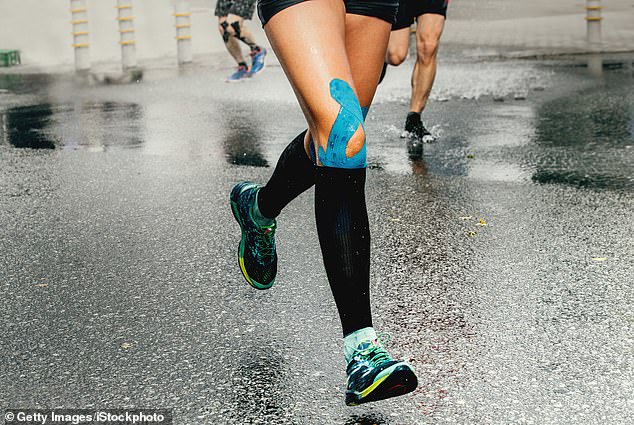
Kinesio tape has been widely used since the 1970s to treat muscle and joint problems and to help improve mobility
This includes common conditions such as knee surgery recovery, chronic knee or back pain, knee osteoarthritis, tennis elbow and plantar fasciitis.
However, the researchers found little or no evidence that KT tape improves pain or function in the medium term, or affects muscle strength, range of motion, or quality of life. In most cases, the tape was only slightly better than placebo or sham taping and the certainty of this evidence was low.
Side effects were rare but still a concern. Of the trials that reported on safety, skin irritation occurred in 40 per cent and itching in 30 per cent of participants, usually clearing up without treatment.
The quality of most of the reviews was poor, and the studies varied widely in design. This makes it difficult for doctors to give firm recommendations about its use.
Published in the journal BMJ Evidence-Based Medicine, the researchers concluded: ‘Current evidence is very uncertain regarding the clinical effects of KT taping on musculoskeletal disorders.
‘Considerable differences between studies, unclear relevance to real patients, and potential side effects may limit its use in clinical practice.’
KT tape – a 16ft roll usually costs between £6 and £15, depending on the brand – is not just used in sports.
Its popularity has spread online for ‘body sculpting’ and lymphatic drainage, where it is meant to lift the skin slightly to enhance contours around the jaw, neck, or abdomen.
The effect is real but temporary and cannot replace cosmetic procedures.
Despite its widespread use among athletes and on social media, experts caution that the actual medical benefits of Kinesio tape remain unclear.
The company that makes the brand-name KT Tape has previously warned athletes not to put it on their faces because it has never been tested for that use.