
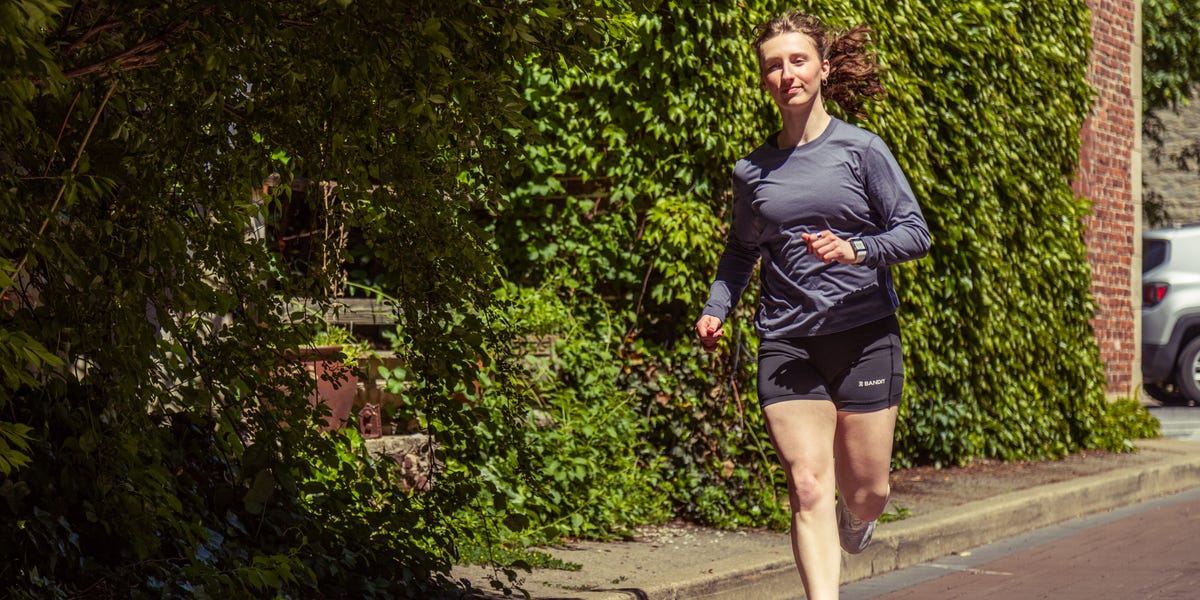
For the longest time, I didn’t understand how glute strength translated to runs. I just knew that I loved lifting weights. But over the past few years, I’ve learned that the glutes play a major role in strong running form, powering your stride and offering stability through every step.
“You can have a really strong core, but if the seat of your power (a.k.a. your glutes) is not contributing its fair share of work, then you’re not going to have the best outcome,” says Janet Hamilton, CSCS, exercise physiologist and founder and head coach of Running Strong.
Strong glutes ensure your pelvic floor muscles, core, and legs can all work together synergistically to make you faster and more powerful in every stride. Unfortunately, many runners struggle with inactive glutes or “dead butt syndrome,” in which the muscles don’t turn on to fully support your mechanics.
Firing up my glute muscles while running is a piece of the puzzle that I hadn’t fully nailed down—until recently.
Curious about translating glute strength into powerful runs, I spoke with Hamilton and picked up three strategies to help wake up my backside. Steal them for yourself for a stronger stride.
How Glute Activation Powers Your Runs
Runners often develop gluteal amnesia or “dead butt syndrome” from sitting too much or neglecting glute exercises. Without glute strength powering your runs, you risk running without pelvic stability.
“The amount that your hip dips when you run is somewhat determined by how strong the lateral hips are. If the hip on your weight-bearing side is a little bit weak, then your hip will dip down further,” Hamilton says. Over time, this can lead to poor knee alignment, injuries like IT band syndrome, and it can waste energy that could otherwise help you run faster, she explains.
Plus, when your glutes don’t fire, your body can overcompensate by shifting load to other muscle groups like your hamstrings and lower back muscles, leading to more injury risk or fatigue.
“If you want to be a good, strong runner, especially if you’re going to be running trails, hills, or long distances, then a strong butt is a good friend to have,” says Hamilton.
Plus, the more strength you build in key running muscles (i.e., your glutes), the more power and speed you build, which equals a better chance at a PR.
As one of many runners who works a desk job, I know I have to make up for glute activation and glute strength in my workouts not only for the sake of my long-term health, but also for faster, more powerful run performances. Here’s what I do to make that happen.
3 Tips for Activating Glutes Before and During Runs1. Core and Glute Activation Warmups
Activating a muscle has to happen in order to use it, so some warmup drills before runs (and strength workouts) help you wake up your muscles before you challenge them, says Hamilton.
One of my favorite things to do before a run is activate my core and glutes with some light dumbbell and bodyweight movements for about 10 minutes. It makes me feel mentally and physically primed to actually recruit my glutes on my run. That way, I don’t have to deal with my form falling apart.
My typical core activation warmup includes roughly one minute each of:
PlankSide plankRenegade rowDead bugGlute bridgeSingle-leg glute bridge
Once I started doing these moves before my runs, I no longer felt like my core caved, leading to a rounded posture, and I had way more forward propulsion with less effort.
Hamilton also recommends a simple activation exercise, focusing on one glute at a time:
Glute Isolation Exercise
Why it works: This exercise builds the mind-body connection between your brain and your glutes so you’re more aware of the muscles and can activate them more in your movements, Hamilton says.
How to do it:
Lie facedown on the floor, legs extended, arms wherever comfortable.Tighten only the right glute, leaving the left glute alone. Hold for a few seconds, then release.Tighten the left glute, leaving the right glute alone.Hold for a few seconds, then release.Continue alternating for about 10 reps per side.
You can do this move before runs or strength workouts to warm up the glutes in isolation.
MORE GLUTE ACTIVATION EXERCISES
2. Glute-Based Strength Training
Once you’ve figured out how to activate the muscle, targeting your glutes through focused movements helps reinforce the mind-muscle connection and build overall strength.
With consistency, your glutes’ ability to fire comes more naturally on your runs without thought, Hamilton explains. “Running is largely reflexive,” she says. “If the strength is there, you don’t have to think about using it. It’s ready for you to use.”
Some of my go-to glute-based movements, and ones that Hamilton recommends, include:
Squat variationsHip thrustsWeighted glute bridgesStep-upsDeadliftsLateral lunges
Hamilton suggests strength training with these moves about two to three times per week, with two to three sets of eight to 12 reps per movement. She explains that these exercises successfully target your glutes, as long as you execute them with good form. To do so, following a solid strength program and getting evaluated by a certified strength coach for even just a few sessions helps to nail it down, she adds.
Hamilton also particularly recommends lateral movements (lateral lunges in particular) to target the glute medius, which keeps your hips from dropping as you run and supports a stable pelvis.
3. Ditch What Doesn’t Work
Recently, I attempted the single-leg Romanian deadlift (which starts from a standing position and involves just a slight knee bend) for the dozenth time to try and figure out why I struggle to feel my glutes in that movement. I have seen so many athletes on Instagram include it in their routines, and it’s a great move that many run coaches recommend for promoting single-leg strength, glute strength, and balance.
But after a few conversations with coaches including Hamilton, I realized I don’t have to feel pressured to do this specific move if it doesn’t work for me. “If you feel your glutes are activated in one move, but not in another, go with the move that you feel is working them the most,” says Hamilton.
I feel my glutes work the most during strength sessions when I perform classic deadlifts (with more range of motion and more hip and knee bend than the Romanian style) and hip thrusts, so I’m sticking to the ones that bring me confidence.
How Glute Activation Has Paid Off on My Runs1. More Power
Ever since I started running, I would get sharp side stitches later in runs when I got tired and my posture started falling. They would often pop up when I was running my slowest, and as a vicious cycle, the aches also slowed me down even more.
During seasons where I’m regularly lifting heavy weights, performing glute-focused movements, and activating my glutes in a warmup, I notice I run a little taller and drag my feet less. I feel I have more power every time I push off the ground.
As a result, I’m able to maintain a faster pace and waste far less energy.
2. Faster Hill Running
Uphill running demands a lot from your glutes and hamstrings, so as I gain glute strength, I notice that I can go up hills on my typical running routes and I don’t feel as beat up by them.
“As you gain strength in your glutes, you should hopefully notice that you can get to the top of a hill and you’re able to sustain your pace rather than feeling like you need to recover at the top,” Hamilton notes.
In activating my glutes before my runs, I’m less likely to ignore those muscles on the backside of my body and can maximize all my power to propel forward.
3. Delayed Fatigue
As a runner looking to gain more experience with half and full marathons, I know how important it is to have a strong running form that doesn’t break down after a few miles. Before building glute strength and working to translate it on my runs, I noticed how quickly my form would falter despite logging many miles, fueling well, and putting in the work.
After working on glute activation more and more in recent years, I no longer feel like my legs break down or get as heavy during longer distances. While, yes, I can credit that to spending lots more time on feet and completing longer long runs, my glutes also help keep me steady.
With more efficient glutes and core muscles comes a more efficient stride, which means I can conquer a long distance without relying so much on my legs alone.

Kristine Kearns, a writer and avid runner, joined Runner’s World and Bicycling in July 2024. She previously coached high school girls cross country and currently competes in seasonal races, with more than six years of distance training and an affinity for weightlifting. You can find her wearing purple, baking cupcakes, and visiting her local farmers market.