
I confess I have a tendency to stress… and it doesn’t help that stressful events could land from any number of unpredictable areas. Teenage children generally, delayed commute to London, pressing deadlines, friends in various stages of crisis, family budget issues, relationship meltdowns, health challenges… you get the picture! It’s hard to know what’s going to strike, when… and that’s probably why I feel like I’m hurtling ever faster towards some unknown crisis point.
Of course, there’s nothing extraordinary about these stresses. In fact they are all par for the course as you age – and the only thing you can control is your response to the stresses. Rather than existing in a state of hyper-vigilance, braced for the next crisis to appear round the corner, a better approach is to manage our response to stressful situations.
Research suggests that chronic stress is one of the greatest drivers of chronic ill health. To stay well, as much as diet, exercise, sleep and socialising, we need to limit our exposure to stress… and failing that, implement ‘downshifting’ strategies to nip stress surges in the bud.
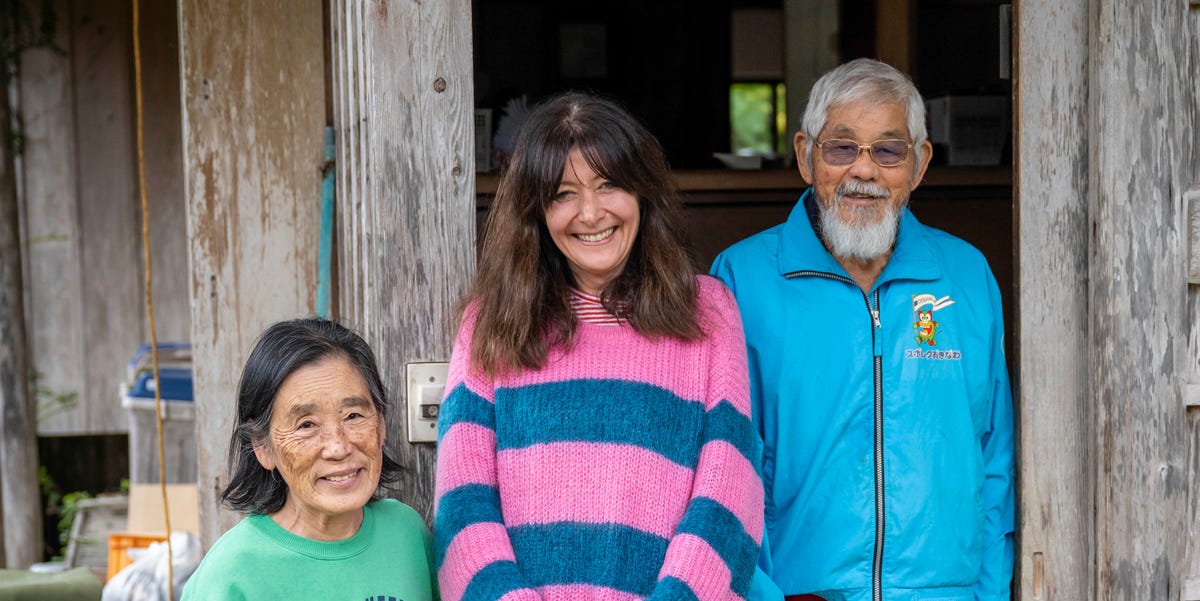
Nowhere is this better understood than the Blue Zones, pockets of the world where scientists have identified ‘super-agers’ with unusually long life expectancies. There are five Blue Zones in total – Sardinia, Italy; Nicoya, Costa Rica; Ikaria, Greece and Loma Linda, California, and Okinawa, Japan. And it was during a memorable week in Okinawa living with the super-agers that I was able to find out directly from the oldest residents how to cope better with stress. I may not live on a remote Japanese island, but I can certainly adapt from of their strategies, tried and tested for generations. Here’s everything I learnt – and the steps I’ve taken to keep stress at bay at 55.
Expose yourself to morning sunlight
This one is easy. Instead of lying in bed under a duvet drinking my morning coffee at 5am while worrying about the day ahead, I’ve taken a tip from Okinawan super-ager Rikio Yokoda, 82, and now start the day outside. Coffee is no longer in bed, scrolling, but on the decking, in my dressing gown, listening to the birds wake up. The science behind this simple step is powerful – exposure to morning light helps set your body clock for the day, makes sleep easier, and regulates your metabolism.
Stop rushing
It’s time for a deliberate slow down. This flies absolutely counter to my ‘must be productive’ instinct, which means I go as fast as I can at all times… but it’s critical for managing stress. ‘Okinawans like to use the term taygay to refer to people or their society in general,’ say Bradley and Craig Willcox, Okinawan researchers and the authors of The Okinawa Way. ‘It’s a word from the Okinawan dialect that can be translated as ‘easy-going’ or ‘laid-back’. Social relations in Okinawa tend to operate on this principle, in that they lean toward a flexible, non-hierarchical, loose style.’
Research has found that Okinawan centenarians score extremely low in ‘time urgency and tension’. ‘‘Slowing yourself down to reduce stress and its negative effects is learned behaviour,’ say Bradley and Craig Willcox. ‘We can learn how to unlearn Western time which simply gives you a choice between feeling in control of time or feeling controlled by it.’ This is a work in progress for me, but I am really trying to slow my pace, be in the moment, and feel the ground under my feet.
All the super-agers I met in Okinawa were part of a village community. Stresses were shared, solutions are sought by thinking together about problems, and all the elders seemed aware of the greater needs of the community, and of giving back. Rikio’s wife Etsuko, for example, spent her spare time caring for others in the community, knocking on doors to check in with neighbours, and connecting with her social circle every day. I’m certain this helps keep any problems and stresses in perspective. I can be insular, wrapped up in my own world and personal challenges. I’ve made a conscious effort to see more people regularly – and at the very least text back when I’m WhatsApped. Another step I’ve put in place is to re-establish sea swimming with friends; while I can’t make it daily as we did during the pandemic, I can ensure I do this twice a week. The swimming is lovely – but better still is the tea and chat afterwards.
Tidy your garden
Nearly all the super-agers I met in Okinawa spend time every day tending their gardens – this often amounts to hours if they are also growing vegetables. Rikio glowed with health during our dinner together and recounted a day spent working in the fields, growing mushrooms and potatoes. The majority of Okinawans also grow their own tiny satsumas, known as shikuwasa, in their gardens. Gardening requires a sufficient amount of physical activity, so it’s a great way to get daily movement while also shedding stress. Fortuitously, I moved house a few weeks ago and our new home comes with a beautiful – and currently pretty wild – 80ft garden. I’ve swapped scrolling and writing endless to do lists with actually doing… Friday, Saturday and Sunday mornings now have several hours of gardening thrown in.
Related StoryRelated StoryRelated Story