
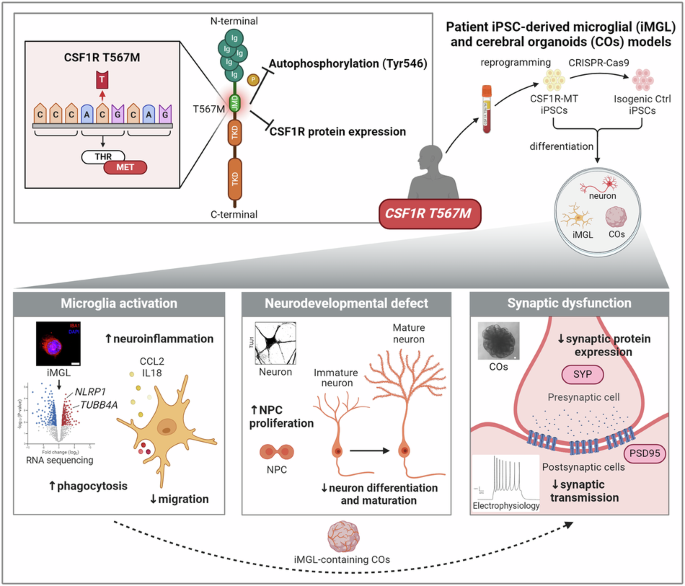
Ayrignac X, Carra-Dalliere C, Codjia P, Mouzat K, Castelnovo G, Ellie E, et al. Evaluation of CSF1R-related adult onset leukoencephalopathy with axonal spheroids and pigmented glia diagnostic criteria. Eur J Neurol. 2022;29:329–34. https://doi.org/10.1111/ene.15115.
Shetty D, Desai A, Gupta V, Agarwal A. CSF1R-related leukoencephalopathy. J Clin Neurosci. 2023;113:60–1. https://doi.org/10.1016/j.jocn.2023.05.008.
Dulski J, Muthusamy K, Lund TC, Wszolek ZK. CSF1R-related disorder: state of the art, challenges, and proposition of a new terminology. Parkinsonism Relat Disord. 2024;121:105894. https://doi.org/10.1016/j.parkreldis.2023.105894.
Wu J, Cheng X, Ji D, Niu H, Yao S, Lv X, et al. The phenotypic and genotypic spectrum of CSF1R-related disorder in China. Mov Disord. 2024;39:798–813. https://doi.org/10.1002/mds.29764.
Tipton PW, Kenney-Jung D, Rush BK, Middlebrooks EH, Nascene D, Singh B, et al. Treatment of -Related Leukoencephalopathy: breaking new ground. Mov Disord. 2021;36:2901–9. https://doi.org/10.1002/mds.28734.
Yska HAF, Golse M, Beerepoot S, Hayer S, Bergner C, de Paiva ARB, et al. Hematopoietic stem cell transplantation in an international cohort of colony stimulating factor-1 receptor (CSF1R)-related disorder. Mov Disord. 2025;40:1826–35. https://doi.org/10.1002/mds.30282.
Chadarevian JP, Hasselmann J, Lahian A, Capocchi JK, Escobar A, Lim TE, et al. Therapeutic potential of human microglia transplantation in a chimeric model of CSF1R-related leukoencephalopathy. Neuron. 2024;112:2686–707. https://doi.org/10.1016/j.neuron.2024.05.023.
Mun SH, Park PSU, Park-Min KH. The M-CSF receptor in osteoclasts and beyond. Exp Mol Med. 2020;52:1239–54. https://doi.org/10.1038/s12276-020-0484-z.
Kraya T, Quandt D, Pfirrmann T, Kindermann A, Lampe L, Schroeter ML, et al. Functional characterization of a novel CSF1R mutation causing hereditary diffuse leukoencephalopathy with spheroids. Mol Genet Genom Med. 2019;7:e00595. https://doi.org/10.1002/mgg3.595.
Papapetropoulos S, Pontius A, Finger E, Karrenbauer V, Lynch DS, Brennan M, et al. Adult-onset leukoencephalopathy with axonal spheroids and pigmented glia: review of clinical manifestations as foundations for therapeutic development. Front Neurol. 2021;12:788168. https://doi.org/10.3389/fneur.2021.788168.
Jiang J, Li W, Wang X, Du Z, Chen J, Liu Y, et al. Two novel intronic mutations in the CSF1R gene in two families with CSF1R-microglial encephalopathy. Front Cell Dev Biol. 2022;10:902067. https://doi.org/10.3389/fcell.2022.902067.
Rademakers R, Baker M, Nicholson AM, Rutherford NJ, Finch N, Soto-Ortolaza A, et al. Mutations in the colony stimulating factor 1 receptor (CSF1R) gene cause hereditary diffuse leukoencephalopathy with spheroids. Nat Genet. 2011;44:200–5. https://doi.org/10.1038/ng.1027.
Lai J, Tu H, Tan JY, Lim WK, Zeng L, Ng A. A novel T567M mutation outside the tyrosine kinase domain of CSF1R with clinical and radiological features of HDLS (238). Neurology. 2020;15:238.
Luo J, Elwood F, Britschgi M, Villeda S, Zhang H, Ding Z, et al. Colony-stimulating factor 1 receptor (CSF1R) signaling in injured neurons facilitates protection and survival. J Exp Med. 2013;210:157–72. https://doi.org/10.1084/jem.20120412.
Konno T, Kasanuki K, Ikeuchi T, Dickson DW, Wszolek ZK. CSF1R-related leukoencephalopathy: a major player in primary microgliopathies. Neurology. 2018;91:1092–104. https://doi.org/10.1212/WNL.0000000000006642.
Han J, Sarlus H, Wszolek ZK, Karrenbauer VD, Harris RA. Microglial replacement therapy: a potential therapeutic strategy for incurable CSF1R-related leukoencephalopathy. Acta Neuropathol Commun. 2020;8:217 https://doi.org/10.1186/s40478-020-01093-3.
Biundo F, Chitu V, Shlager GGL, Park ES, Gulinello ME, Saha K, et al. Microglial reduction of colony stimulating factor-1 receptor expression is sufficient to confer adult onset leukodystrophy. Glia. 2021;69:779–91. https://doi.org/10.1002/glia.23929.
Hu B, Duan S, Wang Z, Li X, Zhou Y, Zhang X, et al. Insights into the role of CSF1R in the central nervous system and neurological disorders. Front Aging Neurosci. 2021;13:789834. https://doi.org/10.3389/fnagi.2021.789834.
Oosterhof N, Chang IJ, Karimiani EG, Kuil LE, Jensen DM, Daza R, et al. Homozygous mutations in CSF1R cause a pediatric-onset leukoencephalopathy and can result in congenital absence of microglia. Am J Hum Genet. 2019;104:936–47. https://doi.org/10.1016/j.ajhg.2019.03.010.
Miura T, Mezaki N, Konno T, Iwasaki A, Hara N, Miura M, et al. Identification and functional characterization of novel mutations including frameshift mutation in exon 4 of CSF1R in patients with adult-onset leukoencephalopathy with axonal spheroids and pigmented glia. J Neurol. 2018;265:2415–24. https://doi.org/10.1007/s00415-018-9017-2.
Mao C, Zhou L, Zhou L, Yang Y, Niu J, Li J, et al. Biopsy histopathology in the diagnosis of adult-onset leukoencephalopathy with axonal spheroids and pigmented glia (ALSP). Neurol Sci. 2020;41:403–9. https://doi.org/10.1007/s10072-019-04116-7.
Li X, Hu B, Guan X, Wang Z, Zhou Y, Sun H, et al. Minocycline protects against microgliopathy in a Csf1r haplo-insufficient mouse model of adult-onset leukoencephalopathy with axonal spheroids and pigmented glia (ALSP). J Neuroinflammation. 2023;20:134. https://doi.org/10.1186/s12974-023-02774-1.
Arreola MA, Soni N, Crapser JD, Hohsfield LA, Elmore MRP, Matheos DP, et al. Microglial dyshomeostasis drives perineuronal net and synaptic loss in a CSF1R(+/-) mouse model of ALSP, which can be rescued via CSF1R inhibitors. Sci Adv. 2021;7:eabg1601. https://doi.org/10.1126/sciadv.abg1601.
Guo L, Bertola DR, Takanohashi A, Saito A, Segawa Y, Yokota T, et al. Bi-allelic CSF1R mutations cause skeletal dysplasia of dysosteosclerosis—Pyle disease spectrum and degenerative encephalopathy with brain malformation. Am J Hum Genet. 2019;104:925–35. https://doi.org/10.1016/j.ajhg.2019.03.004.
Chua WM, Kok SS, Ng AS, Yu WY. White matter disease in a young adult presenting as rapidly progressive Parkinsonism. Ann Acad Med Singap. 2019;48:274–8.
Wang YL, Wang FZ, Li R, Jiang J, Liu X, Xu J. Recent advances in basic research for CSF1R-microglial encephalopathy. Front Aging Neurosci. 2021;13:792840. https://doi.org/10.3389/fnagi.2021.792840.
Pridans C, Sauter KA, Baer K, Kissel H, Hume DA. CSF1R mutations in hereditary diffuse leukoencephalopathy with spheroids are loss of function. Sci Rep. 2013;3:3013.
Konno T, Miura T, Harriott AM, Mezaki N, Edwards ES, Rademakers R, et al. Partial loss of function of colony-stimulating factor 1 receptor in a patient with white matter abnormalities. Eur J Neurol. 2018;25:875–81.
Han J, Chitu V, Stanley ER, Wszolek ZK, Karrenbauer VD, Harris RA. Inhibition of colony stimulating factor-1 receptor (CSF-1R) as a potential therapeutic strategy for neurodegenerative diseases: opportunities and challenges. Cell Mol Life Sci. 2022;79:219. https://doi.org/10.1007/s00018-022-04225-1.
Murga-Zamalloa C, Rolland DCM, Polk A, Wolfe A, Dewar H, Chowdhury P, et al. Colony-stimulating factor 1 receptor (CSF1R) activates AKT/mTOR signaling and promotes T-cell lymphoma viability. Clin Cancer Res. 2020;26:690–703. https://doi.org/10.1158/1078-0432.CCR-19-1486.
Konno T, Miura T, Harriott AM, Mezaki N, Edwards ES, Rademakers R, et al. Partial loss of function of colony-stimulating factor 1 receptor in a patient with white matter abnormalities. Eur J Neurol. 2018;25:875–81. https://doi.org/10.1111/ene.13611.
Thierry GR, Baudon EM, Bijnen M, Bellomo A, Lagueyrie M, Mondor I, et al. Non-classical monocytes scavenge the growth factor CSF1 from endothelial cells in the peripheral vascular tree to ensure survival and homeostasis. Immunity. 2024;57:2108–21.e2106. https://doi.org/10.1016/j.immuni.2024.07.005.
Priller J, Prinz M. Targeting microglia in brain disorders. Science. 2019;365:32–33. https://doi.org/10.1126/science.aau9100.
McQuade A, Coburn M, Tu CH, Hasselmann J, Davtyan H, Blurton-Jones M. Development and validation of a simplified method to generate human microglia from pluripotent stem cells. Mol Neurodegener. 2018;13:67. https://doi.org/10.1186/s13024-018-0297-x.
Kenkhuis B, Somarakis A, Kleindouwel LRT, van Roon-Mom WMC, Hollt T, van der Weerd L. Co-expression patterns of microglia markers Iba1, TMEM119 and P2RY12 in Alzheimer’s disease. Neurobiol Dis. 2022;167:105684. https://doi.org/10.1016/j.nbd.2022.105684.
Dorion MF, Casas D, Shlaifer I, Yaqubi M, Fleming P, Karpilovsky N, et al. An adapted protocol to derive microglia from stem cells and its application in the study of CSF1R-related disorders. Mol Neurodegener. 2024;19:31 https://doi.org/10.1186/s13024-024-00723-x.
Borst K, Dumas AA, Prinz M. Microglia: immune and non-immune functions. Immunity. 2021;54:2194–208. https://doi.org/10.1016/j.immuni.2021.09.014.
Cherry JD, Meng G, Daley S, Xia W, Svirsky S, Alvarez VE, et al. CCL2 is associated with microglia and macrophage recruitment in chronic traumatic encephalopathy. J Neuroinflammation. 2020;17:370. https://doi.org/10.1186/s12974-020-02036-4.
Nikolopoulos D, Manolakou T, Polissidis A, Filia A, Bertsias G, Koutmani Y, et al. Microglia activation in the presence of intact blood-brain barrier and disruption of hippocampal neurogenesis via IL-6 and IL-18 mediate early diffuse neuropsychiatric lupus. Ann Rheum Dis. 2023;82:646–57. https://doi.org/10.1136/ard-2022-223506.
Liu YJ, Zhang T, Cheng D, Yang J, Chen S, Wang X, et al. Late endosomes promote microglia migration via cytosolic translocation of immature protease cathD. Sci Adv. 2020;6:eaba5783. https://doi.org/10.1126/sciadv.aba5783.
James OG, Selvaraj BT, Magnani D, Burr K, Connick P, Barton SK, et al. iPSC-derived myelinoids to study myelin biology of humans. Dev Cell. 2021;56:1346–58. https://doi.org/10.1016/j.devcel.2021.04.006.
Marzan DE, Brugger-Verdon V, West BL, Liddelow S, Samanta J, Salzer JL. Activated microglia drive demyelination via CSF1R signaling. Glia. 2021;69:1583–604. https://doi.org/10.1002/glia.23980.
McNamara NB, Munro DAD, Bestard-Cuche N, Uyeda A, Bogie JFJ, Hoffmann A, et al. Microglia regulate central nervous system myelin growth and integrity. Nature. 2023;613:120–9. https://doi.org/10.1038/s41586-022-05534-y.
Yap JKY, Pickard BS, Chan EWL, Gan SY. The role of neuronal NLRP1 inflammasome in Alzheimer’s Disease: bringing neurons into the neuroinflammation game. Mol Neurobiol. 2019;56:7741–53. https://doi.org/10.1007/s12035-019-1638-7.
Piancone F, La Rosa F, Marventano I, Saresella M, Clerici M. The role of the inflammasome in neurodegenerative diseases. Molecules. 2021;26:953 https://doi.org/10.3390/molecules26040953.
Liu H, Sun Y, Zhang Q, Jin W, Gordon RE, Zhang Y, et al. Pro-inflammatory and proliferative microglia drive progression of glioblastoma. Cell Rep. 2021;36:109718. https://doi.org/10.1016/j.celrep.2021.109718.
Sase S, Almad AA, Boecker CA, Guedes-Dias P, Li JJ, Takanohashi A, et al. TUBB4A mutations result in both glial and neuronal degeneration in an H-ABC leukodystrophy mouse model. Elife. 2020;9:e52986. https://doi.org/10.7554/eLife.52986.
Jiang M, Vanan S, Tu HT, Zhang W, Zhang ZW, Chia SY, et al. Amyloid precursor protein intracellular domain-dependent regulation of FOXO3a inhibits adult hippocampal neurogenesis. Neurobiol Aging. 2020;95:250–63. https://doi.org/10.1016/j.neurobiolaging.2020.07.031.
Jiang M, Tu H-T, Zhang K, Zhang W, Yu W-P, Xu J, et al. Impaired neurogenesis in the hippocampus of an adult VPS35 mutant mouse model of Parkinson’s disease through interaction with APP. Neurobiol Dis. 2021;153:105313.
Zhang W, Thevapriya S, Kim PJ, Yu WP, Je HS, Tan EK, et al. Amyloid precursor protein regulates neurogenesis by antagonizing miR-574-5p in the developing cerebral cortex. Nat Commun. 2014;5:3330. https://doi.org/10.1038/ncomms4330.
Zhang W, Kim PJ, Chen Z, Lokman H, Qiu L, Zhang K, et al. MiRNA-128 regulates the proliferation and neurogenesis of neural precursors by targeting PCM1 in the developing cortex. Elife. 2016;5:e11324. https://doi.org/10.7554/eLife.11324.
Lancaster MA, Renner M, Martin CA, Wenzel D, Bicknell LS, Hurles ME, et al. Cerebral organoids model human brain development and microcephaly. Nature. 2013;501:373–9. https://doi.org/10.1038/nature12517.
Glantz LA, Gilmore JH, Hamer RM, Lieberman JA, Jarskog LF. Synaptophysin and postsynaptic density protein 95 in the human prefrontal cortex from mid-gestation into early adulthood. Neuroscience. 2007;149:582–91. https://doi.org/10.1016/j.neuroscience.2007.06.036.
Park DS, Kozaki T, Tiwari SK, Moreira M, Khalilnezhad A, Torta F, et al. iPS-cell-derived microglia promote brain organoid maturation via cholesterol transfer. Nature. 2023;623:397–405. https://doi.org/10.1038/s41586-023-06713-1.
Centeno EGZ, Cimarosti H, Bithell A. 2D versus 3D human induced pluripotent stem cell-derived cultures for neurodegenerative disease modelling. Mol Neurodegener. 2018;13:27. https://doi.org/10.1186/s13024-018-0258-4.
Arreola MA, Soni N, Crapser JD, Hohsfield LA, Elmore MRP, Matheos DP, et al. Microglial dyshomeostasis drives perineuronal net and synaptic loss in a CSF1R(+/-) mouse model of ALSP, which can be rescued via CSF1R inhibitors. Sci Adv. 2021;7. https://doi.org/10.1126/sciadv.abg1601.
Bianchin MM, Snow Z. Primary microglia dysfunction or microgliopathy: a cause of dementias and other neurological or psychiatric disorders. Neuroscience. 2022;497:324–39. https://doi.org/10.1016/j.neuroscience.2022.06.032.
Guo L, Ikegawa S. From HDLS to BANDDOS: fast-expanding phenotypic spectrum of disorders caused by mutations in CSF1R. J Hum Genet. 2021;66:1139–44. https://doi.org/10.1038/s10038-021-00942-w.
Ishiguro T, Konno T, Hara N, Zhu B, Okada S, Shibata M, et al. Novel partial deletions, frameshift and missense mutations of CSF1R in patents with CSF1R-related leukoencephalopathy. Eur J Neurol. 2023;30:1861–70. https://doi.org/10.1111/ene.15796.
Azhar Z, Grose RP, Raza A, Raza Z. In silico targeting of colony-stimulating factor-1 receptor: delineating immunotherapy in cancer. Explor Target Antitumor Ther. 2023;4:727–42. https://doi.org/10.37349/etat.2023.00164.
Tamhankar PM, Zhu B, Tamhankar VP, Mithbawkar S, Seabra L, Livingston JH, et al. A novel hypomorphic CSF1R gene mutation in the biallelic state leading to fatal childhood neurodegeneration. Neuropediatrics. 2020;51:302–6. https://doi.org/10.1055/s-0040-1702161.
Chadarevian JP, Davtyan H, Chadarevian AL, Nguyen J, Capocchi JK, Le L, et al. Harnessing human iPSC-microglia for CNS-wide delivery of disease-modifying proteins. Cell Stem Cell. 2025;32:914–34. https://doi.org/10.1016/j.stem.2025.03.009.
Chitu V, Gokhan S, Nandi S, Mehler MF, Stanley ER. Emerging roles for CSF-1 receptor and its ligands in the nervous system. Trends Neurosci. 2016;39:378–93. https://doi.org/10.1016/j.tins.2016.03.005.
Nandi S, Gokhan S, Dai XM, Wei S, Enikolopov G, Lin H, et al. The CSF-1 receptor ligands IL-34 and CSF-1 exhibit distinct developmental brain expression patterns and regulate neural progenitor cell maintenance and maturation. Dev Biol. 2012;367:100–13. https://doi.org/10.1016/j.ydbio.2012.03.026.
Hu Y, Tao W. Current perspectives on microglia-neuron communication in the central nervous system: direct and indirect modes of interaction. J Adv Res. 2024;66:251–65. https://doi.org/10.1016/j.jare.2024.01.006.
Dejanovic B, Sheng M, Hanson JE. Targeting synapse function and loss for treatment of neurodegenerative diseases. Nat Rev Drug Discov. 2024;23:23–42. https://doi.org/10.1038/s41573-023-00823-1.
Andoh M, Koyama R. Microglia regulate synaptic development and plasticity. Dev Neurobiol. 2021;81:568–90. https://doi.org/10.1002/dneu.22814.
Parkhurst CN, Yang G, Ninan I, Savas JN, Yates JR 3rd, et al. Microglia promote learning-dependent synapse formation through brain-derived neurotrophic factor. Cell. 2013;155:1596–609. https://doi.org/10.1016/j.cell.2013.11.030.
Stevens B, Allen NJ, Vazquez LE, Howell GR, Christopherson KS, Nouri N, et al. The classical complement cascade mediates CNS synapse elimination. Cell. 2007;131:1164–78. https://doi.org/10.1016/j.cell.2007.10.036.
Li ZZ, Liu WN, Liu KX, Dou ZW, Zhao R, Chen Y, et al. Cingulate retinoic acid signaling regulates neuropathic pain and comorbid anxiodepression via extracellular matrix homeostasis. J Clin Investig. 2025;135. https://doi.org/10.1172/JCI190539.
Kistemaker L, van Bodegraven EJ, de Vries HE, Hol EM. Vascularized human brain organoids: current possibilities and prospects. Trends Biotechnol. 2025;43:1275–85. https://doi.org/10.1016/j.tibtech.2024.11.021.
Young K, Morrison H. Quantifying microglia morphology from photomicrographs of immunohistochemistry prepared tissue using ImageJ. J Vis Exp. 2018:57648. https://doi.org/10.3791/57648.
Chia SY, Li M, Li Z, Tu H, Lee JWL, Qiu L, et al. Single-nucleus transcriptomics reveals a distinct microglial state and increased MSR1-mediated phagocytosis as common features across dementia subtypes. Genome Med. 2025;17:92. https://doi.org/10.1186/s13073-025-01519-4.
Tu H, Yeo XY, Zhang ZW, Zhou W, Tan JY, Chi L, et al. NOTCH2NLC GGC intermediate repeat with serine induces hypermyelination and early Parkinson’s disease-like phenotypes in mice. Mol Neurodegener. 2024;19:91. https://doi.org/10.1186/s13024-024-00780-2.
Tu H, Zhang ZW, Qiu L, Lin Y, Jiang M, Chia SY, et al. Increased expression of pathological markers in Parkinson’s disease dementia post-mortem brains compared to dementia with Lewy bodies. BMC Neurosci. 2022;23:3. https://doi.org/10.1186/s12868-021-00687-4.
Zhang ZW, Tu H, Jiang M, Vanan S, Chia SY, Jang SE, et al. The APP intracellular domain promotes LRRK2 expression to enable feed-forward neurodegenerative mechanisms in Parkinson’s disease. Sci Signal. 2022;15:eabk3411. https://doi.org/10.1126/scisignal.abk3411.