
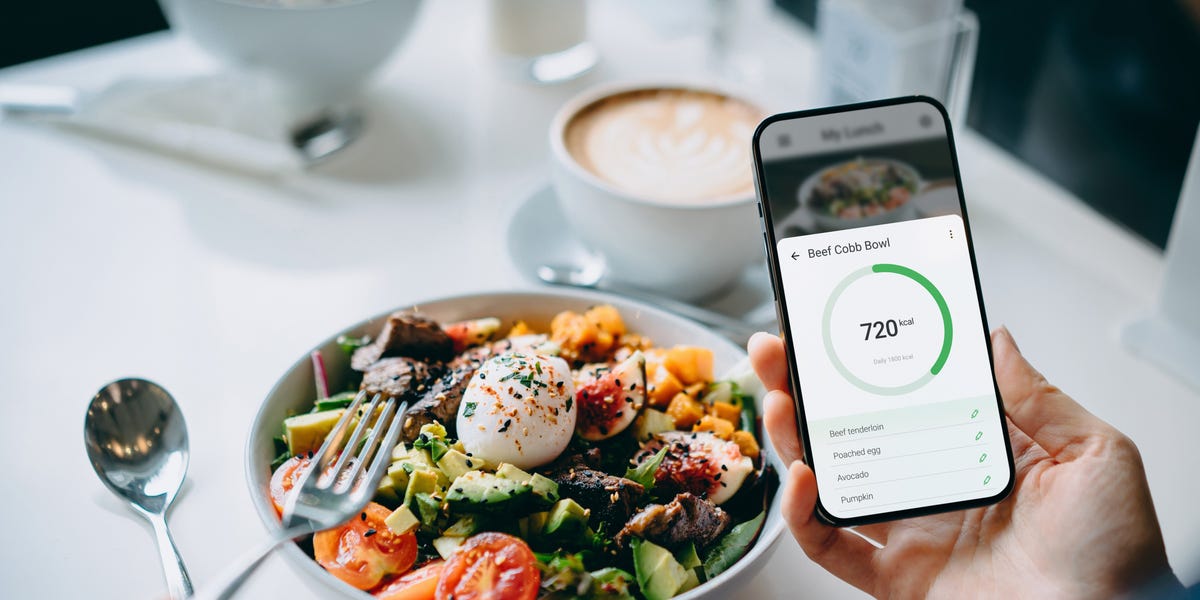
Once upon a time calorie counting used to involve weighing, measuring and then painstakingly logging every mouthful. Now, thanks to AI, you can simply photograph your lunch and let an app do all the maths for you. Convenient? Absolutely. Accurate? Perhaps not.
Preliminary research presented at the American Society for Nutrition’s annual conference found that four popular photo-based apps underestimated the calories and fat in meals by around a third. Depending on the app, the difference averaged as much as 345 calories per meal.
What did the researchers test?
For the preliminary study, presented at NUTRITION 2026, researchers photographed 102 meals prepared in a controlled metabolic kitchen, where every ingredient had been measured to the nearest 0.1g.
They then asked four apps – MyFitnessPal, Lose It!, Cal AI and Appediet – to estimate each meal’s nutritional content from a photograph and compared the results with the known values.
Across the four apps, estimates were an average of 250 to 345 calories too low per meal.
The apps also underestimated fat by approximately 30g, while their carbohydrate estimates were more consistent.
The researchers subsequently tested more than 200 additional meals. Early findings suggest the apps find high-fat, low-carbohydrate meals particularly difficult to assess.
Why can’t AI accurately read your plate?
These apps are clever. They look at your photograph, work out what’s on the plate, guess the portion sizes and then match them with information held in a nutrition database.
But a photograph can’t show how much oil you used to roast your vegetables, or whether you used a light soy sauce or dark soy or exactly how large that mound of pasta is. Those invisible ingredients and uncertain portions can substantially change the final calorie count.
‘The accuracy of many of these apps has not been thoroughly evaluated,’ says Aaron Hengist, a postdoctoral visiting fellow at the US National Institute of Diabetes and Digestive and Kidney Diseases. ‘Our study helps address this question by looking at whether these apps can reliably estimate calories.’
His advice? Don’t take the number on screen as gospel.
‘People using a photo-based tracking app without adjusting the portions or entering the amounts of food should take the results with a grain of salt,’ he says.
‘These apps tend to underestimate calories, especially from fats, so what they actually ate is likely higher than what the app shows.’
Should you stop using calorie-tracking apps?
Whether or not you decide to use a calorie-tracking app is, of course, entirely up to you.
If you find them helpful for building nutritional awareness or staying on top of your macros, then great. But if they leave you feeling worse about food, it might be wise to press delete.
According to separate research from UCL and Loughborough University – which analysed 13,799 negative social-media posts about popular fitness and calorie-tracking apps – users described feeling pestered by notifications, ashamed when they failed to meet targets and demoralised after losing streaks.
‘Where individuals faced difficulties in keeping within the targets set by the app (e.g. losing a ‘streak’ or not meeting their daily goal) this appeared to contribute to avoidant behaviours (‘do NOT put Percy pigs into MyFitnessPal’) or complete disengagement (‘back to eating lotus biscoff spread out of jar’),’ the researchers wrote.
Although it is worth noting that the researchers deliberately selected negative posts, meaning the study couldn’t accurately assess the overall effect of these apps or how many users actually find them helpful.
‘Listening to users’ reports on social media has shown that fitness apps can sometimes leave users feeling demoralised and ready to give up – which is the exact opposite of what these tools are supposed to do,’ says co-author Dr Lucy Porter.
‘We know from previous research that feeling ashamed and miserable about yourself is not going to support healthy, long-term behaviour change.’
Who should avoid calorie tracking?
Counting calories isn’t necessary or appropriate for everyone. Eating-disorder charity Beat has warned that calorie-counting and weight-loss apps may pose particular risks to people living with, recovering from or vulnerable to an eating disorder.
It may also be worth stepping away if tracking makes you feel anxious around food, encourages you to ignore hunger, prompts increasingly restrictive targets or leaves you feeling guilty when you exceed a number.
Remember – if you need nutritional support or advice for a specific health condition, pregnancy, athletic performance or weight management, personalised advice from a registered dietitian is likely to be way more useful than relying on an app-generated target.
The bottom line
These findings don’t necessarily mean that photo-based AI trackers are useless. They can still help you record what you eat.
But, the numbers on the screen are an educated guess, not a nutritional fact – so best treated as a rough guide.